Full Article
about Villanueva De Gumiel
Ocultar artículo Leer artículo completo
The Hotel Montermoso sign appears first, glowing orange at the edge of the A1, then the village itself—stone houses shoulder-to-shoulder, their roofs the same colour as the surrounding earth. Most drivers fill up with coffee and petrol, then rejoin the motorway. Those who stay discover a place that measures time by vine leaves, not clocks.
A grid of vines and stone
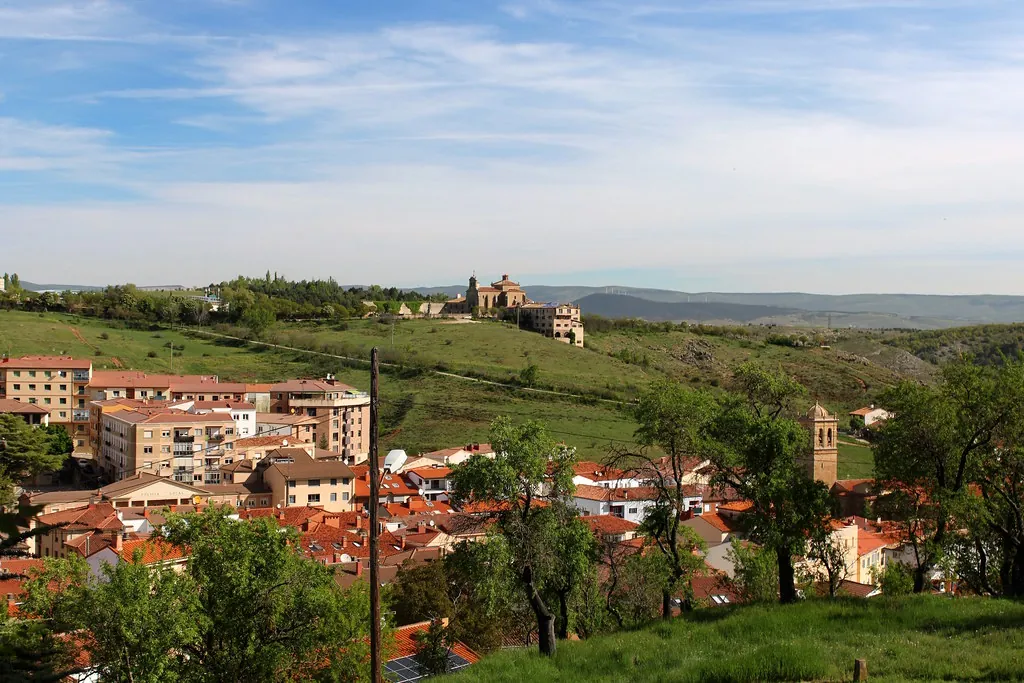
Villanueva de Gumiel sits on a low ridge 840 m above sea level, halfway between Madrid and Burgos. The plateau looks flat until you walk it; then the land reveals gentle folds that channel cold air down from the Sierra de la Demanda at night. That temperature swing—hot days, sharp nights—gives Ribera del Duero reds their dark core of blackberry and liquorice. From the church tower you see nothing but vineyards all the way to the horizon, interrupted only by the white chimneys of underground cellars, each one poking up like a periscope from another century.
The village grid is simple: three parallel streets, two cross-lanes, one plaza. Houses are built from local limestone and river pebble; the older ones still carry faint ochre wash where sun has bleached the pigment. There is no architectural swagger, just solid walls designed to keep out January wind that can knife down from the meseta at –8 °C. In July the same streets shimmer at 34 °C; residents pull down canvas blinds and retreat indoors until the sun tilts.
Wine that never saw a marketing budget
Forget glossy bodega tours. Here wine is made in family cuartelillos—small plots of 0.3 ha handed down through generations. The harvest starts the second Tuesday of September, dictated by the village mayor rather than any corporate calendar. Walk the dirt tracks at dawn and you’ll meet growers snipping tempranillo grapes into plastic crates, their tractors loaded so high the tyres squash flat. By 11 a.m. the smell of crushed fruit drifts through every doorway; by dusk the first vats are already fermenting in subterranean cellars reached by stone staircases no wider than a single shoulder.
Visitors are welcome if they ask. Knock on the green door opposite the bakery and José María will let you taste last year’s crianza straight from the barrel—no tasting notes, no gift shop, just a rinsed-out yogurt pot passed from hand to hand. The wine is deep ruby, still a little tannic, and tastes of the place: iron-rich soil, altitude, the faint resin of oak staves recycled from Rioja cooperages.
When the motorway hush returns
Stay overnight and the village changes gear. By 22:30 the A1 murmur is the only sound; even that fades as lorry drivers obey the 10 p.m. speed-limit reduction. Streets glow under a single amber lamp per block. The lone bar, Casa Galo, shuts its metal shutter at midnight—owner María Angeles counts the cash drawer while customers finish their last zurito (a third of a pint of lager, €1.40). After that, silence is absolute. If you booked one of the converted stable rooms around the plaza, you’ll hear every church bell: one strike for the hour, another for the half, plus an extra on saints’ days.
Sunday intensifies the hush. The bakery opens 8–11 a.m., the food shop until 2 p.m., then nothing until Monday. Fill the hire-car tank before Saturday night—Aranda de Duero’s 24-hour Repsol is 15 km south—or you’ll be hitching to mass with the parish priest who doubles as the only authorised driver of the village minibus.
Roast lamb and almond secrets
Hotel Montermoso’s dining room does the regional greatest hits without embroidery. Order the lechazo asado: milk-fed lamb slow-roasted in a beech-wood oven at 180 °C for three hours until the skin forms a caramelised sheet that shatters like pork crackling. Half a lamb serves two greedy adults, costs €42, and arrives on a clay dish with only a lemon wedge for garnish—no vegetables, no apology. The house red, a 2019 crianza from nearby Moradillo de Roa, drinks like a Rioja that’s spent more time in the gym: darker fruit, tighter structure, €18 a bottle.
Finish with amarguillos, tiny almond meringue biscuits invented in convents to use up egg whites once the yolks went into communion wine. Dry, nutty, they dissolve into marzipan dust—perfect with the short black coffee Spanish waiters call solo and Brits mistake for espresso.
Walking it off
A 6-km loop starts at the church, drops past the cemetery, then follows a farm track between vines towards the abandoned hamlet of Páramo de Gumiel. The path is flat, stony, shared with the occasional hunting dog; wear trainers, not boots. In late October the vines turn traffic-light red and farmers burn the pruned canes, sending wafts of pine-scented smoke across the path. You’ll pass a stone hut every kilometre—tiny field shelters with Roman-tile roofs where workers once sheltered from summer hailstorms. Most are unlocked; step inside and the temperature drops ten degrees, the air scented with dried thyme that grows wild between the rows.
Circular routes link to Gumiel de Izán (10 km) or, for the energetic, Peñafiel castle 22 km west. The tourist office in Aranda will email GPS tracks, but mobile coverage is patchy under the vines—download before you set off.
What the brochures skip
There is no ATM. The nearest cash machine is at the Caja Rural in Gumiel de Izán, a €15 taxi ride each way. Cards are refused for anything under €10 in the bar; the hotel takes plastic, but the terminal crashes if three guests pay at once. Wi-Fi along the main street is shared from the town-hall antenna; bandwidth evaporates when the school uploads homework at 4 p.m.
Winter visits bring crystalline skies but also neblas: ground fogs that roll in from the Duero and refuse to lift before noon. January daytime highs hover at 6 °C; many rural houses lack central heating, relying on plug-in radiators that click off when you run the kettle. Summer is kinder, though August can hit 38 °C—book a room with thick stone walls, not a modern extension.
Leaving the quiet behind
Check-out time is noon, but reception will store bags if you linger. Walk the church nave before you go: the Romanesque apse was rebuilt after a 15th-century lightning fire, its new stones lighter, almost chalk-white against the older grey. Light a candle for €1—proceeds fund the roof—and you’ll be added to a paper list the priest still keeps in a 1950s ledger. Your name stays in that book long after you’ve merged back onto the A1, proof that for one night you belonged to a place where traffic lights don’t exist and the harvest defines the year more accurately than any calendar.