Full Article
about Villasandino
Ocultar artículo Leer artículo completo
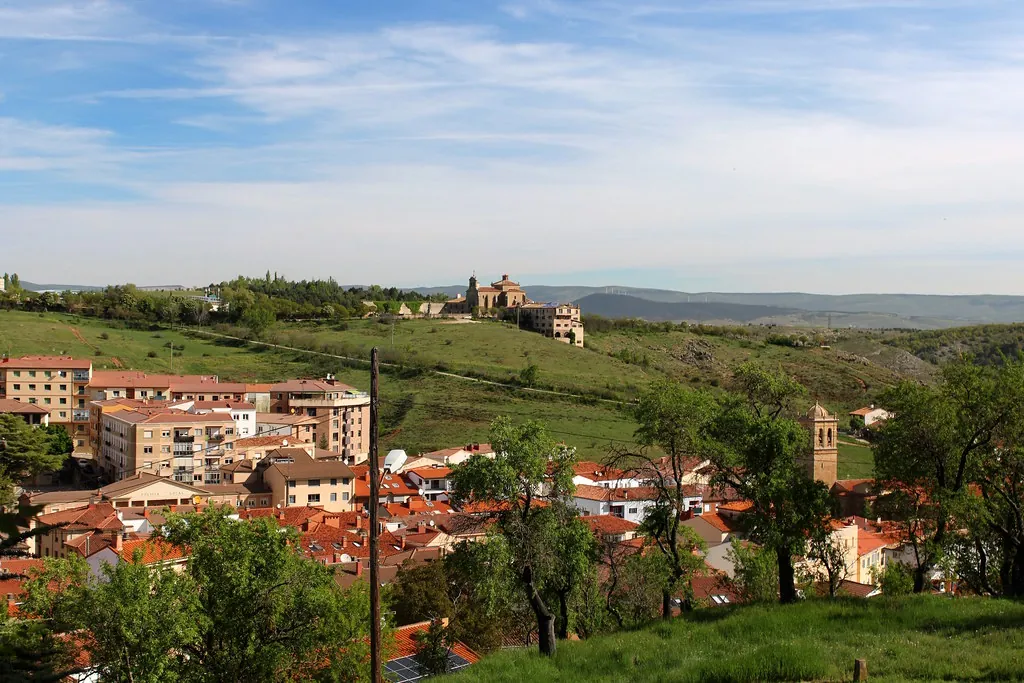
The church bells ring at noon across wheat fields that stretch beyond the horizon, and for a moment, Villasandino feels like the centre of something vast. This Burgos village sits where the Meseta Norte's cereal plains begin their roll towards the Tierra de Campos, 40 kilometres north-west of the provincial capital. It's not dramatic country—no cliffs, no gorges, just an enormous sky and soil that has fed Spain since the Romans arrived with their ploughs.
Locals call this "la España vacía"—empty Spain—and the nickname fits. Five thousand people live here, enough to keep two bakeries busy and the Saturday market alive, but few enough that everyone knows whose car is whose. The village earns its living from wheat, barley and sunflowers, not from visitors' wallets. Tourism happens by accident, usually when someone pulls off the A-231 for petrol and decides to investigate the stone towers visible from the slip road.
What passes for a centre
The parish church of San Andrés dominates the main square, its weathered stone walls showing the patchwork of every century since the 1200s. Step inside and you'll find a single nave, cool even in August, with a retablo that local craftsmen keep threatening to restore properly. The guidebook description would call it "transitional Romanesque"; in reality it's simply the village church, used for baptisms, funerals and the weekly mass that still draws a decent crowd. Opening times are flexible—if the door's locked, knock at the presbytery house opposite and the sacristan's wife will usually appear with a key and a warning not to use flash photography.
Radiating from the square are three streets wide enough for tractors. Stone houses line them, some with the coats of arms that reveal former hidalgos, others patched with adobe where money ran out. Wooden balconies sag under geraniums; every so often a gateway reveals a cobbled courtyard with a well in the middle. It's not uniformly pretty—concrete garages intrude, satellite dishes bloom from medieval walls—but the proportions feel right, built for people rather than cameras.
Eating and drinking like you mean it
There are exactly four places to eat in Villasandino. Mesón El Oso on Calle Mayor does a fixed-price menú del día for €12 that starts with garlic soup and finishes with flan, but the real draw is the cordero lechal—milk-fed lamb roasted in a wood-fired oven until the skin crackles like brittle. Ask for half a quarter; portions assume you've spent the morning behind a plough. At Bar La Plaza, two doors down, the speciality is morcilla de Burgos, the local blood sausage bulked out with rice instead of oats. Order it grilled with a fried egg on top and wash it down with house tinto that arrives in a litre jug whether you asked for it or not.
Shopping is similarly straightforward. The ultramarinos on Avenida de Castilla stocks local cheese—try the queso de oveja, sharp enough to make your tongue tingle—and chorizo that the owner will slice from a drying string above the counter. Bread comes from one of two bakeries; buy it before ten o'clock or resign yourself to yesterday's loaf. If you need vegetables, the Saturday market brings trucks from the Ebro valley loaded with peppers, tomatoes and fruit that actually tastes of something.
Walking without drama
The countryside around Villasandino won't make the cover of walking magazines. The highest hill tops out at 890 metres, and the landscape rolls rather than soars. What it does offer is space. Marked footpaths strike north towards the village of Revilla Vallejera (7 km) and south to the ruins of a Roman villa at Sarracín (5 km). Both routes follow farm tracks between wheat fields; in April the soil is red-brown, by late June everything has turned gold. Take water—there's no café for miles—and expect to share the path only with skylarks.
Cyclists find the same freedom. The CL-623 that links Villasandino to the A-231 carries maybe a dozen cars an hour even in high season. Pootle east for 12 km and you reach Melgar de Fernamental, whose brick-built Plaza Mayor looks oddly Flemish thanks to medieval wool merchants who imported northern styles. Westwards, the road climbs gently onto the Montes de Torozos where buzzards wheel overhead and the wheat finally gives way to oak scrub.
When the village lets its hair down
Fiestas begin on the last weekend of August when ex-pats return from Bilbao factory jobs and Madrid office blocks. The programme hasn't changed in decades: Friday night verbena with a cover band murdering Spanish pop; Saturday morning procession behind a statue of the Virgin decked out in flowers; Sunday's encierro—technically bull-running, though here it involves two confused steers jogging between portable barriers while teenagers show off. Monday finishes with a communal paella cooked in pans two metres wide and stirred with oars. If you dislike brass bands, avoid the centre after midnight—every tune sounds like every other, and they play until the wine runs out.
Semana Santa is quieter. Holy Thursday's procession leaves the church at nine sharp, led by hooded penitents carrying candles that gutter in the wind. Locals line the streets in silence; the only sound is the drumbeat and the shuffle of feet on cobbles. It's surprisingly moving, even if you last attended church for a wedding.
Getting there and away
Public transport exists on paper. One bus a day leaves Burgos at 14:15, reaches Villasandino at 15:20 and continues to Palencia. The return departs at 06:45, which rather scuppers dinner plans. Hiring a car makes infinitely more sense—Burgos airport has a Europod desk, and the drive takes 35 minutes on the A-231 followed by ten on the CL-623. Petrol stations are scarce once you leave the motorway; fill up in Burgos or risk pushing it.
Accommodation is limited. Hostal Casa del Cura has eight rooms above the village shop, all with en-suite bathrooms and Wi-Fi that actually works (€45 double including breakfast). The alternative is to stay in Burgos and day-trip, but you'll miss the evening paseo when the square fills with gossiping grandmothers and teenagers on mopeds doing circuits that haven't varied since 1985.
The bottom line
Villasandino offers no epiphanies, no Instagram moments, no craft-beer bars. What it does give is a slice of provincial Spain that package holidays skip. Come if you like your villages honest rather than manicured, if you can entertain yourself with a long lunch and a longer walk, and if you don't mind being the only foreigner in the bar. The wheat fields will still be here next year, and so will the baker who remembers how you like your coffee.