Full Article
about Villayerno Morquillas
Ocultar artículo Leer artículo completo
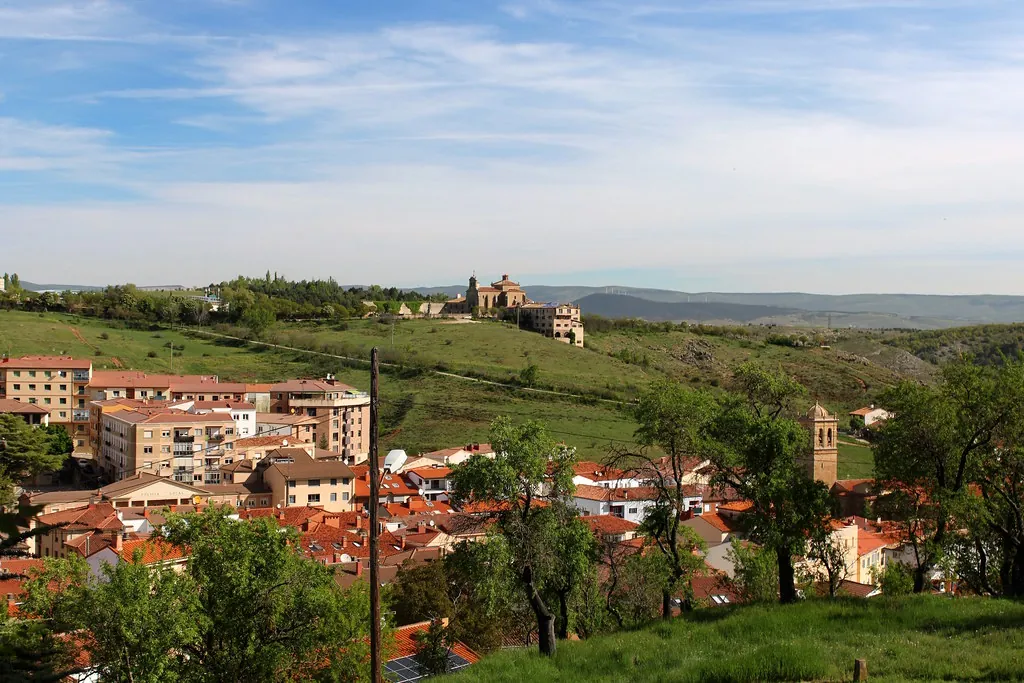
The church bell strikes nine and the only response is a tractor rumbling to life. No café terraces filling with commuters, no rush-hour soundtrack—just diesel engine and the dry scrape of a broom against stone as one elderly woman sweeps yesterday’s dust from her doorway. Villayerno Morquillas, halfway between Burgos and Palencia, refuses to hurry for anyone.
Stone, Adobe and the Smell of Cereal
Houses here are built from what the plateau provides: ochre-coloured stone below, sun-baked adobe above, roofs weighted with curved terracotta tiles that have blackened at the edges. Walls are thick enough to swallow mobile signal, which explains why your weather app keeps spinning. The architectural style isn’t showcased in guidebooks; it simply worked for centuries and nobody saw a reason to change it. Peer through an open gateway and you’ll spot the original wooden stable doors, ironwork eaten by rust, and sometimes a stone manger now filled with flowerpots rather than feed.
A slow circuit of the grid-like centre takes twenty minutes—thirty if you stop to read the ceramic street signs bolted high onto corners. Calle San Pedro, Calle Real, Calle del Medio; all arrow-straight, all designed for carts rather than cars. Where tarmac has cracked, the old paving stones reappear like archaeology pushing through.
The Parish That Outlived Its Blueprint
The parish church of San Andrés sits squarely at the top of the slight rise, its bulky tower acting as both spiritual and literal compass. Construction began in the 16th century, paused for a plague, restarted, was partly rebuilt after a 19th-century lightning strike, and acquired a neo-Romanesque porch in the 1950s when the population briefly topped a thousand. The result is layered rather than elegant: Gothic base, Baroque vault, cement-rendered buttress. Push open the heavy door (it’s usually unlocked until midday) and the interior smells of candle wax and grain dust—the latter drifting in from trailers parked outside during harvest thanksgiving.
Sunday Mass attracts forty parishioners on a good week. Arrive five minutes early and you can claim a pew with a clear view of the single stained-glass window showing Saint Andrew against a background of wheat sheaves—local donors insisted on the crop, not the Galilean sea.
Walking Rings Around the Combine Harvesters
Tracks radiate from the village like bicycle spokes, each one following the edge of a wheat or barley plot. They’re farm access routes rather than signed paths, so maps on phones become decorative; better to note the position of the sun and keep the church tower in peripheral vision. A ninety-minute loop south passes an abandoned brickworks turned nesting site for lesser kestrels, then climbs a low ridge that reveals the entire municipality: five kilometres of open plateau, colour-coded by season—emerald in April, gold by late June, brown stubble by August.
Take water, a hat, and realistic expectations. Shade is confined to the occasional poplar windbreak, and the wind can flip from warm to chill within minutes. On the upside, you’re unlikely to meet anyone except a farmer on a quad bike who will nod, perhaps point out a short-cut, then disappear in a dust cloud.
What Passes for Lunch
Villayerno itself has one bar, usually open from 08:00 for coffee and churros, then again around 13:00 for beer and tapas. The printed menu is short: morcilla (blood sausage) from Briviesca, roasted peppers preserved in oil, and migas—fried breadcrumbs heavy on garlic and pancetta. Prices hover at €1.80 per tapa; order three and you’ve spent less than the London pint you left behind.
For a sit-down meal you drive ten minutes to Melgar de Fernamental where Asador La Cueva serves lechazo (milk-fed lamb) roasted in a wood-fired clay oven. The half-portion feeds two, costs €24, and arrives with a simple lettuce salad designed to cut the fat rather than win prizes. House red is from the Arlanza valley; it’s young, peppery, and arrives at cellar temperature—cooler than Rioja, warmer than claret.
Fiestas Without the Fringe
Each 30 November the village celebrates San Andrés with a “toro de fuego” that sounds more dramatic than it is: one resident drags a frame loaded with sparklers through the streets for five minutes while children chase the embers. The real action is communal soup night in the plaza: cast-iron cauldrons of cocido stew stirred with paddles, free to anyone who brings a bowl and spoon. Visitors are welcome but not announced; queue up and you’ll be served without ceremony.
Summer feria shifts to the nearest weekend after 15 August. A fairground truck installs a single bumper-car ride and a raffle stall; the village band—two saxophones, trumpet and snare—plays pasodobles at decreasing volume until the wine runs out. Brits expecting Andalusian flamenco will be disappointed; this is Castilian pipe-and-drum territory, closer to a Scottish village fête with more sun and worse coffee.
Getting There, Staying Awake
High-speed trains slice through the plain but won’t stop for you. From London, fly to Bilbao, pick up a hire car, and drive south-east for 90 minutes on the A-68 and A-1. Alternatively, take the Eurostar to Paris, overnight train to Madrid, then regional service to Burgos—total journey about fifteen hours if connections behave. Villayerno lies 38 km west of Burgos along the N-120; the turn-off is signposted, but only just.
Accommodation is the weak link. There are no hotels inside the municipality, and the nearest hostal in Melgar has fourteen rooms, none en-suite, charging €45 for a double including breakfast of instant coffee and a doughnut marginally fresher than the packaging. Self-catering cottages appear on Airbnb from €65 a night; interiors mix IKEA and heirlooms, Wi-Fi is patchy, and heating is by pellet stove—you’ll be taught how to light it, then left to negotiate the thermostat alone.
When to Cut Your Losses
Come between mid-April and mid-June when green contrasts with limestone walls and temperatures linger in the low twenties. October works too, but skies grey faster and harvest dust hangs like fog. July and August hit 35 °C by noon; the village empties into shuttered houses until 18:00, life relocating to interior courtyards where the splash of a single fountain passes for entertainment. Winter is not romantic: wind straight from the Meseta, fields ploughed into furrows of frozen mud, bars that shut early because everyone’s home watching football.
Leave if you need museums, guided tours, or souvenir shops. Stay if you’re content to trade spectacle for stillness: the smell of rain on parched earth, a hare lolloping across the road, the moment at dusk when the tractor engines cut out and the plateau finally answers back with silence.