Full Article
about Zael
Ocultar artículo Leer artículo completo
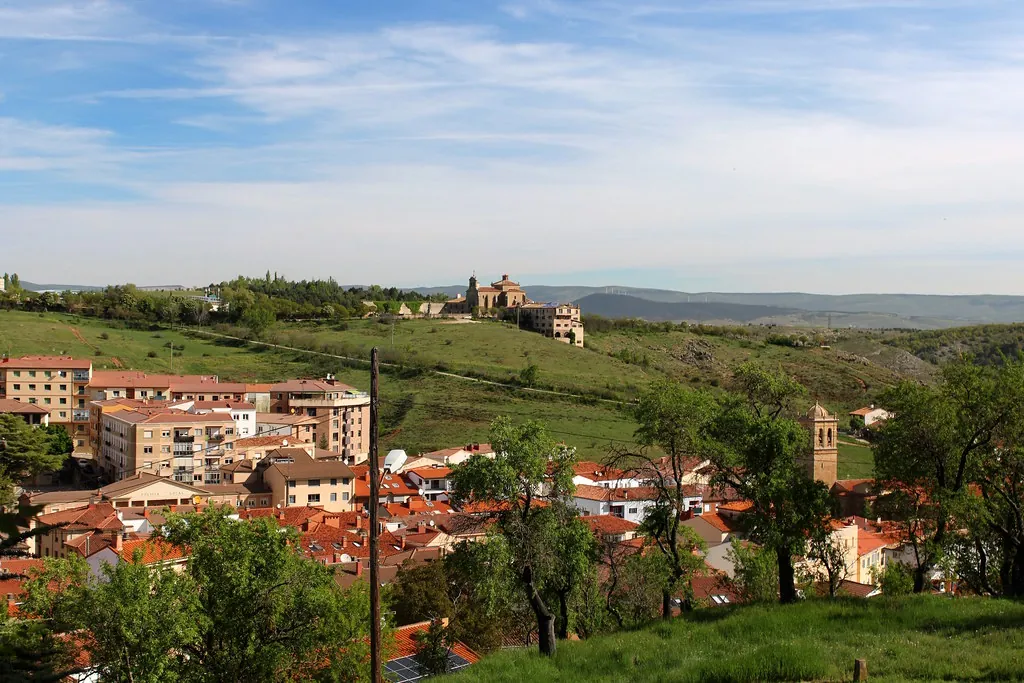
The church bell strikes noon and nobody appears. Not a soul crosses Zael's single paved street, though washing flaps on distant balconies and a tractor idles outside a stone barn. At 800 metres above sea level, the village seems suspended between earth and sky, the cereal fields rolling away in every direction until they merge with a heat-hazed horizon that could be ten or fifty miles distant. This is Castile at its most uncompromising: vast, silent, and utterly indifferent to whether you stay or leave.
Stone, Adobe, and the Weight of Centuries
Most visitors race past the turn-off on the BU-901, bound for the arterial A-62 and the promise of Burgos' cathedral spires fifty kilometres north. Those who do swing south find a settlement that has refused the cosmetic upgrades applied to so many rural Spanish towns. Houses here are still the colour of the earth they stand on—ochre adobe patched with grey limestone, timber balconies sagging under the weight of geraniums that nobody planted on purpose. Building styles haven't so much been preserved as simply never abandoned; when a wall collapses, neighbours help rebuild it the same way their grandfathers did, because concrete blocks would look ridiculous against this landscape.
The fifteenth-century parish church of San Miguel squats at the village centre like a blunt fortress. Its Romanesque doorway is worth a glance—particularly the weather-worn capital depicting what appears to be a farmer beating a tax collector—but the real architecture is vernacular. Walk fifty paces down Calle de los Hornos and you'll pass a medieval wine cellar carved into the hillside, still used for storing the harsh local tempranillo; further on, a farmhouse doorway bears the remains of a coat of arms whose nobility dissolved along with the family line sometime around the Peninsular War. Nobody has added a gift shop or an interpretation board. Interpretation is strictly DIY.
What the Land Gives, and What It Takes Away
Zael's altitude means winters bite. Frost can linger into April, and when the northeasterly cierzo wind arrives it scours the plateau for days, rattling loose shutters and driving even the dogs indoors. Spring arrives suddenly—usually in the first week of May—when the wheat turns emerald overnight and the stone walls warm enough for lizards to venture out. Summer is fierce: temperatures touch 35 °C by mid-June, and the only shade is what you find against a barn wall. Autumn is the sweet spot, the stubble fields glowing bronze under enormous skies, the air thin and sharp as cider.
These seasonal swings dictate more than wardrobe choices. They explain why the local menu hasn't changed much since the 1950s. Roast suckling lamb (lechazo) arrives at table with skin so crisp it shatters like toffee; the meat beneath is pink, almost buttery, a reminder that Castilian cooking was perfected in wood-fired ovens long before anyone heard of induction hobs. Morcilla—blood sausage studded with rice and onion—comes crumbled over chickpea stew thick enough to support a spoon upright. Prices in the only remaining tavern, Casa Emilio, are disarmingly honest: a three-course menú del día with wine costs €12 if you arrive before three o'clock. Vegetarians can expect grilled peppers, omelette, and the faint suspicion that they are missing the point.
Walking the Lines Between Fields
There are no signed hiking loops, no ticket booths, no car parks bristling with selfie sticks. Instead, a lattice of agricultural tracks radiates outward, originally carved by ox-drawn ploughs and now used by the occasional combine harvester. Follow any of them for twenty minutes and you'll reach a stone shelter once used by shepherds overnighting on the cañada real—one of the ancient drove roads that funnelled merino sheep toward winter pastures in Extremadura. The stone walls are waist-high, the interior blackened by centuries of fires. Sit on the threshold at dusk and you can watch harriers quartering the stubble, their wings flickering like pale flags against the darkening plain.
Early risers are rewarded by a phenomenon the locals barely notice: thermal inversion. On windless mornings between October and February, cold air pools in the valley basins while warmer air rides above. From the ridge track south of the village you look across a sea of fog that stops exactly at the church tower, as though someone sliced the world horizontally and forgot to reattach the bottom half. Photographers mutter about golden hour, but the real magic is the silence—no distant traffic, no machinery, only the soft clank of a cow bell carried from a farm you cannot see.
When the Village Decides to Celebrate
August's fiestas patronales turn the central street into an open-air kitchen. Neighbours who haven't spoken since the last harvest share long tables set up beneath strings of coloured bulbs powered by a chugging generator. The soundtrack is a loop of 1980s Spanish pop played at conversation-stopping volume; the food is cocido stew simmered in cauldrons big enough to bathe a toddler. Outsiders are welcome, though you'll be expected to buy raffle tickets for a hamper of local sausages. First prize is always claimed by someone's cousin from Burgos—proof that provincial nepotism survives even in a population of 500.
Easter is quieter. A single procession leaves the church at dawn on Good Friday, fifteen hooded figures carrying a platform draped in black velvet. The only light comes from wax torches that spit and gutter in the wind; by the time the cortège returns, wax droplets have splattered the cobbles like pale blood. Tourists are thin on the ground, which is precisely why some visitors time their trip for Holy Week. You will not find a hotel—there isn't one—but the parish almoner keeps a list of villagers willing to rent a spare room for €25 a night. Bathrooms are shared, heating is not guaranteed, and breakfast will involve strong coffee and yesterday's sponge cake. Accept graciously; refusal offends.
Getting There, Getting Away
Public transport is theoretical. One bus a day leaves Burgos' Estación de Autobuses at 14:15, reaches Zael at 15:40, and turns around immediately. Miss it and you're spending the night, because taxis refuse to come this far unless you pre-book and pay both ways. Driving is straightforward: take the A-62 west from Burgos, exit at junction 8, then follow the BU-901 south for twenty-five minutes. Petrol stations are scarce—fill up at Villarcayo, the last town of any size. Roads are single-track for the final approach; pull into the verge when a tractor bears down with the confidence of someone who knows exactly how wide his combine is.
Mobile reception flickers in the village centre and dies entirely among the fields. Download offline maps before you set out, and carry water: the flat terrain tempts you to walk farther than intended, and the nearest bar could be an hour away. Summer visitors should start early and finish by noon; winter arrivals need layers and a torch, because street lighting switches off at 23:00 sharp. None of this counts as hardship—merely the modest admission price for standing where the Meseta opens its hand and lets the horizon run wild.
Zael will not change your life. It offers no epiphanies, no Instagram vistas, no artisan gin distilled from local herbs. What it does provide is a calibration point: a place to recalibrate your sense of scale against a landscape that was old before England had universities. Come for a day, stay for a night, leave before the silence becomes unnerving. The village will still be here when the motorways crack and the guidebooks crumble, the wheat waving like a calm, golden sea above the bones of Visigoths, Romans, and countless farmers who never bothered to write their names down.