Full Article
about Becerril de Campos
Town in Tierra de Campos, declared a Historic Site; it holds exceptional artistic heritage and the unique San Pedro Cultural project in the region.
Ocultar artículo Leer artículo completo
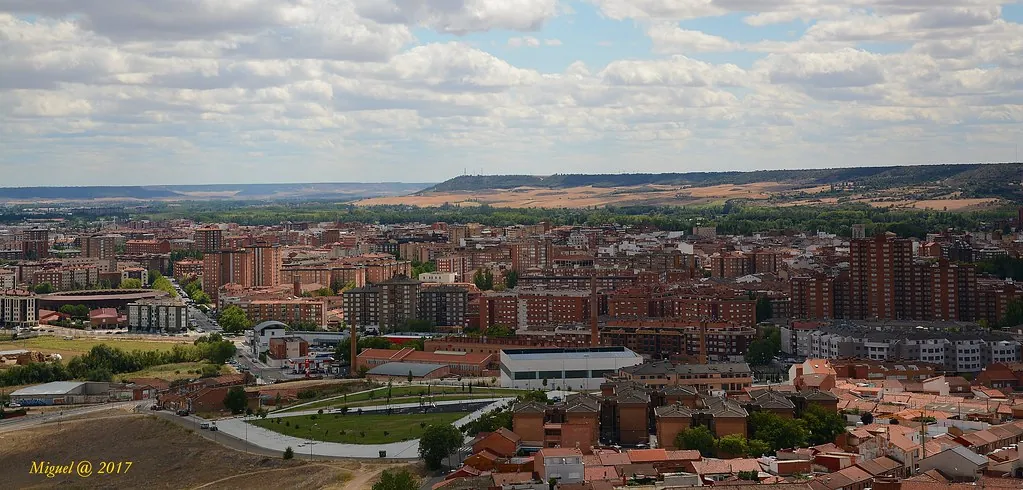
The brick tower of Santa María appears long before the village itself. From the A-623 it rises straight from the wheat, a salmon-coloured exclamation mark against kilometre after kilometre of biscuit-coloured stubble. At 770 m above sea-level, Becerril de Campos has nothing to hide behind—no hills, no river gorge, just the uncompromising flatness of Tierra de Campos and a skyline built entirely by human stubbornness.
That visibility once meant wealth. In the fifteenth century this was a minor judicial capital; merchants stored grain in underground silos and the lord of the manor employed the best stonemasons money could buy. The evidence is still there in the plaza mayor, an arcaded rectangle bigger than many provincial cities yet serving barely 700 residents. British visitors usually mutter "bit over the top, isn't it?" while circling the stone benches with their takeaway coffees—then check their watches and realise the place really is that quiet after ten at night.
Brick, clay and bare horizons
The village palette is simple: terracotta roofs, ochre earth, white-washed upper walls that throw the light back in your face. Adobe houses sit shoulder-to-shoulder with taller brick dwellings whose wooden balconies were added in the nineteenth century when wool money replaced cereal money. Walk Calle Saturno at sunrise and the façades glow the same colour as a Cornish pilchard boat; by midday they bleach to biscuit, and at dusk the air turns the colour of diluted terracotta paint. Photographers love it—so long as they pack a lens cloth. The wind lifts dust from the surrounding ploughland and coats every surface in a fine Castilian powder.
Start with the two churches because, frankly, they are impossible to ignore. Santa María, late-Gothic graduating into plateresque, charges admission of €2.50 and keeps erratic hours (Tue-Sun 10:30-14:00 & 16:30-19:00; pick the key up from the tourist office on the plaza if the door is locked). Inside are panels attributed to Pedro Berruguete and a gilded altarpiece that locals call "our little Prado". The brick bell-tower can be climbed for an extra euro; from the top you grasp just how ruler-straight the surrounding grain roads are—Roman cadastral lines still dictate modern tractor routes. San Pedro, two blocks north, is older and heavier: Romanesque bones clothed in later rebuilds. Its tower is shorter, squatter, the bell-hole a simple Castilian arch that frames the sky like a minimalist painting.
Between them stands the sixteenth-century rollo jurisdiccional, a stone column where public punishments were carried out. It is not ornate, but it is eloquent: a reminder that this community once had the power to hang you. Touch the iron ring halfway up and you will find it polished by centuries of bored shepherds.
Cafés, churches and the Tuesday invasion
Becerril wakes up only once a week. On Tuesday morning vans from Valladolid and Palencia roll into the south-east corner of the plaza and unfold awnings: cheese trucks, honey stalls, a chap who sells nothing but padded coat-hangers. Market day doubles the population for four hours; the butcher runs a two-for-one on morcilla and the bakery brings out almond biscuits called mantecadas that taste of pork lard and Christmas. Arrive at eleven, queue with the locals for a churro, and you will hear more Castilian Spanish than English spoken all year. That is the point: no one comes here by accident, and very few come at all.
Stay for lunch. El Rescate opens at 13:30 and will, if pushed, serve what they advertise as an "English breakfast" (eggs, bacon, Heinz beans) but the real action is at Tres Culturas on the main Valladolid road. Order the menestra de verduras and you get a bowl of chickpeas, spinach and blood sausage that could stun a ploughman at twenty paces. House wine comes in 250 ml porróns—miniature glass jugs that look like chemistry equipment. A three-course menú del día costs €14 and you will not need supper.
Afternoon options depend on footwear. The village itself is flat and can be walked end-to-end in twenty minutes, but the surrounding grain belt is criss-crossed by cañadas, ancient drove-roads now signed as PR-PO-14. They are dead straight, shade-free and, in July, a study in shimmering heat haze. Spring and autumn are kinder: skylarks overhead, the smell of wet clay after rain, and occasional circles of stork nests perched on electricity pylons. Fifteen kilometres north the Canal de Castilla slices through the plain; the tow-path is rideable on hybrids so long as you avoided last night's storm—otherwise the surface turns to glue and you will push rather than pedal.
A room with no view—and why that matters
Accommodation is limited. Hotel Camino Real occupies a converted grain warehouse on Calle Venus; rooms are large, heating is fierce (this is 770 m remember) and the Wi-Fi works most of the time. Double rooms start at €55 including garage parking—useful because street lighting is modest and the nearest petrol is 18 km away in Palencia. There is no pool, no spa, no rooftop bar, just thick walls and small windows designed to keep out the summer furnace. Book ahead for Holy Week; otherwise you can usually turn up and haggle.
Evenings revolve around the plaza. Children play tag beneath the arcades while grandparents occupy the stone benches in strict rotation. By 22:30 even the dogs have gone home; the loudest sound is the clack-clack of the automatic irrigation sprinklers on the football pitch. British visitors expecting tapas trails or craft-beer pubs are disappointed—until they realise this is the attraction. The sky is enormous, the stars unsullied, and the only Instagram danger is battery drain from long-exposure shots of the Milky Way.
When to come—and when not to
April-May: green wheat, mild days, night frost possible. Storks everywhere.
September: harvest dust turns sunsets copper; temperatures drop to walking-friendly 24 °C.
Mid-December to mid-January: sharp nights (-8 °C), brilliant days, almost no tourists; Santa María keeps festive opening hours but bring cash because the ATM is still 13 km away.
Avoid August weekends unless you crave silence so complete it feels post-apocalyptic. Avoid Easter unless you booked months ago. And if you must come in July, start walking at dawn, finish by eleven, then retreat to a shaded café and pretend you always meant to read a book all afternoon.
Leave time for the sacred-art museum attached to Santa María. It takes forty minutes, admission is included in the church ticket, and the custodian will unlock the lights if you ask nicely. Among the gilded monstrances and frayed bishops' gloves is a polychrome Virgin whose face was repainted in 1931 to resemble a famous actress of the day—local gossip claims it was an attempt to stop the parish priest flirting with cinema usherettes. The story may be apocryphal; the smile is definitely Hollywood.
Becerril will not change your life. It will, however, slow it down to the rhythm of grain ripening and church bells that still mark the quarters rather than the hour. Drive away across the empty plain and the tower stays in the rear-view mirror longer than seems geometrically possible, a brick bookmark holding your place in Castile until you decide to return.