Full Article
about Castromocho
A Terracampina town with two major churches, known for its farming heritage and revived local traditions.
Ocultar artículo Leer artículo completo
The Horizon That Never Ends
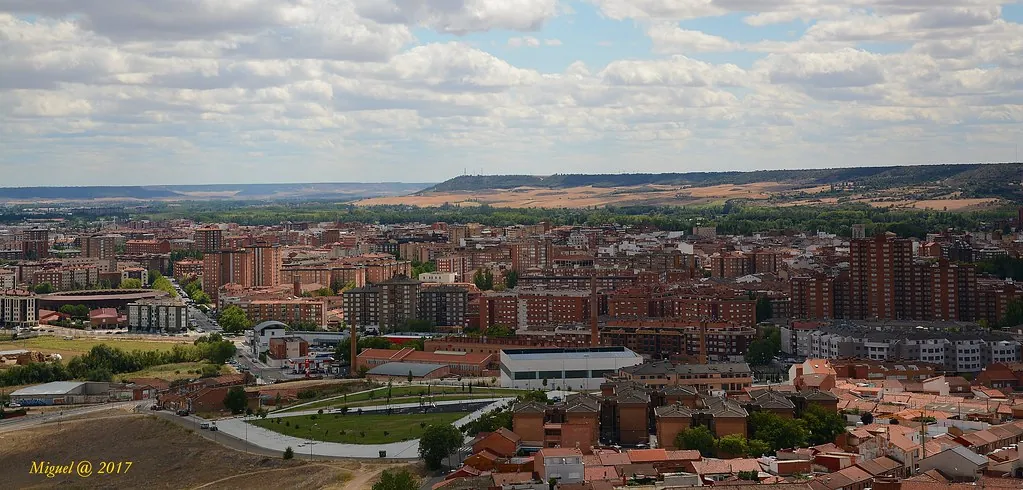
From thirty kilometres away, Castromocho appears as a dark smudge on an otherwise unbroken line. The village rises from the cereal plains of Tierra de Campos like a ship on a golden ocean, its 16th-century church tower the only vertical punctuation in a landscape where the horizon stretches 360 degrees. At 750 metres above sea level, the air carries a clarity that makes distant objects seem closer than they are—a trick of light and altitude that first-time visitors find disorienting.
The 190 residents who remain here understand this illusion well. They've watched countless travellers squint at their maps, certain they've taken a wrong turn somewhere between Palencia and León. There are no wrong turns in this part of Castilla y León—only the straight Roman roads that slice through wheat fields, and the dirt tracks that lead, eventually, to settlements like this one.
Adobe Against the Elements
The village architecture tells its own story of survival. Mud-coloured houses, their walls built from adobe and tapial, cluster together as if seeking mutual protection. The walls are thick—sometimes a metre deep—designed to keep interiors cool during summer months when temperatures touch 35°C, and warm during winters that can drop to -10°C. Walking the narrow streets reveals the evolution of rural building: 18th-century adobe structures lean companionably against 1970s brick additions, while modern concrete blocks stand slightly apart, like newcomers at a village dance.
The Church of San Esteban Protomártir dominates the skyline, its sandstone walls having withstood everything from Napoleonic troops to the 1755 Lisbon earthquake that cracked its bell tower. Inside, the retablos display the sober Baroque style typical of Castilian religious art—no excessive gilt here, just carved wood painted in muted colours that have faded over centuries of candle smoke and incense. Finding the church open requires local knowledge; the key keeper lives three doors down from the bakery, and she's usually happy to interrupt her afternoon telenovela for visitors who ask politely.
The Economy of Empty Spaces
This is cereal country, where the land's value lies not in what you can build upon it but what you can coax from it. The surrounding fields shift through an annual chromatic cycle: emerald green in April when the wheat emerges, golden blonde by July during harvest, and the raw umber of ploughed earth from October through March. Farmers time their days by the sun's arc rather than clock faces, starting fieldwork at dawn when the light is soft enough to spot the difference between wild oats and cultivated grain.
The abandoned dovecotes scattered across the landscape speak to a different economy. These circular towers, some standing proud at twelve metres tall, others crumbling into picturesque decay, once housed pigeons whose droppings provided fertiliser for the fields. The practice died out in the 1960s when chemical fertilisers became cheaper than maintaining the structures. Now they serve as perches for kestrels and the occasional adventurous stork, their entrances blocked by tumbleweed and time.
Walking Where Romans Once Marched
The flat terrain makes for easy walking, though "easy" depends on the season. Spring brings pleasant temperatures and the chance to spot great bustards performing their mating dances—males transforming from brown birds into white-feathered pom-poms through clever feather manipulation. Summer walking requires planning; start early or risk heatstroke under skies that offer no shade for kilometres. The GR-340 long-distance path passes within five kilometres of the village, though few hikers divert this way.
Local farmers use the caminos agrícolas that connect fields, and these provide the best walking routes. They're marked on detailed maps but not signposted—following them requires a sense of direction and willingness to backtrack when they dead-end at private property. The reward comes in the form of uninterrupted views across Spain's breadbasket, where red kites wheel overhead and the only sounds are wind through wheat and the distant hum of a combine harvester.
The Taste of Hard Work
Food here reflects the landscape—substantial, straightforward, designed to fuel fieldwork rather than impress food critics. The local bakery produces pan de hogaza, round loaves with thick crusts that last a week without going stale. Inside the single bar, which doubles as the village social centre, morning coffee comes with mantecados—crumbly biscuits made with lard, their richness balanced by a glass of rough red wine that locals claim aids digestion.
The weekly market on Thursdays brings vendors from larger towns, their vans selling chorizo made from pigs that rooted for acorns in nearby oak dehesas. Cheese comes from Manchega sheep, their milk transformed into wheels that develop a natural rind during months of ageing in stone cellars. The bar's menu del día, served from 2 pm sharp, might feature cocido maragato—the hearty stew that starts with soup, progresses through chickpeas and cabbage, and finishes with boiled meats that fall apart at the touch of a fork.
When the Village Comes Alive
August transforms Castromocho. The fiestas patronales honour San Esteban, and the population swells as former residents return from Bilbao, Barcelona, even Birmingham. The plaza fills with generations who greet each other with the easy familiarity of those who share great-grandparents. Brass bands play until dawn, their music carrying across the plains like a challenge to the silence that prevails for the other eleven months.
The religious procession at dawn on August 3rd sees the saint's statue carried through streets strewn with rosemary and thyme, their scent released by the feet of the faithful. Later, the younger generation organises foam parties in the municipal pool—an incongruous sight against the medieval backdrop, but one that speaks to the village's determination to survive through adaptation.
Practicalities for the Curious
Reaching Castromocho requires private transport. The nearest train station is Palencia, 45 minutes away by car. From there, a rental vehicle navigates the A-66 autopista before turning onto the CL-613, a road so straight it seems to disappear into the sky. Accommodation options within the village itself are non-existent; the closest hotels lie in Villada (20 kilometres) or Palencia (35 kilometres).
Visit in late April or early October for optimal conditions. Winter brings crystal-clear skies but temperatures that freeze car batteries, while summer turns the landscape into a shimmering heat haze that makes photography challenging. Bring water—lots of it—because once you leave the village, there are no facilities for miles. Mobile phone coverage is patchy; Vodafone works better than other providers, but don't rely on Google Maps when the nearest landmark is a field of wheat indistinguishable from the last ten you passed.
Castromocho won't change your life. It offers no Instagram moments or bucket-list experiences. What it provides is something increasingly rare: the chance to stand in a landscape that has fed Spain for two millennia, where the relationship between people and land remains visible in every adobe wall and every furrowed field. Come prepared for silence broken only by birdsong, for skies that make you understand why Castilian painters chose such particular blues, and for a pace of life measured not in minutes but in seasons.