Full Article
about Ceinos de Campos
A town with Templar history in the heart of Tierra de Campos, noted for its church and the remains of old commanderies.
Ocultar artículo Leer artículo completo
The tractor that rattles down Calle Real at seven each morning carries no number plate, just a fine dusting of chalky soil that drifts onto the single pavement. Nobody in Ceinos de Campos would think to complain; the machine is as much a parishioner as the elderly women who shuffle into church for the 8 a.m. mass, and considerably louder.
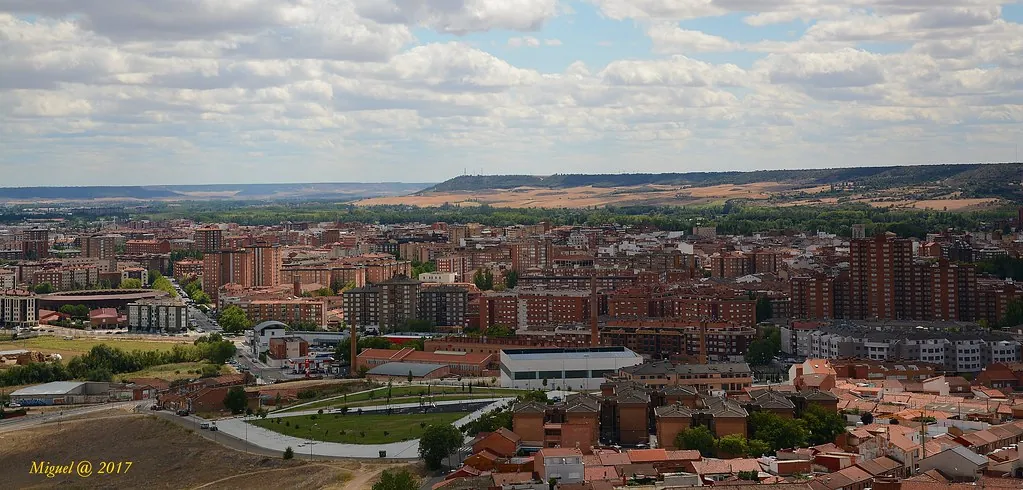
This is Tierra de Campos in its purest form: 170 inhabitants, wheat to every horizon, and a sky that feels higher than anywhere else on the peninsula. The village sits 740 m above sea level on Spain’s northern plateau, roughly midway between Valladolid and León. Madrid lies two hours south by car; the sea is a distant rumour. Expect wind, expect solitude, and expect to explain what you’re doing here—locals meet strangers with courteous bafflement rather than rehearsed welcome.
Adobe, Brick and the March of Time
Houses are low, walls thick. Adobe keeps bedrooms cool in July and lukewarm in January, when Atlantic fronts sweep across the plateau and the thermometer can dip to –8 °C. Most façades wear that particular Castilian palette of terracotta, bone and rust; paint peels politely, revealing earlier colours like archaeological strata. Nothing is staged for the visitor. A pair of stocky dovecotes tilts outside the built-up area, their brickwork nibbled by decades of hail. They are private, not picturesque, and the message is clear: look, but don’t Instagram your way inside.
The parish church of San Andrés squats at the top of the single square, tower short and sturdy against the wind. Step in and you’ll find a single-nave interior repainted in the 1960s, a Christ in painted wood whose expression suggests He, too, has witnessed too many droughts. Ask the sacristan—usually the woman who keeps the key in her apron pocket—about the 16th-century font and she’ll haul back the damp carpet to show you. No ticket, no leaflet, just conversation carried on in careful Castilian Spanish that still drops the final “s”.
Walking the Grid
Ceinos throws no ring-road around itself; the village simply dissolves into cereal fields scored by ruler-straight tracks. These caminos form an ideal walking circuit: flat, vehicle-scarce and signed only by the occasional granite milestone. A 6 km loop south towards the abandoned hamlet of Villafáfila takes forty-five minutes, though photographers dawdle—telegraph poles recede into heat shimmer, and every verge flickers with calandra larks. Bring water; shade does not exist. In April the soil exhales a cool, almost maritime smell; by late July the stubble glints like broken glass and the air smells of biscuit.
Cyclists can push farther. A paved farm lane runs 14 km west to the Romanesque church at Villalón de Campos, its portal carved with acanthus that has survived both Reconquest and Reformation. The return leg is a straight eastward blast on the CV-232—traffic averages one car every nine minutes, according to the regional road census, so you can ride the crown of the road and count skylarks instead.
When the Day Ends
Evenings deliver the village’s real spectacle. At nine the sun drops behind the grain silo, gilding the brickwork and turning every puddle into polished brass. By ten the sky has drained to bruise-violet; the Milky Way appears with a clarity you last saw on a school geography camp. Night-time temperatures can fall 15 °C within an hour—even in August—so pack a fleece alongside the sangria glasses. Amateur astronomers set up on the Vía Pecuaria south of the last streetlamp; the nearest bulb is 3 km away, a lonely diode on a farmer’s yard.
What You Won’t Find
There is no hotel, no café terrace, no artisan bakery. The grocery that opens three mornings a week stocks UHT milk, tinned asparagus and a surprisingly good local queso castellano at €9 a kilo. Bread arrives in a white van around 11 a.m.; if you miss the horn, you miss lunch. The nearest proper meal is in Villalón, 12 minutes by car, where Mesón La Cazuela serves cordero lechal (milk-fed lamb) for €22 with wine. Vegetarians should order judiones—buttery giant beans from nearby La Bañeza—and accept that even the salad comes topped with jamón.
Bank machines are equally elusive. Bring cash; the bakery van doesn’t do contactless.
Festivals Measured in Decibels, Not Crowds
The patronal fiesta lands on the third weekend of August. Emigrants return from Valladolid and Madrid, tripling the population overnight. A sound system appears in the square, competing with the tractors still working the night shift. Saturday’s communal paella feeds 400; the queue starts at 14:00 sharp and latecomers get crisps. Visitors are welcome—someone will press a plastic cup of verdejo into your hand—but don’t expect bilingual signage or a printed programme. The fireworks consist of a single string of bangers tied to the church railings; health-and-safety forms are conspicuously absent.
Holy Week is quieter: a dozen hooded cofrades carry a petite Virgin through streets too narrow for traffic. The event lasts twenty minutes, after which everyone retreats indoors for potaje (chickpea stew) and an early night.
Getting There, Getting Out
Ceinos sits 70 km northwest of Valladolid. Take the A-6 towards Benavente, peel off at junction 178 and follow the CL-613 for 18 km of arrow-straight tarmac across the plain. The final approach is a single-lane CV-232; wheat brushes both wing mirrors in a good year. Buses reach the larger village of Cerecinos de Campos, 7 km away, on Tuesdays and Fridays only—timetables favour market-goers, not tourists. A taxi from Valladolid costs €70; most drivers will phone ahead to check someone is actually waiting to pay.
Winter access can be sporting. The plateau collects snow from Atlantic storms; drifts blow sideways for miles. Carry a blanket and charged phone between December and February, and don’t trust the weather app—local farmers still predict storms by watching ant behaviour.
Worth It?
Ceinos de Campos offers no postcard moment, no fridge magnet, no story that will play well at an office dinner party. It delivers instead the rare sensation of standing in the middle of an enormous, half-empty map. If that thought quickens the pulse, come. If you need a souvenir, pocket a stalk of wheat; it will shed grains in your rucksack for months, a stubborn reminder that some corners of Spain refuse to entertain you—and are none the worse for it.