Full Article
about Fuentes de Valdepero
Dominated by its striking Sarmiento castle; a town near the capital with well-preserved history and heritage.
Ocultar artículo Leer artículo completo
The castle keep is open only at weekends, so on a Tuesday morning the loudest sound in Fuentes de Valdepero is the clack-clack of a single domino game spilling out of the bar onto Calle Real. Two elderly men play, a third keeps score on a cigarette packet, and the only audience is a stork balancing on the church tower opposite. At 780 m above sea level the air is thin enough to make the beer go to your head before lunch; the barman will tell you this is normal, just as it is normal for the wind to carry the smell of dry straw even in February.
A horizon measured in wheat fields
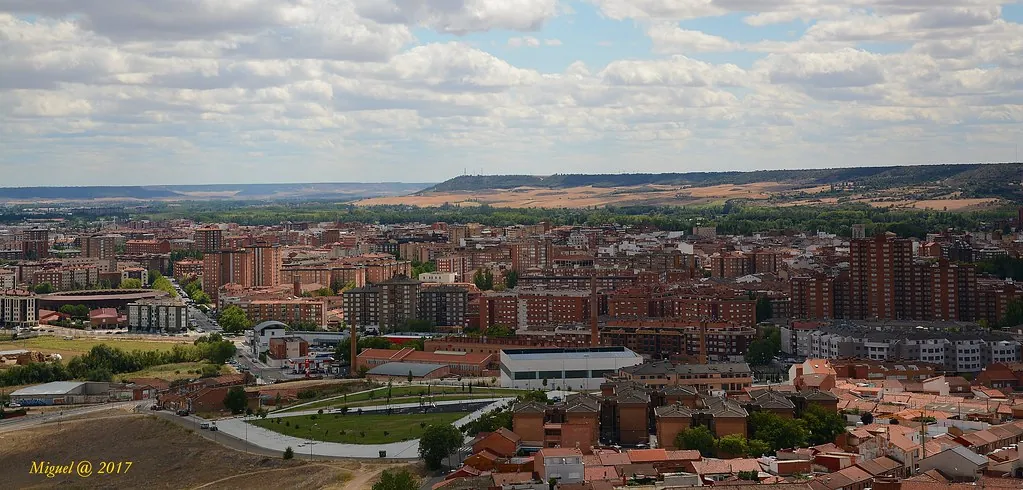
The village sits in the middle of Tierra de Campos, a plateau that the Romans used for wheat and modern Spaniards still do. Stand on the tiny Plaza Mayor, turn through 360 degrees, and every view ends in a pale gold line where the earth meets a huge sky. There is no dramatic sierra to break the rhythm, only the occasional dovecote – cylindrical adobe towers dotted among the houses like grain silos left behind by giants. Some have lost their conical roofs and stand open to the weather; others have been patched with modern brick and pressed back into service, proof that pigeon manure still fetches a price at the agricultural co-op.
The network of farm tracks that radiates from the last houses is perfect for flat cycling. Distances feel shorter than they are because the landscape repeats itself: every kilometre you pass another ruined dovecote, another irrigation pond reflecting the same sky. Bring OS-type mapping or you will swear you have pedalled in a circle when you haven’t. Spring brings lapwings and the odd bustard; autumn brings harriers that follow the combine harvesters and feed on spilled grain. Mid-summer is best avoided – shade is scarce and the thermometer nudges 38 °C.
Mud brick, Romanesque and one defensible tower
The parish church of San Juan Bautista looks shut even when it isn’t. The south door, carved with worn floral capitals, gives onto a single-aisle nave that smells of candle wax and damp stone. Inside, a sixteenth-century retablo gilded with American gold stares back at visitors who rarely number more than three at a time. The castle, 30 m away, is more sociable – but only just. Built in the fifteenth century and restored in 2003, it charges €3 entry (€1.50 concessions) and opens Saturday and Sunday 11:00-14:00, 16:00-18:00. Outside those hours you can still walk the perimeter; the walls are lit at night and the stone glows amber under the sodium lamps, a useful landmark if you are staying in the scattered rural guesthouses and lose your bearings after dinner.
Inside the keep a spiral staircase leads to an exhibition room where scale models reconstruct local history: a medieval wheat market, a Civil-war checkpoint, a 1950s threshing crew. Captions are Spanish-only; a phone translator works well enough. The roof terrace delivers the promised panorama – 30 km of uninterrupted cereal fields, the railway to León a thin pencil line on the horizon, and, if you visit between March and July, storks ferrying sticks to the nest wedged above the belfry.
Eating when the combine drivers eat
Fuentes has two places that serve full meals. Restaurante Canario, painted an aggressive shade of custard on the outside, does a reliable lechazo (milk-fed lamb) carved tableside with a soup bowl for the juices. Expect €14 for a weekday menú del día: three courses, half a bottle of house red, and bread baked in Palencia that morning. Across the road, Bar Cristóbal offers simpler raciones – morcilla, fried peppers, cheese from the Picos de Europa – and opens earlier if you need coffee before ten. Neither takes cards; cash only, and the nearest ATM is ten minutes away in neighbouring Becerril. Palencia city, 12 km north on the CL-615, has British-friendly tapas bars around Calle Mayor if you miss speaking English while you eat.
Getting here, getting in, getting stuck
Ryanair’s Stansted–Valladolid flight runs March to October; from the airport it is 45 minutes by hire car, almost all of it on the A-62 motorway. The alternative is Madrid, then AVE train to Palencia (1 h 20 m) and a €30 taxi for the final 20 km. Buses do exist on paper – Linecar route 2 – but the morning service reaches the village at 07:15 and the return leaves at 14:00, which means you either breakfast at dawn or spend the night. Most British visitors fold Fuentes into a circular driving tour: Palencia cathedral in the morning, castle at lunchtime, the wine-route villages of Cerrato in the afternoon.
Accommodation within the municipality is limited to three rural casas rurales, each with four to six bedrooms, prices €70-90 for the house. They are clean, heated with wood-burning stoves, and thick-walled enough to mute the howling campos wind that picks up after dark. In Palencia you have the usual provincial three-stars; the Hotel Castilla Canal is walkable from the station and has secure parking if you prefer not to leave the car on the street.
When to come, when to leave
April and May turn the fields emerald; sunflowers appear in June; by July everything is the colour of digestive biscuits. Harvest starts mid-July and brings extra traffic – combine convoys wider than the lanes, grain lorries grinding through the village at 06:00. September is quieter and the light softens, ideal for photography if you want those long shadows across the adobe. Winter is sharp: night temperatures drop to –5 °C, the castle closes if the steps ice over, and the bar shortens its hours, but you could have the entire place to yourself for the price of a coffee.
Stay too long and the silence becomes contagious; conversations slow to the speed of the domino game outside the bar. One night is usually enough to reset the urban pulse, two if you intend to walk every track. Leave on a Sunday afternoon and the castle door will shut behind you with a thud that carries across the empty square – a reminder that Fuentes de Valdepero is perfectly happy when nothing happens at all.