Full Article
about Manquillos
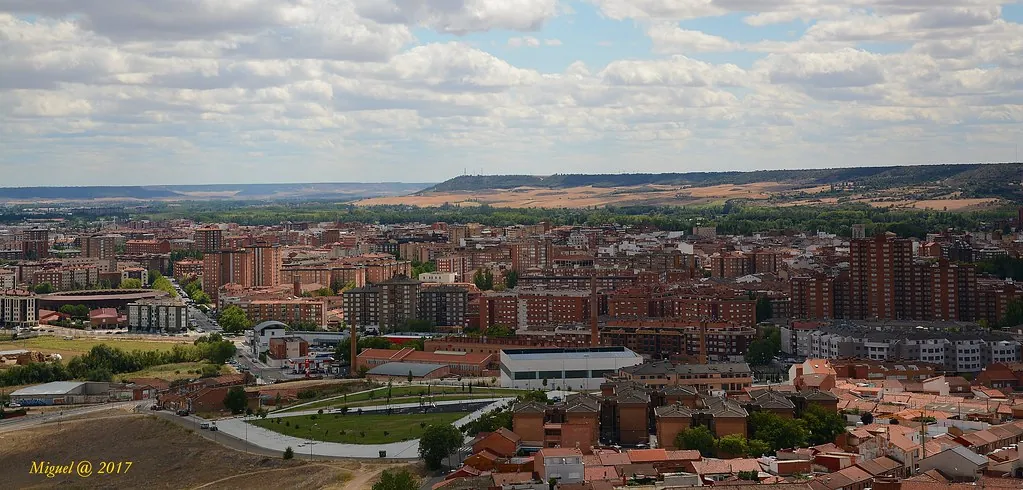
Small village on the banks of the Carrión; known for its riverside setting and quiet just a few kilometres from the capital.
Ocultar artículo Leer artículo completo
The grain silo comes into view long before the village does. A single concrete cylinder rising 25 metres from a swell of wheat, it is Manquillos’ exclamation mark on an otherwise uninterrupted horizon. From the A-231 autopista it looks almost heroic; drive the last 12 km on the CV-231 and the joke is on you—the road narrows, the tarmac gives up, and the silo turns out to be the only thing built here since 1973.
740 Metres Above the Sea that Isn’t There
Manquillos sits on the roof of Palencia province at 740 m, high enough for the air to carry a thin snap even in July. The surrounding plateau—Tierra de Campos, once christened “the breadbasket of Spain”—feels more prairie than Iberian. There are no coastlines, no cliffs, no fishermen mending nets. Instead, the village behaves like a land-locked lighthouse: its 13th-century church tower acts as a reference point for tractor GPS rather than shipping lanes. Wheat, barley and vetch roll away in every direction, changing colour with the hour: silver at dawn, ochre after lunch, bruised purple when storms march in from the Cordillera Cantábrica 80 km north.
That flatness is deceptive. Stand beside the cemetery wall at dusk and the plain reveals itself as a shallow saucer; the land dips just enough to hide the neighbouring hamlet of Villarramiel 5 km south-west. Locals call the effect el mar de campos—the sea of fields—and on days when the cierzo wind blows, the ripening grain moves in waves that mimic an Atlantic swell. Bring a kite: there’s nothing to snag it for miles.
Mud, Adobe and the Smell of Rain on Dust
Sixty souls are registered as residents, though only about forty are usually here. The houses they occupy are low, earth-coloured, hand-made. Adobe bricks—straw, clay, livestock urine—were sun-dried in the street itself; the same bricks now buckle under corrugated iron roofs. Some façades still carry the owners’ initials pressed into the wet clay a century ago; others have surrendered to the weather, revealing fist-sized stones that serve as primitive aggregate. It is architecture without architects, and it is vanishing. One in three dwellings is roofless, their timber beams removed for firewood during the post-2008 winters when unemployment in the province topped 25%. Peek through a broken shutter and you may find a 1950s calendar still nailed to the wall, its December girl wearing a one-piece swimsuit and a Santa hat.
There are no souvenir shops, no boutique hotels occupying former convents. The only commerce is a weekly mobile butcher’s van that parks beside the church on Thursdays at 11:00 and sells morcilla blood sausage for €6 a kilo. Bring cash—notes only, preferably small.
Walking the Agricultural Labyrinth
Manquillos doesn’t do signposted trails. What it does possess is a chessboard of caminos vecinales, dirt tracks wide enough for a combine harvester, that stitch the village to its satellites. Park beside the playground (one swing, one slide, no children) and head north on the track signed “FV-13” in fading white paint. Within ten minutes the settlement is invisible; all that remains is sky, wheat and the occasional carraca—a stone shelter once used for grain storage—now colonised by rock sparrows. After 4 km the path crosses the Arroyo de Valdepeñas, a seasonal stream that in May carries enough water to reflect the clouds like polished steel. By August it is a ribbon of cracked mud where larks bathe dust into their feathers.
Carry water. Shade is theoretical: the only trees are poplars planted beside irrigation ditches, and farmers sometimes remove them to widen pivot sprinklers. A circular route back via the hamlet of Frechilla adds 7 km; the reward is the Romanesque hermitage of San Pelayo, its doorway decorated with rope mouldings that predate Magna Carta. The door is locked, but the stone is cool enough to rest your forehead against after 90 minutes in 35 °C heat.
When the Village Doubles in Size
Visit in late August and the population explodes to roughly 200. The fiestas patronales honour the Assumption with a portable bar installed in the square, a sound system powered by a tractor’s alternator, and a paella cooked over vine prunings. Outsiders are welcome but not fussed over; buy a €3 beer and you are treated as provisional family. At midnight on the 14th a brass band—recruited from neighbouring villages—marches down Calle Real playing pasodobles while residents follow with chairs in hand, setting them down wherever the music stops. The evening ends with a firework strapped to a telegraph pole; the bang ricochets off the grain silo and sends every dog within five kilometres into orbit.
Outside fiesta week, evenings belong to the peñas, groups of retired men who sit outside the former schoolhouse playing mus, a Basque card game whose scoring system requires the memory of a tax inspector. Games start at 20:30 sharp; spectators may pull up a crate but conversation is minimal until the rubber is decided.
Eating (Elsewhere) and Sleeping (Scarce)
Manquillos itself offers no meals, but the 12-minute drive to Frómista remedies that. At Casa Santiago (Plaza de San Martín 5) a three-course menú del día costs €14 and includes roast suckling lamb, the local lechazo, scented with marjoram and wood-smoke. Vegetarians get sopa de ajo—garlic soup thickened with bread and egg—plus sympathetic shrugs. Closer, in Villarramiel, Bar La Plaza opens at 07:00 for farmers; ask for pincho de morcilla warmed on the plancha and served with a glass of tinto de Toro for €2.50. They’ll refill the wine jug until you place your hand over the glass—Spanish semaphore for “enough or I’ll fall off my tractor”.
Accommodation within the village limits amounts to one rental house, Casa Rural El Silo (sleeps four, €90 a night, book via the Palencia tourist office). The conversion is tasteful—exposed adobe, underfloor heating—but Wi-Fi is theoretical and the nearest shop is 18 km away in Carrión de los Condes. Budget travellers sometimes wild-camp beside the carraca north of the village; technically illegal, but the Guardia Civil patrol frequency averages once every lunar eclipse. Bring insect repellent: steppe mosquitoes have adapted to altitude and laugh at citronella.
Getting Here Without Losing the Will to Live
From the UK, fly into Santander with Ryanair (Stansted, daily in summer) or Bilbao with Vueling (Heathrow, three weekly). Both airports are 90 minutes’ drive on the A-67 and A-231—toll-free, though petrol hovers around €1.65 a litre. Public transport is for purists: ALSA runs one bus a day from Palencia city at 14:15, returning at 06:20 next morning; the fare is €5.70, but the service is axed on public holidays with no notice. A hire car remains the sane option; book in advance or Santander airport will hand you the keys to a left-hand-drive seven-seater when you ordered a Fiat 500.
The Honest Verdict
Manquillos will not change your life. It offers no Instagram pinnacle, no Michelin stars, no flamenco bar where a dancer snaps castanets at midnight. What it does provide is a calibration device for European hurry. Spend an afternoon watching clouds shadow the wheat and you may discover your pulse has slowed to match the village’s—somewhere around 45 bpm. Just remember to fill the petrol tank before you arrive; the nearest station closes at 14:00 and doesn’t reopen until Tuesday.