Full Article
about Mayorga
Historic town in Tierra de Campos, famous for its Vítor procession; known for its bread museum and Mudéjar heritage.
Ocultar artículo Leer artículo completo
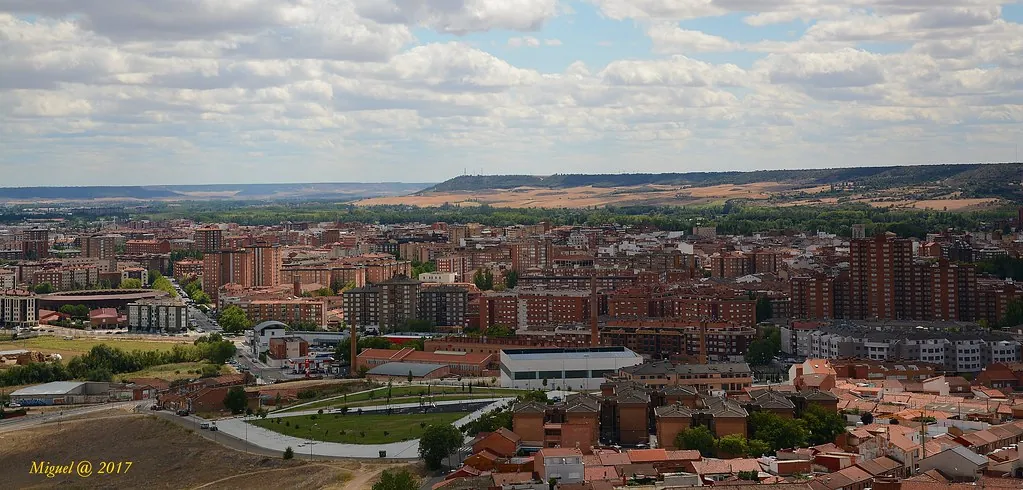
The first thing you notice is the horizon. It sits level as a spirit-level line, forty kilometres away in every direction, broken only by the 35-metre brick tower of Santa María de Árbas. Mayorga perches at 770 m above sea level, high enough for the air to feel thin and the Castilian light to bleach the terracotta walls by mid-morning. This is not a village that “tumbles” anywhere; it stands its ground on the adobe-coloured plain of Tierra de Campos, midway between Valladolid and León, and has done since the Knights of Santiago stored grain here in the twelfth century.
Most visitors arrive by accident, usually on the way to somewhere else. The A-62 motorway slips past 3 km south; from the exit you follow the N-601 for five minutes, then turn onto a road so straight it could have been drawn with a ruler. Wheat flashes past the windows—emerald in April, gold by late June, stubble-grey after the combine harvesters have gone through. The only traffic jam is caused by a tractor pulling a trailer of sunflowers.
A Plaza That Still Belongs to Locals
The Plaza Mayor is not photogenic in the postcard sense. Its arcades are uneven, the paint on the timber balconies is flaking, and the stone fountain in the centre hasn’t worked since the 1990s. What it does have is function. At 07:30 the bar under the clock tower fills with farmers in overalls who knock back small coffees and brandy chasers before driving out to the fields. By 11:00 the same tables belong to retired men arguing about football; at 13:00 mothers collect children from the primary school on the corner and feed them bocadillos of cured sheep’s cheese. Tourism is incidental. If you want a menu in English you will be disappointed; if you want a three-course lunch with wine for €11, pull up a chair.
The weekly market is held on Wednesday morning. Stallholders lay out three varieties of dried chickpeas, ropes of red chorizo, and flat loaves that look like oversized crumpets. Ask for “pan de Mayorga” and you will be handed a loaf weighing nearly a kilo, crust cracked like a dried riverbed. It keeps for a week—essential in a place where the nearest supermarket is 25 km away.
Brick, Mud and Heraldry
Mayorga never had a grand cathedral; instead it has half a dozen parish churches, each built from whatever material was closest. Santa María de Árbas, started in 1240, is brick laid in the Mudéjar pattern more common in Andalucía, but here baked by the meseta sun to the colour of burnt biscuits. The south door is Gothic, narrow and pointed, designed more for processional crosses than for camera tripods. Inside, the air smells of wax and damp stone; the altarpiece is nineteenth-century, gilded so thickly it looks like embossed leather. Opening hours are nailed to the door: 10:00–12:00, 18:00–19:00, but if the sacristan is at the harvest the church stays shut.
Opposite, the smaller church of San Juan keeps its bell in an open stone turret that leans two degrees off vertical. Locals claim it has tilted since the Lisbon earthquake of 1755; engineers blame unstable clay. Either way, the lean is enough to make the bravest photographer queasy. The narrow lanes around it are lined with manor houses whose coats of arms record marriages between local wheat barons and the lesser nobility of León. One shield shows a sheaf of grain crossed with a sword—an accurate summary of Mayorga’s history: food and soldiers, in that order.
The Only Museum Dedicated to Crumbs
Spain has museums for ham, wine, even tobacco, but only one for bread. The Museo del Pan occupies a sixteenth-century granary on Calle San Pedro. The ground floor explains how Castilian peasants ground spelt on rotary querns; upstairs you can sniff a reconstruction of a 1940s bakery powered by a wood-burning oven the size of a London taxi. Admission is €3, children free, and on the way out an attendant hands you a warm roll stamped with the municipal crest. The place is staffed by volunteers, so if you arrive on Monday it will be locked. Peer through the window and you will still learn something: the exhibition labels are large enough to read from the street.
Walking the Grid
The agricultural plain around Mayorga is scored into a grid of dirt tracks that follow Roman centuriation lines. You can walk them for hours and meet nothing noisier than a calandra skylark. A gentle circuit starts at the Arco de San Agustín, the only surviving medieval gate, and heads north for 4 km along the Camino de la Mata. The path is dead flat, bordered by stone walls built to keep livestock off the wheat. In late May the verges are purple with viper’s bugloss; by July everything is the colour of digestive biscuits. There is no shade—take water and a hat, and don’t count on phone signal.
Cyclists use the same lanes. A hire bike from Valladolid costs €20 a day and the ride to Mayorga is 55 km on a service road with a generous shoulder. The gradient is imperceptible, but the altitude makes your lungs work harder than expected. Headwind on the return leg can add thirty minutes to the journey.
Roast Lamb and Early Nights
Evenings wind down fast. By 21:30 the plaza is quiet enough to hear the click of the traffic lights changing for non-existent cars. Restaurants—there are three—specialise in lechazo, milk-fed lamb roasted in wood-fired brick ovens. The meat arrives on a clay dish, pale pink, with only a wedge of lemon for garnish. A half-kilo portion serves two and costs €24; ask for “a punto” if you like it juicy, “bien hecho” if you prefer the Castilian version of well-done. Vegetarians can order sopa de ajo, garlic soup poured over bread and a poached egg, but don’t expect a salad beyond tomatoes dressed with salt and olive oil.
The local wine is a young tempranillo from the nearby Cigales valley. It comes in short, dumpy bottles sealed with wax and costs €9 in the supermarket, €14 in a bar. Order a copa and you will be asked whether you want it “frío” or “del tiempo”. Choose the latter: cellar temperature here is about 14 °C, perfect for the soft, cherryish fruit.
When to Come, and When to Stay Away
Spring is the kindest season. Days reach 18 °C, the wheat is green, and the air smells of wet earth and fennel. September is almost as good, with harvest dust settling and stubble fires sending thin columns of smoke into a cobalt sky. Summer is hot—35 °C is normal—and the lone hotel has no pool. Winter brings sharp frosts; the plaza thermometer can read –8 °C at dawn. On those mornings the bakery stays shut and locals breakfast on yesterday’s bread dunked in thick hot chocolate.
Accommodation is limited. Hotel Mayorga, on the main road, has 32 rooms with tiled floors, thin duvets, and a bar that shows televised bullfights on Saturday night. Doubles are €55–65 including parking; earplugs are advisable if your window faces the delivery yard. The alternative is a single rural cottage, El Pajar, converted from a grain store and sleeping four. It has under-floor heating and a small pool, but you will need to book months ahead for Easter weekend.
Getting There Without Tears
Valladolid airport, 61 km south, has summer flights from London Stansted on Ryanair three times a week. A compact hire car is essential: public buses reach Mayorga twice daily from Valladolid bus station, but the midday service is cancelled if the driver is sick. From Madrid, take the A-6 northwest for 200 km; allow two hours after the airport ring road, longer if fog cloaks the meseta. Fill the tank before leaving the motorway—service stations are scarce and the village garage closes at 14:00.
Parting Shot
Mayorga will not change your life. It offers no beach, no Michelin stars, no souvenir shops beyond a baker who sells tea towels printed with wheat sheaves. What it does give is a calibration of scale: an hour spent watching cloud shadows slide across an endless field reminds you how much of central Spain is still given over to food production rather than selfies. Come for the bread, stay for the horizon, leave before the silence starts to feel like solitude.