Full Article
about Monasterio de Vega
Quiet village with remains of an old monastery; noted for its Mudéjar tower and the Cea river setting.
Ocultar artículo Leer artículo completo
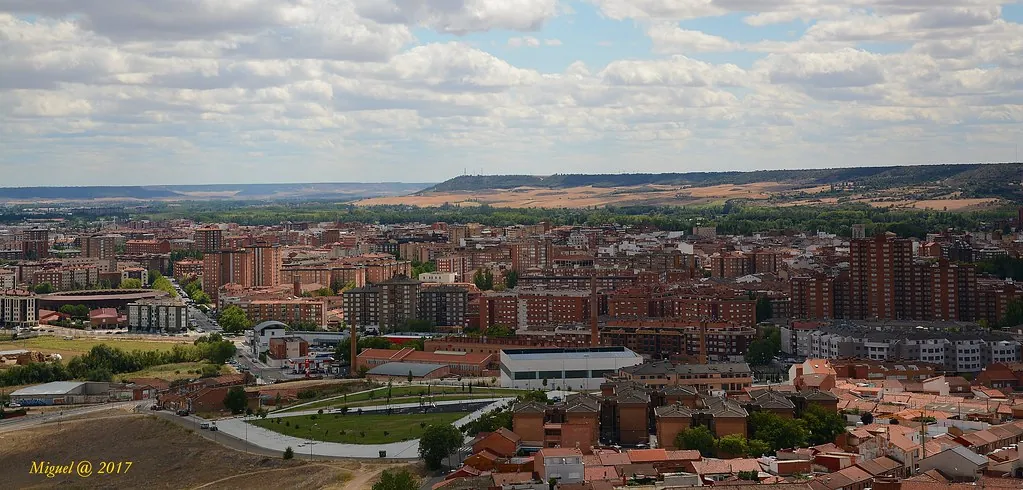
The church bell strikes noon and only eight chimneys smoke. That's already a busy day in Monasterio de Vega, where the population hovers around eighty souls and the altitude sits at 765 metres—higher than Ben Nevis's base, though you'd never guess from the pancake-flat horizon. This is Tierra de Campos, Castile's answer to East Anglia, only sun-blasted and half-empty.
Drive in from Valladolid and the approach road dares you to keep going. Thirty kilometres of wheat, then thirty more. The village materialises like a heat mirage: a single cluster of adobe houses, a squat stone tower, and a sky so wide it feels sarcastic. Park wherever—there's no traffic warden because there's no traffic. The only central square doubles as a threshing floor, ringed by benches that face inward, as if the buildings themselves are curious who's mad enough to arrive.
What Passes for a Centre
The parish church of San Vicente Martir won't win beauty contests. Its walls bulge in different centuries, the tower is more patchwork quilt than bell tower, and the wooden doors hang slightly askew. Yet stand inside at 6 p.m. when the sun drops below the cornice and light stripes the nave through the slit windows. The stone glows amber, the air smells of candle wax from the 1950s, and for three minutes the place feels cathedral-sized. No entry fee, no guard, no postcards—just push the door and hope it isn't locked for wheat storage.
Round the back you'll find the old monastery foundations that gave the village its name. Only a few courses of masonry poke above the grass, fenced off to stop sheep falling in. Interpretation boards? Forget it. Bring imagination or, better, ask the man with the walking stick who appears whenever strangers linger. He'll explain—slowly, in a dialect that turns Latin endings into whole new words—how Cistercian monks drained marshes and planted wheat here in 1146. His family has the receipts, almost literally: yellowing land-registry papers he keeps in a biscuit tin.
Adobe, Adobe Everywhere
Houses are the colour of biscuits too, baked from local clay mixed with straw and optimism. Some crumble politely, walls bowing out like middle-aged waists; others sport fresh cement and PVC windows that squeak when opened. There is no architectural unity, only the unity of function: keep heat out in July, keep it in during January. Roof tiles vary from wavy Moorish terracotta to flat grey slate salvaged after somebody's barn collapsed. Peer over a low wall and you'll spot bodegas—underground cellars—dug into the hillside, their doors barely shoulder-height. Most are padlocked, but the one opposite the bakery stays open; step down three stairs and temperature drops ten degrees. Empty now, yet the air still carries a ghost whiff of last century's wine.
Photographers arrive expecting tumbleweed and leave with memory cards full of texture: cracked plaster revealing fist-sized river stones, iron knockers shaped like tiny hands, a wooden balcony held up by what looks like a pitchfork. The best shots happen at day's first and last hour when the cereal plains throw long shadows and even rust looks golden. Midday sun is merciless; colours bleach to biscuit again and the only subject left is sky.
Walking Routes that Don't Reach the Sea
There is no coastline for 250 kilometres, yet the landscape behaves tidally. Wheat rolls in waves, cloud shadows sail across like boats, and the horizon could be a shoreline except it never gets closer. Three signposted footpaths start from the fountain—though "signposted" flatters two rusted arrows and a sticker for a 1998 fun-run. Choose the 7-km loop south-east and you'll share the track with the occasional tractor and the more occasional hoopoe. The ground is dead-level; stiles don't exist, just gaps where farmers have removed a plank. After rain the soil turns to Velcro, coating boots with ochre paste that dries to concrete in minutes. Summer walkers should carry more water than they think—there's no pub garden waiting at the corner.
Cyclists love the caminos blancos, the unpaved service roads that grid the fields. A mountain bike is overkill; any hybrid tyre suffices. Ride west for an hour and you'll reach Castromonte (population 120, one bar). Order a caña and you'll be charged €1.20 unless the owner decides you look thirsty, in which case it's €1. Return via the disused railway line—tracks lifted decades ago, ballast now a chalky ribbon through the sunflowers. Total distance: 24 km. Total climbing: negligible. Total humans met: likely zero.
Bread, Cheese and the Missing Menu
Forget restaurant hunting; the last full-time eatery closed when the widow running it turned ninety. Instead, time your visit for Saturday morning when the mobile bakery van parks by the fountain at 10:30. Buy the round loaf with the cracked crust—still warm from ovens in Medina de Rioseco—and a slab of local sheep's cheese wrapped in paper that used to be a maths textbook. Total cost: under €6. If the van's late, nobody complains; the driver is probably cousin to half the queue.
For a sit-down lunch, drive 18 minutes to Villalón de Campos. Try La Cuchara de Villalón, where the menú del día (weekdays only) costs €12 and includes a carafe of house wine thick enough to stain the table. They do a leek-and-potato soup that tastes of foggy mornings, followed by roast lamb that hasn't travelled far. Vegetarians get tortilla or… tortilla. Book ahead during harvest—tractor drivers have large appetites and small watches.
When to Bother, When to Skip
Spring arrives late at this altitude; farmers sow in April when the soil finally hits 8 °C. Come then and you'll see storks gliding between newly cut irrigation channels, but nights still dip to 5 °C—pack a fleece. July and August roast. The village thermometer once touched 42 °C, and shade is scarce because the square's only plane tree was pollarded into a stump after a storm. August does host the fiesta patronal: one Saturday of brass bands, portable bars, and a paella pan wider than a grain silo. Accommodation within the pueblo books out six months ahead—book nine or don't.
Autumn brings stubble fires whose smoke drifts across the road like theatrical fog. Photographers love it; asthmatics less so. Winter is raw. At 765 metres frost lingers until noon, and the wind straight from the Meseta finds every gap in British-made clothing. Still, the light is knife-sharp, the wheat stubble rattles like bones, and you'll have the place to yourself bar a retired teacher who walks his greyhound at dawn regardless of temperature.
Beds for the Night-Blind
Staying over means self-catering. Casai.com lists 47 cottages, most converted from grain stores; expect beam ceilings, wood-burners and Wi-Fi that sighs when more than two devices connect. Prices swing from €70 to €220 a night depending on whether the owner discovered designer rusticity. Hotel Astura in nearby Villalón offers conventional rooms for €55 including breakfast—toast, coffee and a stare from the waitress until you pronounce "gracias" correctly. Camping? The municipal plot outside Monasterio has water and a view of the stars so bright it feels intrusive, but no showers. Bring wet wipes and humility.
Leaving Without a Souvenir
There is no gift shop. The closest thing is the bakery's paper bags, which make serviceable bookmarks. Instead, roll down the car window as you depart and listen. At 40 km/h the engine note drops below the wind and you'll hear what residents mean by "the silence of the plain"—a soft hiss of wheat stalks rubbing together, like the sea heard through a conch shell made of soil. No fridge magnet beats that, and it travels free.