Full Article
about Osorno la Mayor
Key transport hub and historic town; noted for its heritage
Hide article Read full article
Between routes and open land
Osorno la Mayor appears in medieval documents as a stopping point in the cereal plains of Tierra de Campos. Its position near old routes linking the Meseta with Spain’s northern coast helps explain how it developed. For centuries it remained a small agricultural settlement shaped by the rhythms of grain खेती, though its past reaches further back. In the surrounding area, Roman remains have been identified in connection with Dessobriga, a settlement that already occupied this strategic space between the Meseta and the Pisuerga valley.
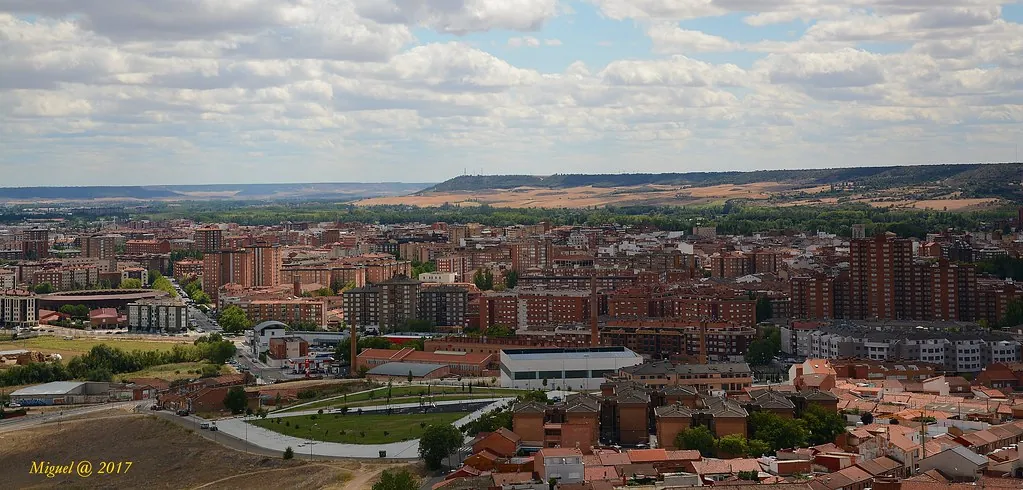
Today the village has around a thousand residents and retains the layout common to many Castilian places that grew around a church and a central square. The streets are wide, designed more for carts and farm work than for dense urban life. The landscape sets the tone. Just beyond the last houses, open fields begin and stretch across Tierra de Campos.
Landmarks and traces of history
The main visual reference is the Iglesia de Nuestra Señora de la Asunción. The current building dates from the late fifteenth to the sixteenth century, a period when many parish churches in the area were expanded thanks to agricultural prosperity. It combines late Gothic elements with later alterations. Its solid tower, clearly visible across the flat terrain, still serves a basic purpose once essential in Meseta villages: orientation.
Inside, there is usually a collection of altarpieces and liturgical objects from different periods. Works from the seventeenth and eighteenth centuries are common, when Baroque decoration gradually replaced earlier structures in many Castilian churches. The building’s interest lies less in its size and more in what it reveals about local history.
A little way outside the centre stands the Ermita del Cristo. These peripheral chapels often reflect long-standing devotions and traditional pilgrimages that link the village with the surrounding countryside. Its architecture is simple, built with local materials and intended more for occasional gatherings than for daily worship.
Walking through the centre, you come across houses with stone coats of arms on their façades. These are traces of families who held land or local positions in earlier centuries. They do not form a monumental ensemble, yet they hint at periods of relative economic stability tied to cereal production.
Beyond the built area, scattered along the tracks, there are traditional dovecotes. In Tierra de Campos they were an essential part of rural life. Pigeons provided meat and, importantly, droppings used to fertilise the fields. Many are now abandoned, but their circular or square forms still punctuate the landscape.
Walking the plains
The surrounding area is best understood on foot or by following the agricultural tracks that lead out of the village. The routes are flat, passing through large plots of land with wide horizons. In spring the cereal turns the fields green. In summer, after the harvest, the land returns to the dry tones often associated with the Meseta.
In these open spaces, bird species adapted to steppe-like environments can still be found. They are not always easy to spot, but they form part of the ecological balance of fields that have been cultivated for centuries.
Festivals and shared traditions
The main celebrations follow the traditional religious calendar. Around 15 August, during the feast of the Assumption, the village often sees its population rise for a few days as many former residents return.
There is also a pilgrimage connected to the Cristo, linking the parish church with the chapel on the outskirts. These events are simple and community-focused, shaped more by local participation than by any aim to attract visitors.
A place to read the landscape
Osorno la Mayor can be explored without hurry in a short time. What stands out is how directly the village opens onto the countryside, and how its architecture reflects an agricultural way of life. For those interested in ancient history, it is worth looking into the nearby site of Dessobriga before visiting. It provides context for why this part of Tierra de Campos has been inhabited for so many centuries, and helps make sense of a place where landscape and history remain closely linked.