Full Article
about Palencia
Quiet, monumental provincial capital on the banks of the Carrión River; famous for its Cristo del Otero and its Gothic cathedral known as La Bella Desconocida.
Ocultar artículo Leer artículo completo
The storks arrive at dusk, long legs folding as they land on the cathedral’s medieval gutters. From the Plaza de la Inmaculada the birds look almost ornamental—until one croaks, guttural as a heron, and reminds you that this is still a working Spanish city rather than an open-air museum. At 749 m above sea level on the high northern plain, Palencia feels the wind first: it sweeps across the Tierra de Campos, rattles the poplars along the Carrión River and keeps the summer heat bearable for anyone walking between Romanesque towers.
A town that forgot to shout
Palencia’s marketing budget never matched its monuments. The regional tourist board likes to call it “la bella desconocida”—the beautiful unknown—but the phrase is more apology than boast. Seventy-six thousand people live here, enough for a proper market, a proper theatre and a proper railway station, yet coach parties still barrel past on the A-67 towards Santander or Madrid. The upside is elbow room. On an average Tuesday you can stand alone in the crypt of San Antolín cathedral, seventh-century Visigothic stones lit by a single coin-fed spotlight, while the guard ambles outside for a cigarette.
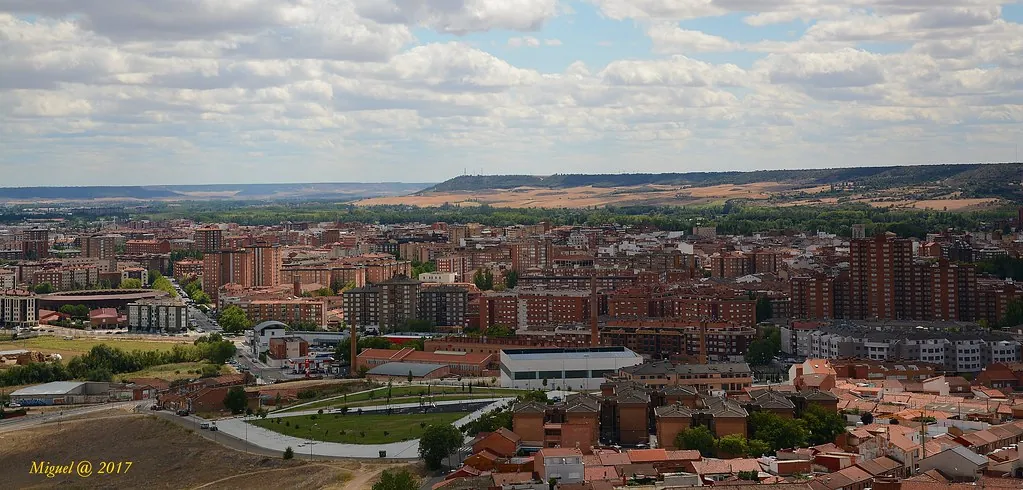
The cathedral itself is not classically pretty: a grey bulk patched over six centuries, the west façade never quite finished. Step inside, pay the €7 ticket, and the scale flips. Fifteenth-century Flemish panels, a Greco canvas of the Virgin (smaller than expected, darker, better) and a choir whose carved misericords include a nun sneaking sips of wine. Climb the narrow stair to the cloister roof and the city spreads flat as a map—ochre tiles, modernist shopfronts on the Calle Mayor and, beyond, the wheat ocean that paid for it all.
Stones, wheat and a giant Christ
Head north up the Cerro del Otero and the wheat follows you. Twenty minutes of steady gradient (trainers sufficient, no hiking poles required) brings you to the feet of the Cristo del Otero, Victorio Macho’s 20-metre concrete Christ. The sculpture divides opinion: some see serene modernism, others a 1930s electricity pylon with a face. Either way the summit is the only place in town where the plain finally breaks; on a clear day you can clock the steelworks at Valladolid 45 km away. Take a jacket—when the Atlantic weather front rolls in you’ll understand why locals joke that Palencia has nine months of winter and three of hell.
Back at river level the Carrión offers shade and a different pace. The Paseo del Salón, a plane-tree avenue laid out in 1789, fills with office workers at lunchtime clutching paper-wrapped pork sandwiches. Cyclists spin along the Canal de Castilla towpath—built in 1753 to haul grain to the sea, now a quiet green corridor where herons outnumber barges. Rent bikes from the shop behind the bullring (€15 half-day; passport as deposit) and you can pedal 14 km north to the first working lock at Herrera de Pisuerga, returning by rail if legs give up.
Romanesque overload—proceed with a plan
Palencia province claims one of Europe’s densest Romanesque belts, and the capital is the logical base. The problem is saturation: after the fifth weather-worn apse even dedicated church-spotters glaze over. Be selective. Taxi out (€22 fixed daytime fare) to San Juan de Baños, oldest church in Spain, 7th-century Visigothic with later Romanesque sleeves; Wednesday free, otherwise €2 and they close for siesta at 13:30 sharp. Further south, the Villa Romana La Olmeda mosaics are the equal of anything in Córdoba—hypocaust floors, leopard hunts, a 30-metre dining room—yet you’ll share them with a handful of Spanish retirees and an English audio guide that actually works. Allow an hour, then drive on to Saldaña for coffee; the local pastry there, hojaldre de cabello de ángel, is worth the sugar crash.
Inside the city ring-road the itinerary can be walked in a lazy two-hour loop: San Miguel (twelfth-century, squat tower like a castle keep), San Francisco (Gothic, now used for art exhibitions) and the Convento de San Pablo, its façade so frilly it resembles alabaster lace. Drop into the Museo de Palencia on the way; the ground-floor Roman gold and dusty nineteenth-century portraits are skip-able, but the upper gallery of rural Romanesque capitals—sheep, lions, a bishop being bitten on the bottom by a dragon—explains why these stones matter.
Eating without the tour-group mark-up
Meal times are orthodox: breakfast until 11, lunch 14:00–16:00, supper 21:00 onwards. If you absolutely must eat at 18:00, the Chinese on Plaza de Abastos will serve you; otherwise join the queue at Gloria Bendita, where the chef updates Castilian classics—migas with apple and bacon, leek-and-raisin empanadilla—without charging city-break premiums. Menú del día in the side streets runs €12–15 and usually includes a half-bottle of wine; look for hand-written whiteboards rather than laminated photos. Vegetarians survive but do not flourish: the province’s idea of a green salad is still lettuce, tinned asparagus and a cathedral of tuna. Coeliacs are better catered for—El Perejil labels gluten-free dishes and stocks wheat-free bread if you ask the day before.
Market days (Tuesday, Thursday, Saturday) turn the Plaza de Abastos into a brief carnival. Old women in housecoats haggle over purple garlic; one stall sells only cheese from three family farms—try the pata de mulo, a buttery sheep cheese that oozes if left in a rucksack. Picnic supplies secured, head to the Jardines de la Huerta del Guadián: lawns, drinking fountains and enough shade to contemplate the cathedral tower while finishing the last of the wine. Public drinking is tolerated if discreet; glass bottles are frowned upon, so decant into plastic like everyone else.
Getting there, getting out
Palencia sits on the Madrid–Santander railway line. The fast Alvia from Chamartin takes 1 h 20 min, fares from €24 each way if booked a fortnight ahead. Drivers leave the A-67 at junction 25; the city is 40 minutes south of Santander airport, handy for evening Ryanair hops. Parking in the blue-zone centre costs €1.20 per hour weekdays, free after 14:00 Saturday and all Sunday. Accommodation is sensible rather than sensational: the three-star Hotel Castilla Canal (doubles €65–80) has river views and underground parking; the newly opened Sercotel Rey Sancho, in a converted nineteenth-century bank, adds rooftop drinks and weekday single rates at €55.
Stay a night, perhaps two. Use the second to drive the back roads of Tierra de Campos, stopping wherever a Romanesque bell-tower pops out of the wheat. Palencia will not hand you Insta-ready photo ops; it offers instead a calm index of Spanish life—unhurried, largely untainted, mildly indifferent to whether you turn up or not. That, in the end, is its appeal.


