Full Article
about Piña de Campos
A Camino de Santiago village with a grand church that looks like a cathedral; known for its museum and Jacobean hospitality.
Ocultar artículo Leer artículo completo
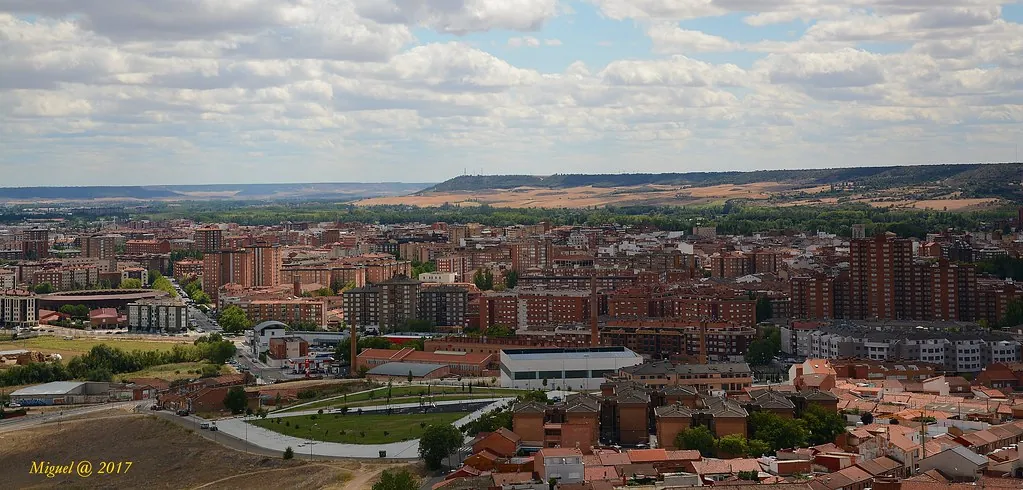
The church bell strikes noon, and the only other sound is wheat rustling in the breeze. At 760 metres above sea level, Piña de Campos sits high enough that the horizon seems to bend, stretching golden cereal fields until they blur into blue. Two hundred souls call this home—fewer than most British secondary schools—yet the village has endured since medieval farmers first broke the tough Castilian soil.
The Arithmetic of Empty Spain
Drive north from Palencia city for forty minutes on the CL-613, and the maths becomes stark. Each kilometre brings fewer people, more sky. Piña de Campos loses roughly five inhabitants every year to pensions that arrive faster than paychecks. The secondary school closed in 2008; the last grocery shut two years later. What remains is a working timetable written by tractors and harvesters. Visit in mid-July and you'll share the main street with combine harvesters wider than the terraced cottages they pass. Come in February, and the same street is silent enough to hear your boots crunch on frost-rimed gravel.
This is Spain's España Vacía, the Empty Quarter commentators wring hands over. Yet emptiness has its own grammar. Adobe walls two feet thick regulate summer heat; bread ovens built into house gables still smoke each Friday. Even the palomares—dovecotes shaped like fat cigars—serve a purpose, their limestone droppings sold to allotment holders in Valladolid for €3 a sack.
What the Fields Remember
The parish church of San Pedro doesn't do postcards. Its Romanesque doorway is plain, the bell-tower patched with brick where stone once stood. Inside, the air smells of beeswax and mouse droppings. A 17th-century fresco of Saint Christopher carries river fish that look suspiciously like Yorkshire carp—the artist had clearly never seen a crocodile. The priest visits fortnightly; between times, the key hangs in the bar opposite, given willingly to anyone who asks for "la llave, por favor".
Walk the grid of three streets and patterns emerge. Houses alternate stone-adobe-stone because quarried limestone cost more than mud mixed with straw. Wooden balconies are narrow—timber was freighted by mule from the Montaña Palentina, 80 km north, and priced by the cartload. Even the 1950s telephone box is brick, a Franco-era refusal to import British red ironwork.
Outside the village, footpaths follow medieval drove roads. One track, the Cañada Real Leonesa, runs 12 km east to the abandoned hamlet of Oteros. Markers exist only as vertical stones every half-kilometre; miss one and you'll understand how Castilian armies got lost en route to Lisbon. Take water—there's none between here and there, and July temperatures touch 36°C.
Bread, Lamb and the Tyranny of the Wood-Fired Oven
Gastronomy is dictated by altitude and aridity. Wheat thrives; vegetables sulk. The weekly bread cycle starts Tuesday when Conchi lights the communal oven behind the Ayuntamiento. Dough proofs overnight in pillowcases; by 6 a.m. Wednesday, loaves the size of steering wheels emerge with crusts thick enough to gravel a driveway. Cost: €1.80 if you brought your own dough, €3.50 for one of Conchi's. She also sells hornazo—a pork-and-egg pie originally baked for fieldworkers who wouldn't see the village until sunset.
Meat arrives on Thursday's mobile van. Leg of lamb is €14/kg, cheaper than Tesco yet twice the price of Palencia's supermarket. Locals mutter about madre—the matriarch who still weighs joints on a 40-year-old scale and remembers every unpaid tab. Vegetarians face the potato omelette at Bar El Pósito or a 30-minute drive to the nearest Carrefour.
The summer fiesta (15 August) is the only time food becomes spectacle. Lambs rotate on spits in the plaza; the smell drifts into fields where harvesters work overtime to finish before the Día de la Asunción procession. Visitors are handed chunks of meat on waxed paper—no tickets, no wristbands, just an expectation you'll buy rounds of clarete (the local rosé) at €1.20 a glass until you can't remember where you parked.
Practical Notes for the Stubborn Traveller
Getting here: No railway. From Santander ferry port, it's 180 km south on the A-67 and CL-613. Petrol stations thin out after Aguilar de Campoo—fill up. In winter, carry snow chains; the final 8 km climb to 760 m can ice over despite the region's "plateau" reputation.
Where to sleep: There isn't a hotel. The casa rural Los Cuetos (three doubles, €65/night) books up with bird-watchers in April and harvest contractors in July. Owners Juanjo and Marisol live next door; they'll lend wellies but expect you to strip beds on departure. Alternative: Palencia city (35 km) has the four-star Hotel Sercotel Rey Sancho, often under €70 mid-week.
Birding without the brochure: Great bustards display 3 km south towards Amusco at dawn, March–May. Take the dirt track opposite the cemetery; park after the irrigation pivot. Binoculars essential—Spanish landowners still shoot first and ask questions later if you stride across unmarked cereal.
Weather honesty: Spring brings 25°C days and 5°C nights—pack like the Peak District in May. August tops 38°C; shade is scarce, and the plaza fountain runs dry after three rainless weeks. Winter sinks to –8°C; the only heating in the bar is the coffee machine.
Piña de Campos will not change your life. It offers instead a calibration device: how much silence can you stomach, how straight can you walk after two claretes, how long before you crave a curry house? Stay three days and you'll leave with wheat chaff in your pockets and a new definition of horizon. Stay three months and the village will have renamed you—el inglés who once asked for directions to nowhere in particular.