Full Article
about Quintanilla del Olmo
Tiny Tierra de Campos village with rural charm; noted for its quiet and traditional architecture.
Ocultar artículo Leer artículo completo
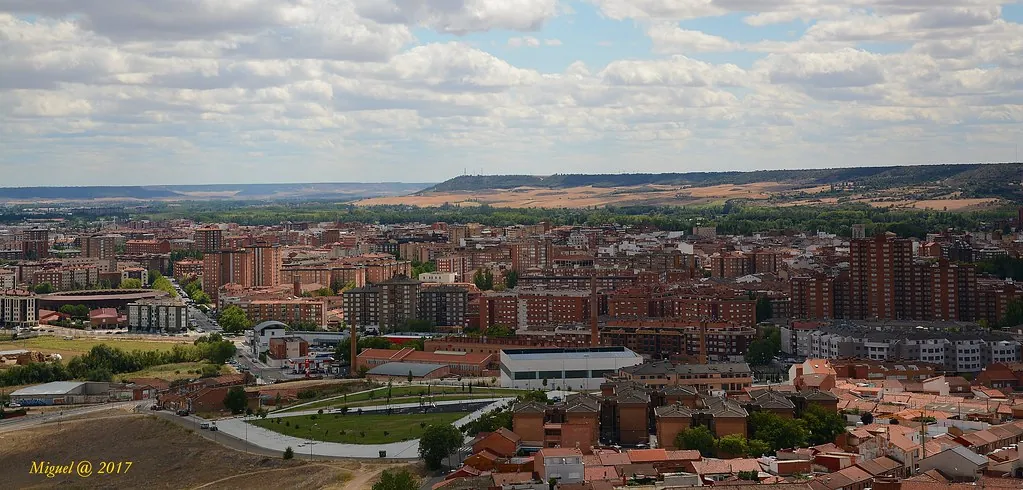
The church bell strikes noon and nobody appears. Not a soul. Just swallows slicing through the thin air at 691 metres, and the low hum of a tractor somewhere beyond the wheat. Quintanilla del Olmo doesn't do dramatic arrivals—no castle keep, no cliff-edge mirador—yet the emptiness stops you in your tracks. Stand on the single tarmac lane that doubles as the village high street and you can turn through 360 degrees without meeting a wall, a tree, or another human. Only barley, wheat, sky.
This is Tierra de Campos, the "Land of Fields" that fans out across southern León and northern Valladolid. Motorists blast through on the A-62 to Salamanca, unaware that barely ten minutes north of the motorway the tarmac shrinks, the phone signal flickers, and villages like Quintanilla survive on grain, pensions, and stubbornness. The 2008 crash halved the population; today the ayuntamiento lists 27 permanent residents, though locals say the true figure is nearer twenty if you discount the people who keep their names on the padron for tax reasons.
Adobe, Brick, and the Slow Retreat
The built fabric is what estate agents would call "authentic" and conservationists call "endangered". Adobe walls—mud mixed with straw and lime—bulge peacefully beneath red-tiled roofs. Some houses still carry the hand-painted house numbers applied during the 1960s census: cobalt blue, the brushstrokes visible. Walk Calle de la Iglesia at dusk and you pass four inhabited dwellings, eight boarded-up, and two that have already slipped into rubble, the roof beams splayed like broken ribs. There is no souvenir shop, no interpretation board, not even a bench. The village's entire public furniture consists of one stone trough, one litter bin, and the iron cross erected for the 1941 agricultural festival.
What keeps the place photogenic is the colour wheel of cereal farming. Visit in late April and the fields glow emerald; poppies puncture the green with red exclamation marks. By mid-July the same land has bleached to parchment, the ears heavy enough to whisper when the wind lifts. In October the stubble resembles a military buzz-cut, and the soil waits for the next rotation. The only vertical punctuation comes from the sixteenth-century church tower and, half a kilometre south, the brick chimney of the old flour mill—now a barn for pigeon fancying.
Birds, Bikes, and the Art of Not Getting Lost
Serious walkers sometimes sniff at Tierra de Campos—too flat, they complain, too samey. Try saying that after cycling 40 km into a headwind that smells of baked straw. The GR-14 long-distance path skirts the village, but the real pleasure lies in the unsigned farm tracks that link Quintanilla with Villalón de Campos (11 km east) and Castromonte (7 km west). These are stone tracks graded twice a year by the cooperatives; a sturdy hybrid bike copes fine, though skinny tyres will pinch-flat on the flints. Carry water: the only bar closed in 2016 when Concha retired and nobody took over.
Ornithologists arrive with clearer expectations. The steppe-like plains hold Spain's last decent population of great bustards—those ponderous birds that look like Victorian judges in wigs. Dawn from the Villafáfila reserve (25 minutes by car) gives the best chance, but even from the village edge you can pick out Montagu's harriers quartering the crop, and in May the lesser kestrels nest in the church tower, oblivious to the tiny congregation inside. Bring a scope; the birds are approachable, but the heat haze shimmers by 10 a.m.
Eating: Bring Your Own Everything
There is no shop, no bakery, no Saturday market stall. The lone vending machine in the plaza stocks water and cans of Aquarius; it broke last winter and the distributor still hasn't come. Self-caterers stock up in Villalón de Campos (Consum supermarket, open 9–9, closed Sundays). If you want the full field-to-fork routine, the cooperative at Castromonte sells 5 kg sacks of local lentils—small, mottled green, €6—and chorizo from the mobile butcher who visits fortnightly. Otherwise, the nearest menu del dia is at Bar La Plaza in Villalón: €11 for three courses, wine included, lunch only, finished by 4 p.m.
When to Come, When to Stay Away
Spring and autumn give the kindest light and temperatures that British bones recognise—15 °C at noon, sweater weather at night. Summer is furnace-hot; 38 °C is routine, shade is scarce, and the only swimming option is the public pool at Villalón (€2, open July–August). Winter brings hard frosts and the occasional dusting of snow that melts by lunchtime. Roads are gritted promptly—grain lorries need access—but if a northerly gale coincides with sleet, the exposed lanes ice over fast. Carry blankets, not just because of the weather but because a fallen tree can block the only road out for hours.
Accommodation is the deal-breaker. Quintanilla itself has no hotel, no casa rural, not even a room to rent. The closest beds are in Villalón: Hotel Camino de Santiago (two-star, €45 double, decent coffee) or, five minutes further, the slightly smarter La Casona de Castromonte (restored manor, €80 double, dinner on request). Campers sometimes wild-pitch by the harvested field south of the village; farmers tolerate it if you ask at the first house with lights on and leave no trace. Otherwise, Valladolid is 45 minutes by car and offers everything from student hostels to five-star chains.
Fiesta Days, When Silence Breaks
August 15 brings the fiesta patronal. The population swells to perhaps 120 as grandchildren and great-grandchildren return. A sound system appears in the plaza, playing Spanish eighties rock at neighbour-waking volume. There's a communal paella at midday (€5 donation, bring your own bowl), a sack race for under-tens, and a mass at 7 p.m. followed by bingo with hams for prizes. By midnight the last generator coughs into silence and the village exhales back into hush. Semana Santa is quieter: a procession of twelve people, one drummer, one statue of the Virgin wrapped in a black shawl, shuffling through streets lit only by handheld candles. Even if you understand no Spanish, the creak of leather sandals on adobe sounds ancient.
Getting Here Without Tears
Fly to Valladolid (Stansted, twice weekly with Ryanair, 2 hrs 15 mins). Hire cars sit directly outside the terminal; ignore the hard sell for satellite navigation—the rural roads aren't on many maps anyway. Take the A-62 towards Benavente, exit 79 for Villalón, then follow the ZA-701 north for nine kilometres. Public transport exists, but only just: one morning bus from Valladolid arrives at 11:37, the return leaves at 17:05. Miss it and you're spending the night in the fields.
Worth It?
Only if you're comfortable with your own thoughts. Quintanilla del Olmo offers no postcard moment, no fridge-magnet epiphany. It gives you instead the rare sensation of geographical slack—land that hasn't been scheduled, monetised, or branded. Stand beside the stone trough at sunset, phone battery dead, no bar to retreat to, and you realise the place is testing you: can you savour space itself? Fail the test and you'll be bored within an hour. Pass it and the quiet becomes addictive, a blank canvas for whatever you need to unpick in your head. Just remember to fill the petrol tank and buy emergency crisps before you arrive.