Full Article
about Revenga de Campos
A town on the Camino de Santiago, known for its church and the monolith to General Amor; a regular stop for pilgrims.
Hide article Read full article
The church bells in Revenga de Campos sound heavier in the winter air, a deep toll that travels far over the flat land. By late afternoon, the low sun hits the side of the adobe walls, turning the unbaked earth a soft gold against the grey of the fields. You hear a tractor long before you see it, a distant hum that eventually appears as a small, moving speck on a line between two expanses of bare soil.
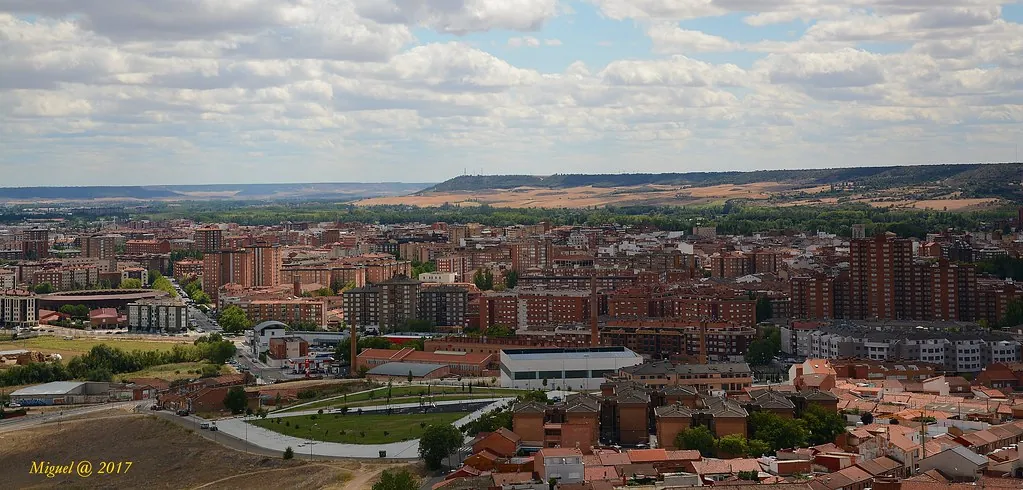
This is Tierra de Campos in Palencia. The village sits at 780 metres on a plateau where the wind has a clear path. The horizon is a straight cut, broken only by the occasional pajar or a line of poplars so far away they look like stitches on the seam of the sky. The population, around one hundred and twenty-seven, means the streets are quiet. The soundscape is made of closing doors, distant engines, and that wind pushing against tiled roofs.
San Adrián and the village fabric
The parish church of San Adrián anchors the small square. Its construction is typically Castilian, a mix of stone and brick from the 16th century with visible repairs from later periods. The door is often closed. What holds attention here isn't the monument itself, but how it fits into the village fabric: the broad wooden gates of the houses next to it, the worn stone curbs, the courtyards visible through archways that still smell of damp earth and stored grain.
The layout is simple. A few streets—Calle Real, Camino de la Mota—lead past houses with ochre and whitewashed walls. Some are carefully restored, their shutters painted a deep green. Others show the original adobe, cracked and weathered. You’ll see old wine cellars dug into the ground, their iron grates covered in rust, and outbuildings with roof beams darkened by time. There is no marked route. You just walk until you reach the last house and the open land begins.
The colour of the fields
Outside the village, the landscape asserts itself. This is working farmland, not a preserved vista. Its beauty is seasonal and stark. In April, the green is almost overwhelming, a vast sheet of young cereal. By July, it’s a brittle yellow under a white sky, the earth cracking underfoot. After the harvest, the palette turns to ochre and burnt umber, with black strips of freshly turned soil.
The light changes everything. A cloud passing over can turn a single field from bronze to grey in minutes. The best time to walk is early morning or that last hour before sunset, when the shadows stretch long and the temperature drops. Bring a layer; that steady wind is cold even in spring.
With patience, you might spot wildlife adapted to this openness. Great bustards are out there, though seeing one requires luck and good binoculars. More common are skylarks rising in song from the barley, or a harrier cruising low over the stubble. Observe from the farm tracks. Do not walk into the crops.
Moving through the plain
The farm tracks are your trails. They run straight for kilometres, flanked by drainage ditches and wire fences. They are perfectly flat, suitable for a slow walk or a bike ride where your only challenge will be the wind. This is crucial to understand: distance is deceptive here. A village that looks reachable may be an hour’s walk away. In summer, there is no shade. Carry water.
The tracks connect to other small villages—Villalcázar de Sirga, Carrión de los Condes—each with more pronounced historical architecture. Revenga is often a pause between them. The visit is short: maybe an hour to feel its rhythm, to stand at its edge where the pavement ends and the earth begins.
A practical pause
Services in Revenga are minimal. Plan to eat in those larger towns nearby. The local cuisine is a direct reflection of this land: soups of garbanzos or lentejas, roast lamb, and sheep’s milk cheeses that taste of herbs and pasture.
Come on a weekday if you can. The silence then is profound, broken only by farm work or birdsong. Weekends might bring a few more cars, voices from an open window. The experience here is about subtraction, not addition. It’s about space, light, and the slow turn of the agricultural year written across a thousand hectares of plain. You either find something in that simplicity, or you don’t. Revenga makes no effort to convince you otherwise