Full Article
about San Cebrián de Campos
A Terracampo town with a magnificent Gothic church declared a National Monument, noted for its tower and altarpieces.
Ocultar artículo Leer artículo completo
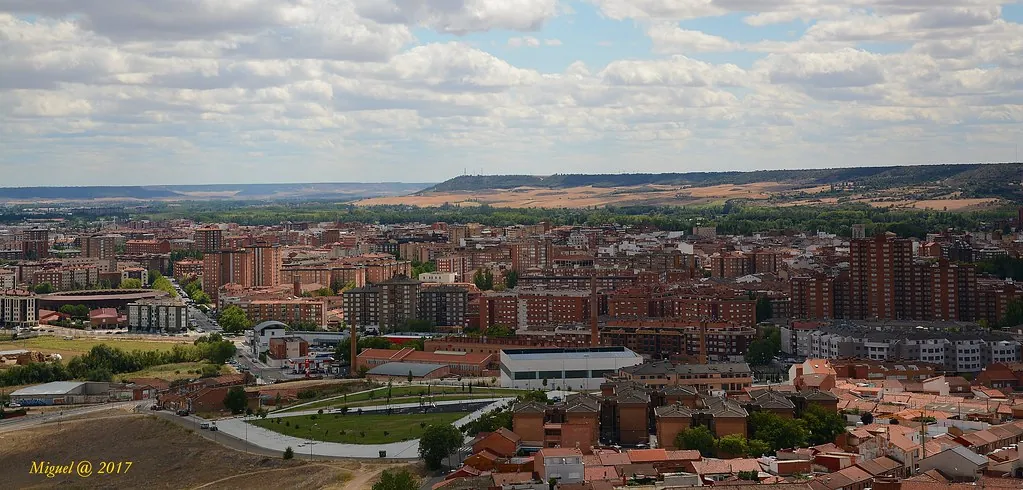
The church bell strikes noon, yet nobody hurries. An elderly man leans against a sun-warmed adobe wall, watching his grandson kick a football across the dusty plaza. In the distance, a combine harvester crawls across an ocean of wheat that stretches so far the horizon blurs into a shimmer of gold. This is San Cebrián de Campos, 790 metres above sea level, where Castilla y León's vast Tierra de Campos plateau keeps its own unhurried time.
At roughly 400 inhabitants, the village feels suspended between centuries. Adobe houses with stone doorways—some restored, others gently crumbling—line narrow lanes wide enough for a single tractor. Their terracotta roofs glow amber against skies so big they seem to bend at the edges. The altitude brings sharp mornings: even in May, dew can silver the wheat stalks, while winter nights drop well below freezing and summer midday heat regularly tops 35 °C. Bring layers, whatever the season.
The Church that Anchors the Plain
Every settlement here circles its church, and San Cebrián is no exception. The parish of San Cebriano, built from the region's scarce stone and plenty of brick, rises solidly at the village centre. Walls are almost a metre thick; inside, the air smells of candle wax and centuries of grain dust carried in on farmers' boots. Opening hours are informal—if the wooden doors are shut, ask in the bar opposite; the key normally hangs behind a jar of pickled anchovies. Entry is free, but a €1 coin in the box helps with roof repairs. Climb the short tower (guide on request) and the plateau folds away in every direction: a chessboard of brown, green and gold that makes the village look like a ship adrift on a cereal sea.
Adobe architecture fans should wander Calle La Era and Calle El Pozo. Number 14 La Era still carries a 1789 datestone above its lintel; next door, a former grain store has been converted into a weekend house for a Valladolid family who arrive with supermarket supplies and two nervous spaniels. Peer over the low wall by the abandoned school and you'll see a half-collapsed bodega: stone steps descend to underground cellars once used for storing wine and potatoes. Restoration grants trickle in, but money is tight; expect gaps-toothed streetscapes rather than polished theme-park perfection.
Walking the Wheat
The village sits on a spider-web of caminos rurales, ancient rights-of-way linking farmsteads to fields. Head south on the track signed "Ermita 3 km" and within ten minutes the settlement shrinks to a smudge. Larks rise and fall, and the only sound is the wind combing through barley. The ermita itself—a tiny 16th-century shrine to the Virgin—is usually locked, yet the picnic table beneath its elm is reliable shade. Carry water; the flatness is deceptive and July sun reflects off pale soil like a mirror.
Cyclists can follow the gravel service road along the Canal de Castilla, eight kilometres north. Completed in 1849, the waterway once carried grain to Bilbao; today its poplar-lined towpath offers one of the region's most gentle bike rides. Rent bikes in Frómista (€18 a day from the shop opposite the 11th-century church of San Martín) and pedal west to the triple locks at Palenzuela, stopping to watch herons stalk the canal's mirror-bright water.
What to Eat and Where
San Cebrián itself has one bar, Casa Galo, open Thursday to Sunday. Inside, the television murmurs the agricultural channel and a wood-fired cooker warms the room even in August. Order the sopa castellana (€6): garlic, paprika, ham bone and a poached egg soaking into rough bread. The lechazo—milk-fed lamb roasted in a clay dish—feeds two and costs €22, but phone ahead (979 80 10 09) because Galo's wife only buys half a lamb when she knows customers are coming. Beer comes in 33 cl bottles; local red wine from Cigales arrives in a chipped jug and costs €2 a glass. If the bar is shut, drive 12 minutes to Frómista where Aire de Castilla does a competent menú del día for €14, including wine and coffee.
Shopping is similarly low-key. A mobile butcher parks in the plaza every Tuesday morning; fruit and veg van arrives Friday at eleven. The nearest supermarket is in Paredes de Nava, 18 km south—stock up before you arrive if you're self-catering.
When the Fields Turn Gold
Come in late June and the wheat changes overnight from green to bronze. Harvesters work under floodlights, giving the scene an industrial ballet quality. Sunsets arrive slowly, staining the sky peach until well after ten o'clock. By mid-August the straw is baled and the plateau looks shaved; dust hangs in the air and temperatures stay above 30 °C well past dusk. Spring—April to mid-May—brings green shoots and migrating storks, but also the risk of abrupt downpours that turn clay paths to glue. Autumn can be perfect: clear, sharp air, empty lanes and the smell of freshly pressed grape must drifting from village cooperatives. Winter is stark, often beautiful, yet daylight is short and north-easterly winds slice across the plain; some rural guesthouses close from November to March.
A Base, Not a Destination
San Cebrián works best as a quiet hub for a slower road trip. Within 30 minutes' drive you can reach the Mudéjar tower at Támara de Campos, the private palace-cum-museum at Ampudia (guided tours €7, closed Mondays), or the Romanesque frescoes in Villalcázar de Sirga. All charge modest entry fees and see a fraction of Burgos or Salamanca crowds. Check opening times online the night before; smaller churches open only when the key-keeper's television schedule permits.
Back in the village, evening unfolds simply. Swallows gather on telephone wires, the bar's lights flick on, and someone tunes a radio to the regional lottery draw. There are no boutiques, no cocktail lounges, no Instagram moments—just the high-plains soundtrack of dogs barking, wheat rustling and, if you listen carefully, your own pulse slowing to match the rhythm of Tierra de Campos. Bring a book, sturdy shoes and an appetite for lamb. Anything else feels excessive here.