Full Article
about Valdescorriel
A Terracampo village with farming and livestock traditions, noted for its church and typical mudéjar-style architecture.
Ocultar artículo Leer artículo completo
The church bell strikes noon and nobody appears. Not a single shop door opens, no chatter drifts from behind the green-shuttered windows. At 730 m above sea level, on a ridge that feels more like the roof of Castilla y León, Valdescorriel keeps its own timetable. Visitors who arrive hoping for a quick coffee will discover that the last bar closed years ago; the nearest espresso is 17 km away in Villalpando. Bring a thermos, or better still, bring patience.
A horizon drawn with a ruler
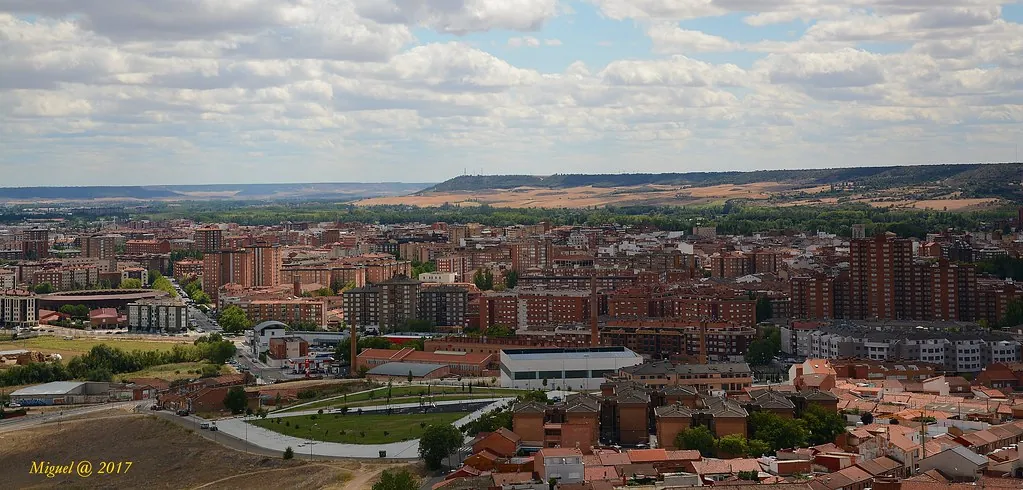
The village sits in the middle of Tierra de Campos, the historic bread-basket province that once fed imperial Spain. Every road in, whether you approach from Zamora, León or Valladolid, cuts through a grid of wheat and barley that runs ruler-straight to every compass point. In late June the fields glow the colour of burnt sugar; by August they have been shaved to stubble and the earth shows its true, pale face. Wind is the only reliable crop here: it scours the ridge all year, lifting the soil into ochre clouds that powder white-washed walls the colour of weak tea.
Adobe and tapial – mud brick and rammed earth – are still the dominant building materials. Some houses stand askew, their walls bulging like old sailors, yet they hold. Others have been patched with modern brick and concrete, creating a patchwork that historians call “ver-nacular honesty” and passing drivers simply call “scruffy”. Either way, the effect is hypnotic. Walk the single main street slowly and you will notice how each dwelling has shortened itself over centuries: doorways have sunk three steps below street level as the lane was resurfaced again and again with compacted straw and threshing waste.
What passes for landmarks
The parish church of San Miguel rises at the highest point, a chunky tower with a pyramidal roof clad in glazed tiles the colour of bruised plums. The door is usually locked – the priest arrives from a neighbouring village twice a week – but the key is kept in the bakery opposite (now a private house, knock twice and ask for Señora Feli). Inside, the nave is narrower than a London bus and the walls carry faint traces of fifteenth-century fresco: ochre ribs of faux vaulting that fooled nobody even when new. The altarpiece is neo-baroque, gilded in 1897 after the original was stripped during the first Spanish Republic. Look closely and you can still see axe marks on the wooden base where the carver lost patience with a stubborn knot.
Outside the village, circular dovecotes punctuate the fields. Known locally as palomares, they were built to house pigeons whose droppings fertilised the thin soils. Most are now hollow shells; one has been converted into an optimistic holiday let with a solar panel glued to its conical roof. The track leading to it is sign-posted “0.8 km” in letters that peel like sun-burnt skin. A farm dog may escort you, barking at every stride; carry a crust of bread and the performance ends in wagging surrender.
Walking the campos
The GR-14 long-distance footpath skirts Valdescorriel on its way from Benavente to Medina de Rioseco. The stage is pancake-flat, but at 25 km it is longer than it looks. Carry more water than you think necessary – the only fountain between villages ran dry in the 2012 drought and has never been repaired. Shorter loops exist: a 7 km circuit south to the ruined hamlet of Corrales de Valdescorriel, where storks nest on the roofless chapel, and a 4 km northward stroll to the irrigation canal built by prisoners during the 1940s. Both tracks are signed with finger-posts whose paint has faded to the colour of dried blood; GPS is useful, though the worst that can happen is an extra kilometre of wheat.
Spring brings calandra larks, their song like a pocket-watch being wound; autumn brings common cranes in loose skeins that sound like distant trumpets. Between migrations the silence is so complete that your ears invent noises: the rasp of your own pulse, the whisper of wheat brushing your trousers, the metallic click of a harrier’s wing overhead. Sunrise and sunset are spectacular, but not in the postcard sense; instead, the land becomes a negative, black soil against molten sky, until you feel you are walking on the roof of the world.
Eating and sleeping (or not)
Valdescorriel has neither hotel nor restaurant. The ayuntamiento keeps a list of three village houses that rent rooms informally – expect lace bedspreads, a crucifix above the headboard and a bathroom down the hall. Price is usually €35 a night including breakfast: instant coffee, packaged sponge cake and, if you are lucky, fresh sheep’s-milk cheese still warm from the pot. For supper you must drive: Villalpando has two decent asadores where a plate of roast lechazo (milk-fed lamb) costs €18 and arrives with a wine that tastes of tin and sunshine. Book ahead at weekends; entire extended families descend from Valladolid to celebrate baptisms and first communions.
The village shop closed in 2009. The mobile grocer’s van rattles in on Tuesday and Friday at eleven, honking like a goose. Stock is random: tinned squid, cola, nappies, courgettes, lottery tickets. Locals treat it as a social club; tourists may find themselves holding three cucumbers they never wanted while someone’s grandmother explains, very slowly, how to cook them with onion and paprika.
Fiestas that almost happen
The patronal fiesta honouring the Virgen del Rosario is held on the nearest weekend to 7 October. The population swells to perhaps 300 as former residents return from Madrid, Barcelona, even Bradford. A sound system is dragged into the square, plastic tables appear and everyone eats cocido, a chickpea stew so thick the spoon stands upright. At midnight a disco starts; by two o’clock the older generation have retreated indoors and the younger ones dance to Spanish reggaeton that thumps across the fields like distant artillery. Fireworks are modest – a single rocket, a Catherine wheel that spins itself into the earth – but the sky is so dark that even a sparkler feels extravagant. By Monday lunchtime the village is empty again; only the smell of gunpowder and stew lingers, trapped in the fibres of the wheat.
When to come – and when to stay away
April and May colour the plain with crimson poppies and the temperature hovers around 20 °C; September offers similar weather plus the drama of harvest. Mid-summer is fierce: 38 °C by noon, shadeless streets, a sun that turns camera bodies too hot to hold. Winter brings biting wind and the occasional dusting of snow that melts before lunchtime; roads become glassy and the single bus from Zamora is cancelled at the first sign of frost. Whatever the season, always check the wind forecast: gusts above 60 km/h are common and can make walking downright unpleasant.
Come if you are content with your own company, if you can amuse yourself by reading cloud formations, if you remember to buy bread before you arrive. Do not come seeking souvenirs, night-life or waiters who speak English. Valdescorriel offers instead a scale-model of rural Spain before irrigation, before tourism, before noise. Stand on the ridge at dusk, wheat straw crackling under your boots, and the horizon bends away in every direction like the edge of a cold, bronze coin. It is enough – but only just.