Full Article
about Villabrágima
A key town in Tierra de Campos, noted for its two churches and the clock gate.
Hide article Read full article
A quiet start in Tierra de Campos
Early in the day, when the sun is still low and the air carries a dry, earthy smell, Villabrágima unfolds at an unhurried pace. The façades still hold the night’s shadow. A wooden door creaks somewhere. The clearest sounds tend to be footsteps on cobbles or a car crossing the main street on its way out to the fields.
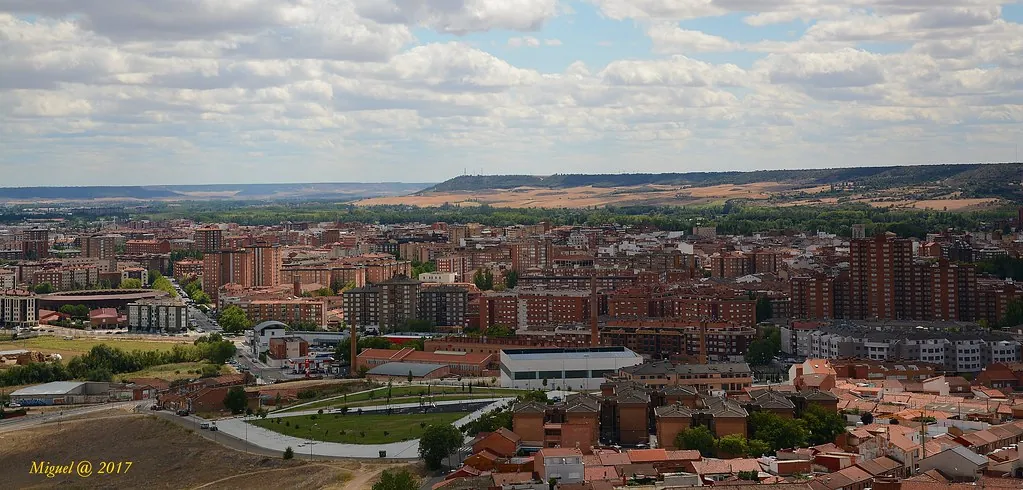
Villabrágima sits in Tierra de Campos, in the north of the province of Valladolid, with just over a thousand inhabitants. It is not a large place, and it is easy to walk through without rushing. The houses reflect the familiar mix of the region: stone, adobe and layers of limewash gradually worn down by the wind. Life here has revolved around cereal farming for generations, and the landscape beyond the last streets makes that clear as soon as you look up.
Santa María and the shape of the town
The tower appears quickly above the rooftops. The church of Santa María stands at one of the most visible points in the village and sets its rhythm, especially when the bells ring.
The building retains Gothic traces in its main structure. Inside, the light filters in softly, falling onto dark wooden altarpieces and thick walls that stay cool even in summer. There are rarely many people around, so the silence is easy to notice: muted footsteps, a door opening, the short echo beneath the vault.
The church is not isolated from daily life. Its presence is constant, marking time and anchoring the layout of the streets that spread out around it.
Stone houses and traces of the past
Nearby, several large houses display worn stone coats of arms. Some have narrow balconies with wrought iron railings and small windows, designed more to keep out cold and wind than to let in light.
Among these buildings, traditional dovecotes made of rammed earth still appear. Some remain standing with a certain solidity; others show cracks and broken edges. These structures are part of the wider landscape of Tierra de Campos and can also be seen along the tracks that lead out of the village.
They speak quietly of older ways of life, without needing explanation. The materials, the proportions and the wear all reflect a long relationship with the surrounding land.
The Plaza Mayor and everyday movement
The Plaza Mayor acts as a meeting point. Arcades supported by stone columns provide shade during hot days. By mid-morning there is usually a gentle flow of activity: neighbours crossing from one side to the other, brief conversations, a car arriving and leaving again.
This is not a square designed for large gatherings. The pace is smaller, more contained. In the middle hours of the day, especially in summer, the space becomes quieter and the sun reflects off the pale walls.
What stands out is not the scale but the rhythm. Movement comes in short bursts, followed by stillness. The square remains tied to daily routines rather than big events.
Open fields beyond the last houses
Once past the edge of the village, the landscape opens without interruption. Fields of wheat and barley stretch out in long lines, divided by straight tracks of compacted earth.
In spring, the colour shifts quickly from deep green to the yellow that arrives with summer. At sunset, the scene becomes particularly clear: a wide sky, wind moving through the grain, and a golden tone that lasts only a few minutes before fading.
Rural paths connect Villabrágima with nearby places such as Villanueva del Val and La Misa. These are usually broad tracks, easy to follow even without much signage. It is worth avoiding the central hours of summer, when shade is scarce and heat lingers over the fields.
The openness defines the experience as much as the village itself. There are no obstacles on the horizon, only long lines and changing light.
Underground cellars and older traditions
Beneath some villages in the area, underground wine cellars have been carved into the earth. These are old constructions linked to a winemaking tradition that is less prominent here today than in other parts of Castilla y León.
In some cases they are still used by families. There is no organised route to visit them; access usually comes through local contacts or during small community gatherings. Inside, they keep a cool temperature throughout the year and carry the smell of damp earth mixed with wood.
They form a hidden layer of the landscape, one that is not immediately visible but still present beneath the surface.
Festivities and the village calendar
The main celebrations tend to take place in summer, when many people who live elsewhere return for a few days. Activity centres on the church and the square, with processions and popular events organised by the residents themselves.
In spring, smaller pilgrimages linked to the agricultural calendar sometimes continue. These are simple occasions, closely tied to the land and its rhythms.
The calendar reflects the same pattern seen in daily life: moments of gathering followed by long stretches of calm.
A place that keeps its pace
Visitors to Villabrágima soon notice that the village does not try to present itself as anything other than what it is. Wide horizons, quiet streets and houses that have faced the same landscape for a long time define its character.
Arriving early or towards evening makes this especially clear. As the light lowers over the rooftops and the wind lifts dust along the tracks, the pace of Tierra de Campos becomes easier to understand.