Full Article
about Villalobón
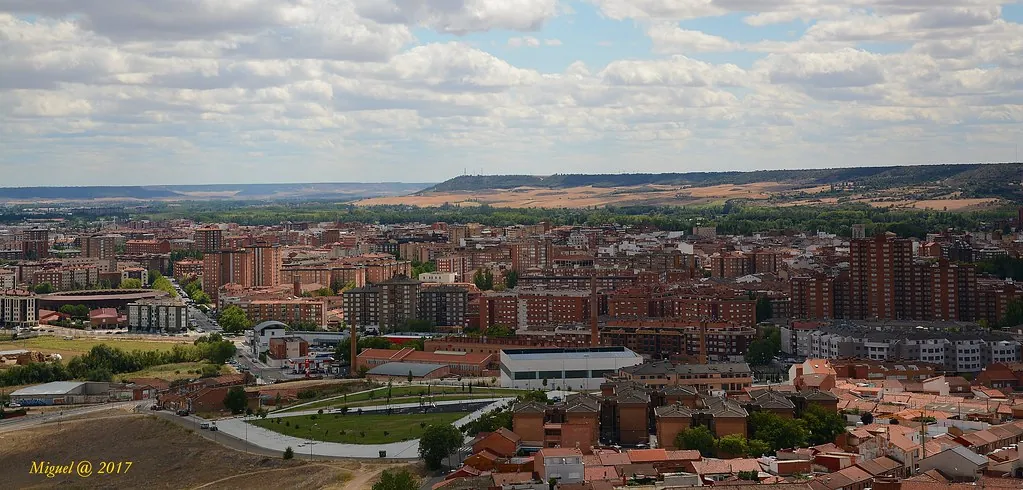
A residential municipality very close to Palencia; it has grown rapidly in recent years while keeping its church and traditions.
Ocultar artículo Leer artículo completo
A horizon that never arrives
Stand on the edge of Villalobón at dawn and you can watch the sun lift itself clear of the Meseta almost a full minute before it touches the village roofs. At 760 m the air is thin enough to make morning coffee taste metallic, and the cereal plains roll away until the curve of the earth swallows them. Palencia province likes its distances honest: the nearest supermarket is 15 km, the nearest coast 120 km, and the next village a 40-minute yomp across a landscape that looks unfinished—no hedges, no hills, just soil and sky in a 70:30 ratio.
This is Tierra de Campos, the old granary of Castile, where the phrase “middle of nowhere” feels like cartographical understatement. Villalobón’s 5000 inhabitants are outnumbered roughly 200:1 by hectares of wheat, barley and vetch, and the parish church tower still doubles as the local GPS—if you lose sight of it, you’ve walked too far.
Mud, brick and the smell of grain stored for centuries
Most visitors arrive expecting stone; they find adobe. The older houses are built from the same loam they stand on, their walls the colour of digestive biscuits, soft-edged and warm to the touch even in December. Timber balconies sag politely toward the street, and here and there a Victorian-era flour mill has been converted into flats whose windows still carry stencilled grain grades—harina floja, sémola—painted in flaking ox-blood paint.
There is no formal museum. Instead, the village is its own exhibit. Duck under the arch beside the baker and you’re in a cobbled yard where a 19th-century wine press lies dismantled, its wooden screw now used as a climbing frame by the owners’ grandchildren. A set of 1930s grain scales sits outside the agricultural co-op; anyone can weigh themselves free of charge, though locals advise subtracting a kilo for the dust that clings to everything.
The dovecotes—square, brick towers with conical roofs—dot the perimeter like forgotten chess pieces. Farmers no longer keep pigeons for fertiliser, but planning law insists any new-build within 500 m replicates the silhouette, so the skyline stays medieval even when the ground floor is a garage.
Walking in circles that feel like straight lines
Maps suggest a network of caminos; reality offers a lattice of tractor scars. From the plaza, head south past the football pitch and you’re on the old drove road to Becerril de Campos, 11 km away. The track is arrow-flat, wide enough for two combine harvesters, and entirely shadeless—bring water, a hat, and enough humility to turn back when the mirage of the village water tower refuses to get closer.
Spring brings colour: crimson poppies stitched through the wheat, bee-eaters hawking overhead, and the occasional Dupont’s lark—best spotted by its song, a castanet rattle that drops in pitch like a failing hard-drive. Autumn is the photographer’s season: stubble fields the colour of burnt toast, threshing dust hanging in a gold haze, and the smell of diesel and dough drifting from the bakery’s predawn batch.
Cyclists appreciate the asphalt variant: a 42 km loop south to Carrión de los Condes and back via Villalcázar de Sirga, almost traffic-free and pancake-flat apart from one 30-metre rise locals call el puerto. Road closes for the harvest fiesta in September; if you’re caught behind a grain convoy, expect to pootle at 12 km/h while the driver waves apologetically from his air-conditioned cab.
Calories you’ve already walked off
Lunch starts at 14:30 sharp; arrive earlier and the bar staff will still be mopping cereal husks off the floor. The daily menú costs €12–14 and follows the agricultural calendar: judiones (giant butter beans) with clams in winter, migas (fried breadcrumbs with grapes and chorizo) after the grape harvest, and roast suckling lamb on Sundays year-round. Vegetarians survive on pimientos de Padrón and the local sheep cheese, mild enough to convert even the most committed Cheddar nationalist.
Evening tapas are a more mobile affair. The ritual begins at 21:00 when the baker wheels out a portable grill and starts searing chuletón—a T-bone thick enough to stencil its own postcode. Order one to share, plus a glass of Alma de Palencia, the province’s un-oaked white, and you’ll find yourself fielding questions about Brexit and Birmingham City in equally fractured English.
The village shop doubles as off-licence, ironmonger and post office; it stocks UHT milk, tinned octopus and, mysteriously, Heinz baked beans. British visitors have learned to request “pan de molde” if they want sliced bread; otherwise you’ll be handed a loaf the size and weight of a house brick.
When the weather refuses to read the brochure
April can be 25 °C and calm, or 8 °C with horizontal rain that finds every seam in your waterproof. The Meseta has no sea to moderate it; weather arrives from the Atlantic like a drunk with a grudge. May is statistically driest, but locals keep wellies by the door until July. August tops 35 °C by 11 a.m.; sensible people siesta, while the British go walking and wonder why the tarmac is melting onto their boots.
Winter is surprisingly busy: the grain cooperatives run 24-hour shifts, floodlights turn the fields orange, and the air smells of diesel and hot bread from the night bakery. Snow is rare but memorable—when it last fell in March 2021, the village WhatsApp group exploded with photos of children sledging on feed-bag plastic while farmers fretted about getting lorries up the CL-613.
Access shrinks with the daylight. The twice-daily bus from Palencia becomes once-daily in November and disappears altogether on Sundays. Car hire is essential; the nearest petrol station is a 20-minute drive, and the pumps close for lunch. Chains are not legally required, but a set of cheap snow socks lives in most gloveboxes—proof that even Castilians can be caught unprepared.
Leaving before the fields convince you to stay
Check-out is 12:00, but the landlord will probably offer coffee at 11:55 and start a conversation about wheat prices that lasts until the dust on your hire car is three shades darker. The road north to Palencia passes a last dovecote, its roof collapsed, bricks weathered to the texture of Weetabix. Beyond it, the horizon reasserts itself—flat, implacable, already forgetting you.
Villalobón does not sell itself; it simply is. Come for the space, the silence and the sensation that you have slipped out of modern Spain into an older, slower country. Bring binoculars, cash and an alarm clock that understands siesta time. Leave before the sky grows so large it no longer fits inside the windscreen.