Full Article
about Villalpando
Head of the Tierra de Campos district with striking Mudéjar heritage; highlights include the Puerta de San Andrés and its arcaded squares.
Hide article Read full article
Tourism in Villalpando feels a bit like meeting a cousin you rarely see. It does not show off. It does not try to impress. Yet if you stay a while, stories start to surface.
Most visits begin the same way. You arrive by car and end up parking near the Plaza Mayor, which is far larger than expected for a town of just over a thousand residents. You look up and there it is: the castle. Time has not been kind to it, the centuries are visible in its walls, yet it still dominates the square as if it had something left to guard.
The Castillo de los Velasco is the first thing that catches the eye. Its origins go back to the Middle Ages, and for centuries it formed part of the area’s defensive system. Today it retains the air of a fortress that has seen too many wars and too much neglect. It is not a polished postcard image. That is precisely what makes it compelling, because it asks you to picture what life was like when the walls were more than a backdrop.
Ruins that almost go unnoticed
One of the curious things about Villalpando is how many traces of its past sit somewhere between what once stood and what remains.
The church of Santa María la Antigua collapsed in the twentieth century. Three apses are still standing. Without context they could pass for an abstract structure in the middle of town. Once you know the story, the view changes. You realise there was once an important church here.
San Miguel follows a similar pattern. This medieval church includes Mudéjar elements, a style that blends Christian and Islamic artistic traditions. The building has long been in a state of deterioration. What survives offers clues about the architecture, though it is harder to imagine the daily life that once unfolded inside.
Then there is the Puerta de San Andrés, probably the most recognisable feature in the historic centre. This monumental sixteenth-century gate recalls the grand entrances of much larger walled cities. Standing in front of it makes one thing clear: Villalpando once held more weight than it might suggest today.
When Villalpando held real importance
There was a time when Villalpando was far busier than it is now. In the Middle Ages it gathered numerous parishes and hermitages, a detail that says a great deal about its size and relevance at the time.
The town is traditionally linked to the Order of the Temple, which had a presence in various parts of the area during the twelfth century. The castle and the settlement’s position in the open plains of Tierra de Campos helped control roads and trade routes. From higher ground the logic becomes obvious. The landscape stretches in every direction, and there is little room to hide.
It is a terrain that appears calm. From a strategic point of view, however, it made perfect sense.
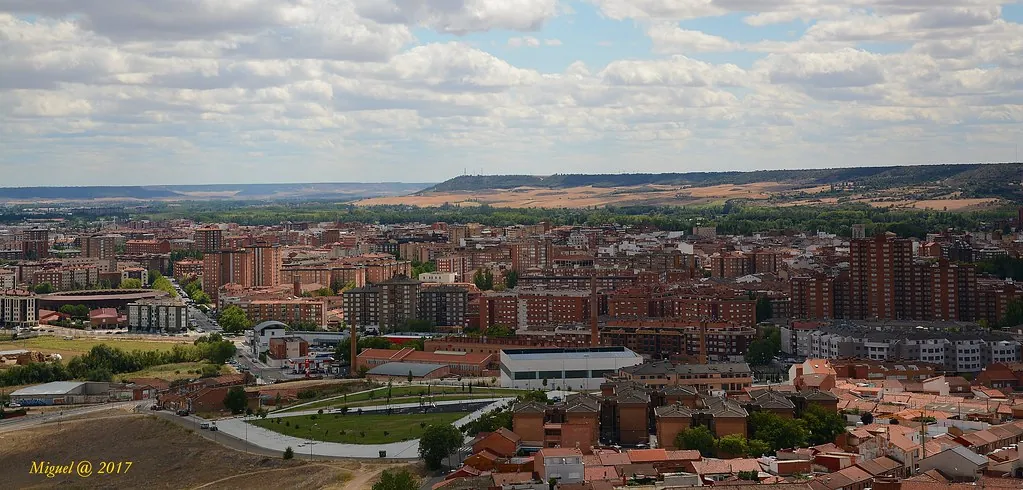
Tierra de Campos, the vast plain that surrounds Villalpando, defines much of this part of Zamora. The horizon feels wide and exposed. The sky seems larger than usual. The town’s broad streets and open spaces echo that same scale.
A very old vow
Villalpando preserves a singular religious tradition. It maintains one of the oldest known vows in Spain dedicated to the Immaculate Conception, known as a voto inmaculista. The promise dates back to the fifteenth century and is commemorated each year on 8 December.
The church of San Nicolás is closely linked to this history. Its exterior is sober, like many churches in the region. Step inside and the atmosphere shifts. The gilded tones of the Baroque altarpiece catch the light. There is the smell of wax and aged wood that lingers in places used for centuries.
You do not need to be particularly religious to notice how many generations have passed through that space.
Eating the Tierra de Campos way
Food in Villalpando follows the logic of Tierra de Campos. Dishes are hearty and direct.
Local tables feature embutidos, cured meats typical of inland Spain, and well-aged sheep’s cheeses. Traditional sweets such as biscotela also appear. This aniseed sponge cake is often sold wrapped in paper. The flavours are distinctly Castilian: dry, intense, and suited to a long coffee or an unhurried conversation after a meal.
Sit for a while on a terrace in the Plaza Mayor when the weather allows, and daily life comes into focus. Outsiders are still noticed here, though the reaction is more curiosity than anything else.
Walkers on the plain
Several Jacobean routes and historic paths cross this part of Zamora. As a result, pilgrims with backpacks occasionally pass through the town.
They tend to arrive after long stages across the flatlands of Tierra de Campos. The landscape can be deceptive. It looks easy because it is flat, yet wind and distance take their toll.
Villalpando often functions as a quiet stopping point. It offers a place to rest, gather strength and continue the following day.
Is it worth stopping?
Villalpando does not make an immediate visual impact in the way that more famous towns might. Some buildings remain intact. Others are clearly in need of restoration. There is wind, a lot of sky, and wide streets that can feel almost too spacious.
Yet it holds an appeal for anyone who likes to take their time with a place.
You might plan a short stroll and end up staying longer than expected. The Plaza Mayor can feel enormous when empty. The ruins that first seemed unremarkable begin to settle into place. The castle, weathered and imperfect, keeps watch over it all.
Villalpando does not compete for attention. It simply waits.