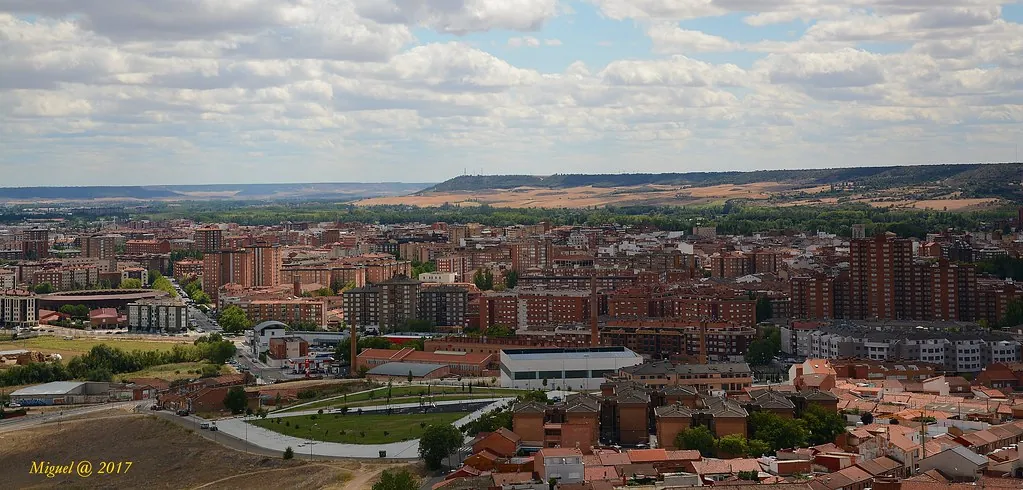
Vista aérea de Villamuriel de Campos
Instituto Geográfico Nacional · CC-BY 4.0 scne.es
Castilla y León · Cradle of Kingdoms

Villamuriel de Campos

The church tower appears first. From any approach road it rises above wheat, barley and the occasional concrete grain silo, a stone exclamation mar...

55 inhabitants · INE 2025
727m Altitude

Why Visit

Church of San Pelayo Rural walks

Best Time to Visit

summer

San Pelayo (June) junio

Things to See & Do
in Villamuriel de Campos

Heritage

  • Church of San Pelayo
  • Clock Tower

Activities

  • Rural walks
  • Peace and quiet

Festivals
& & Traditions

Fecha junio

San Pelayo (junio)

Las fiestas locales son el momento perfecto para vivir la autenticidad de Villamuriel de Campos.

Full Article
about Villamuriel de Campos

Small adobe village known for its church and clock tower.

Ocultar artículo Leer artículo completo

The church tower appears first. From any approach road it rises above wheat, barley and the occasional concrete grain silo, a stone exclamation mark in a landscape so flat that the horizon seems curved. Villamuriel de Campos sits at 740 m on the high plateau of Tierra de Campos, a region that feels more like an inland sea than farmland. When the wind combs through the ripening cereals the whole plain moves in slow-motion swells, gold turning to silver and back again.

With barely five hundred residents, the village is statistically small; spatially it is enormous. You can walk from one side to the other in fifteen minutes, yet the surrounding fields stretch for twenty kilometres without a significant interruption. That contrast—claustrophobic intimacy at the centre, infinite space at the edge—shapes every visit. Photographers arrive expecting sweeping vistas and instead find themselves distracted by the play of shadow on a crumbling adobe wall; hikers come for epic distance and end up talking to the baker about rainfall records.

Adobe, Brick and the Passage of Time

Most houses are built from the ground beneath them: tawny adobe bricks sun-baked on site, trimmed with local stone. The colour palette—ochre, rust, dried thyme—changes only when a cloud passes overhead. Some façades have been patched with modern cement, the architectural equivalent of a sticking plaster, but the majority retain their rounded edges and irregular courses. Look up and you will see nesting holes for storks; look down and the same walls are scalloped by decades of tractor vibration.

The fifteenth-century parish church of San Andrés stands in the logical centre, its tower a handy reference point if you venture onto the unmarked farm tracks. The doorway is pure late-Gothic, slightly lopsided after too many summers expanding in the heat and contracting in the sudden Castilian cold. Inside, the air smells of candle wax and damp stone; the only illumination filters through alabaster windows, giving faces a submarine pallour. Mass is held at 11:00 on Sundays, and the door is otherwise kept locked. Arrive early and someone will usually fetch the key from the house opposite—just knock twice.

Opposite the church a single bar does duty as café, grocery and gossip exchange. Coffee costs €1.20, served in glasses that retain the flavour of last month’s detergent. They open when the owner wakes up—roughly 08:00—and close when the last customer leaves, which can be 14:00 or 17:00 depending on the harvest. Do not expect a menu: the choice is whatever María has cooked that day, perhaps a plate of sopa castellana (garlic and bread soup) or a slab of lechazo, roast milk-fed lamb with skin so crisp it shatters like toffee. Vegetarians should request the omelette and resign themselves to jokes about rabbit food.

Walking the Geometric Plain

There are no signed footpaths, only a grid of agricultural tracks laid out by surveyors two centuries ago. The geometry is hypnotic: every kilometre a right angle, every field a rectangle. Pick any lane and walk for half an hour; the village shrinks to a postage stamp, then vanishes, and you are left with sky. Bring water—there is no shade—and download an offline map: the tracks multiply like forked lightning after rain, and landmarks are few. The only constant companions are skylarks, rising in vertical song flights until they disappear into their own soundtrack.

Spring, from late April to early June, is the kindest season. The wheat is knee-high, green threaded with crimson poppies, and the temperature hovers around 20 °C. By July the plain turns blonde and the mercury can touch 35 °C; walking is best finished by 11:00. Autumn brings stubble fires whose smoke drifts sideways in the windless air, and winter is a study in graphite—low cloud, frozen furrows, the occasional dusting of snow that melts before lunch.

Bird-watchers arrive with telescopes and patience. Great bustards—birds heavy enough to dent a car bonnet—sometimes feed in the fallow fields south-west of the village. They are wary, so park beside the ruined pigeon loft and wait. Lesser kestrels nest in the church tower, diving on feral pigeons with a sound like ripping paper. Bring a collapsible chair; the birds will not appear while you are standing.

When Silence Has a Sound

Nights can be startlingly quiet. Traffic on the VO-600 a kilometre away is sparse after 22:00, and the grain dryers fall silent by dusk. What replaces them is a low ambient hum—blood in your ears, pulse in your temples—punctuated by the church clock striking the half hour. On moonless nights the Milky Way is bright enough to cast shadows; step outside, let your eyes adjust, and you can navigate by starlight alone. Locals claim you can hear the wheat growing in May. The claim is unverifiable, but stand still long enough and the imagination fills in the rest.

Accommodation is limited. There is no hotel; the nearest beds are in Medina de Rioseco, 18 km north, a town grand enough to be called “City of the Admirals” but still unsigned by British standards. The Casa Rural El Cerval (€70 a night for two, breakfast extra) occupies a renovated granary with walls a metre thick—air-conditioning without electricity. Book ahead; weekend cyclists from Valladolid have discovered it. Otherwise, plan on a day trip from Palencia (35 min by car) or Valladolid (45 min), both reachable on the Renfe Media Distancia line. A hire car is essential; buses exist in theory, but the midday service operates only when school is in session.

The Plain Truth

Villamuriel de Campos will not entertain you. There are no interpretive centres, no craft shops, no sunset viewpoints with Instagram frames. What it offers instead is scale—the vertigo of standing in the middle of a circle whose radius is the horizon—and a lesson in how slowly, and how fast, a place can change. One season the field opposite the church is barley, the next it is fallow, the next a solar array. The adobe walls erode, someone slaps on cement, the storks return to the same nest they used when the Catholic Monarchs were still reconquering territory to the south.

Come for the quiet, stay for the conversation you will almost certainly strike up in the bar about rainfall, wheat prices or the best route to the next village. Leave before the wind picks up and the dust begins to drift, and you will understand why Castilians measure distance in time, not kilometres: the plain makes every journey feel longer, every arrival more deliberate.

Key Facts

Region
Castilla y León
District
Tierra de Campos
INE Code
47215
Coast
No
Mountain
No
Season
summer

Livability & Services

Key data for living or remote work

2024
Housing~5€/m² rent · Affordable
Sources: INE, CNMC, Ministry of Health, AEMET

Planning Your Visit?

Discover more villages in the Tierra de Campos.

View full region →

More villages in Tierra de Campos

Traveler Reviews