Full Article
about Villanueva del Campo
A key Terracampo town of brick-and-adobe architecture, noted for its church and preserved traditions.
Hide article Read full article
A place that opens up slowly
Tourism in Villanueva del Campo does not follow the usual pattern. There is no checklist to rush through. You arrive, wander across the main square, glance up at a tower, ask a simple question, and before long you are in conversation with someone who ends up telling half the story of the village.
It often begins with modest expectations. Another village in Tierra de Campos, perhaps, with wind, cereal fields and calm streets. Then something shifts. A question about the Cristo de la Veracruz leads somewhere else, then someone mentions the underground wine cellars. Villanueva has that effect. It seems quiet at first, yet once you look a little closer, stories begin to surface.
A village with the feel of a town
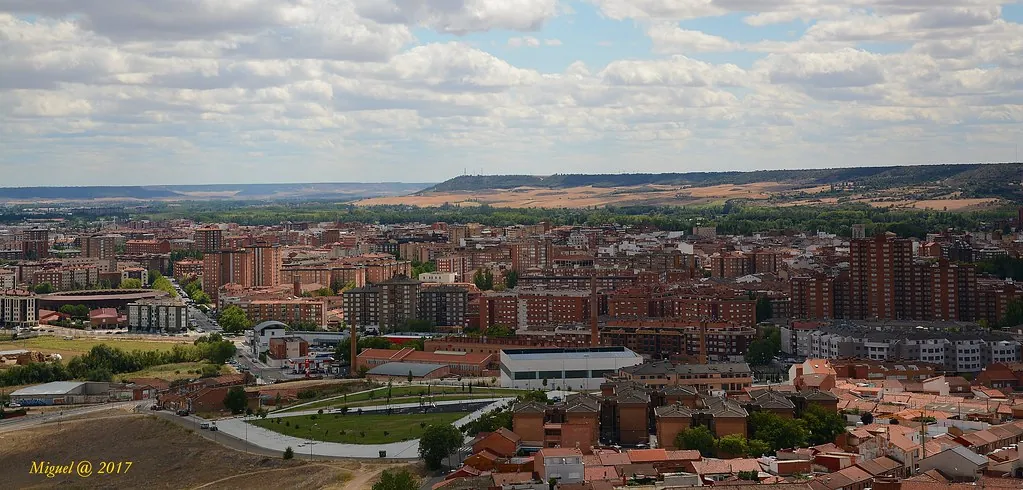
Villanueva del Campo has just over 700 inhabitants, though it spreads across a surprisingly large area. Walking through the centre, there is a sense that it once aimed to grow beyond what it eventually became.
The Plaza Mayor reflects that feeling. It is broad and open, the kind of space where it is easy to picture markets, local celebrations and much of the population gathering without crowding.
Then there is the Mudéjar tower of Santo Tomás. In Tierra de Campos there are several towers in this style, built with brick and geometric patterns influenced by Islamic art, but this one stands out. It can be seen from a distance and dominates the surrounding landscape. Even for those who do not usually pay much attention to churches, it tends to draw the eye.
The Iglesia del Salvador also surprises by its scale. It is large for a place of this size. There is a local story that someone from the village, who made a career in Madrid, helped finance its reconstruction in the 19th century. Inside, a retablo commands attention. It is the sort of piece that makes you pause and look up for a moment before leaving.
Three towers, a Cristo and an unusual bullring
Villanueva is sometimes called the village of the three towers. They are not all equally striking, yet together they create a recognisable silhouette as you approach along the road.
The most notable remains the tower of Santo Tomás, with its Mudéjar design. It has the look of something built patiently, brick by brick, with care for pattern and form.
Another important element is the Cristo de la Veracruz, which holds a strong place in local life. Tradition tells of a miracle centuries ago involving a well and a child who fell into it. Since then, devotion to the Cristo has become part of the village’s identity. The September festivities revolve around it, and during those days Villanueva becomes noticeably livelier, filled with people returning or gathering to celebrate.
There is also a detail that often catches visitors by surprise: a bullring excavated into the ground. It is not monumental or grand. Instead, it is a simple structure sunk into the earth, reminiscent of the improvised arenas found in many Castilian villages. Everything feels close and direct, shaped more by use than by display.
The landscape from Teso de los Casares
To understand the wider setting of Tierra de Campos, there is a particular spot worth visiting: the Teso de los Casares.
It is an artificial rise on the outskirts of the village. At first glance it may not seem remarkable, yet from the top the landscape becomes clear. Open fields stretch out in long lines of cultivation, and the horizon runs flat and seemingly endless.
In spring or early summer, the colours shift. The fields blend into one another until the land looks almost continuous, like a vast blanket of cereal crops spread across the plain.
There is also a curious local tradition linked to the teso. It is said that if an unmarried woman spends an entire night there, she will be married within a year. Whether or not it has led to many weddings is uncertain, though people in the village still mention it with a knowing smile.
Nearby stands the ermita de Valdehúnco, associated with a local romería, a traditional pilgrimage-like gathering. On that day, the path fills with neighbours walking out together, spending time in the countryside, and returning towards evening.
Beneath the village and around the table
Under Villanueva lies another, quieter world: underground bodegas carved into the earth.
For many years they were used to store wine, keeping it cool throughout the seasons. Some are still in use, while others open on special occasions. Stepping inside one feels like entering a different temperature and a slower rhythm.
It often leads to conversation. Someone might explain how wine was made in the past, how the vineyards were worked, or what has changed in recent years. If there is enough familiarity, a homemade bottle may appear.
Food here follows the same straightforward approach. Hearty dishes take over when the cold sets in, alongside cured meats, hornazo during festive days, and sheep’s cheese that calls for a piece of bread on the side. It is not elaborate cooking. It is the kind that has been part of daily life for generations.
When to come and what to expect
Villanueva del Campo is not defined by major landmarks or streets designed for quick photographs. It works best without haste.
A walk across the square, another towards the towers, perhaps a visit to the bodegas or a short wander into the surrounding countryside to take in the landscape. That is often enough.
The atmosphere shifts during the fiestas of the Cristo in September or on other traditional days, when the village fills with people who return even if they no longer live there.
Is it worth stopping? It makes sense for anyone interested in seeing what a place like this is really like, beyond the surface. Villanueva does not present everything at once, but it has a way of revealing itself little by little.