Full Article
about Villanueva del Rebollar
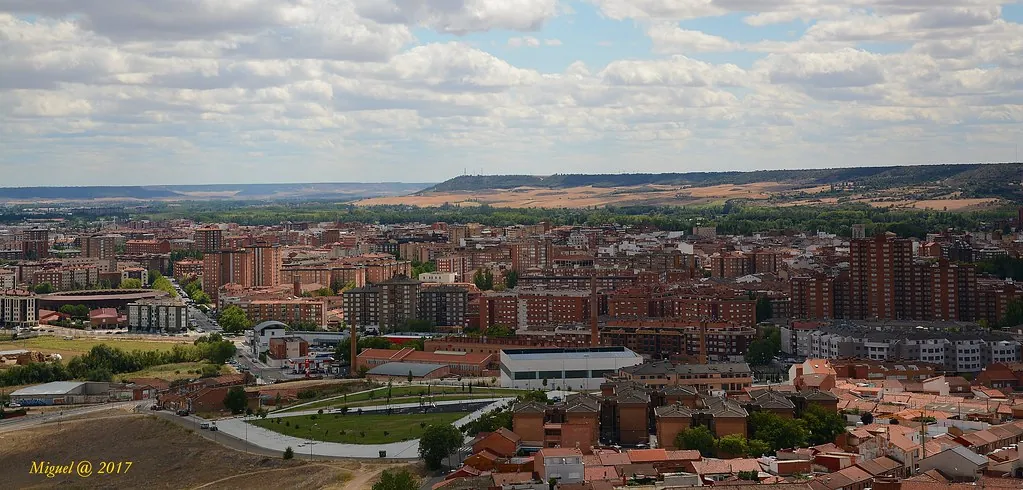
Small Terracampo village; noted for its church and quiet streets; surrounded by cereal fields.
Ocultar artículo Leer artículo completo
The church bell strikes seven and the only reply is a tractor clearing its throat somewhere beyond the wheat. At 800 metres above sea-level, Villanueva del Rebollar is already awake, though you’d be forgiven for thinking the whole place had simply been left in neutral. Seventy-odd residents, one bakery that opens when the owner feels like it, and a horizon so flat you could balance a spirit level on it—this is the Spain the guidebooks forget to mention.
The Edge of the Plateau
Stand on the village’s single paved road at dawn and you’ll understand why locals call the surrounding country el páramo—the wasteland. It isn’t waste, of course; it’s a chessboard of cereal fields that changes colour like a mood ring. April brings acid green shoots, July turns everything the colour of digestive biscuits, and by October the stubble resembles a five o’clock shadow on the earth. The only vertical punctuation comes from abandoned palomares, squat dove-towers built from mud and hope, their roofs long since collapsed under the weight of winters.
There is no high street, no plaza mayor framed by orange trees, no Instagram mural. Instead, adobe houses—walls the thickness of a London bus—lean gently against one another, their clay bricks patched with modern cement the way a grandmother darns a favourite cardigan. Satellite dishes bloom from upper storeys like metal fungi, the sole admission that the twenty-first century has bothered to knock.
What Passes for Sights
The parish church of San Juan Bautista won’t charge you an entrance fee because there’s nobody there to collect it. Push the heavy door and you’ll smell candle wax mixed with grain dust blown in on the wind. Inside, a single nave, a sixteenth-century font, and a Christ figure whose painted blood has faded to a tasteful rust. The bell rope hangs like an untied shoelace; ring it and the whole village knows a stranger is poking about.
Beyond the church, the sightseeing agenda runs dry within twenty minutes. That’s the point. Wander down Calle de la Iglesia, past the locked-up bodegas—underground cellars carved into the limestone—then keep going until the tarmac surrenders to a dirt track. You are now walking the same grid the Romans plotted for wheat carts. The only soundtrack is larks overhead and, if you’re unlucky, the thwack-thwack of a crop-sprayer drone homing in on you.
Bring binoculars, not for architecture but for birds. The Tierra de Campos steppe is one of the last European refuges of the great bustard, a turkey-sized creature that pretends to be a hay bale until the last second. Grey harriers quarter the fields like patrol officers; calandra larks deliver a liquid twitter that sounds almost coastal. There are no hides, no entrance kiosks, no gift-shop fridge magnets—just you, the breeze, and the small adrenaline surge of realising you might be the only moving object for a mile in any direction.
Pedal, Walk, Then Walk Some More
A folding bike is worth its weight here. The old caminos that link Villanueva del Rebollar to neighbouring hamlets are dead-flat, graded dirt, rideable on 35 mm tyres unless it has rained, in which case they turn into chocolate mousse. Head south 6 km to Villaconancio and you’ll pass a ruined ermita where storks have built a living cathedral of sticks. Continue another 9 km east to Boada de Campos and you can reward yourself with a can of Coke in the only bar open between harvest and sowing—hours strictly 08:00-11:00 and 18:00-21:00, closed Tuesday.
If you prefer shanks’s pony, the circular 12 km Ruta de los Palomares starts by the cemetery gate. waymarks are white paint splodges on power-line poles; ignore them at your peril because Google thinks these tracks are roads and will cheerfully send you wading across a freshly irrigated chickpea field. Sunrise and the hour before dusk gift the kindest light; midday in July is an open-air sauna with zero shade—carry more water than you think you’ll need and a floppy hat that makes you look like a prat. You won’t care when the thermometer kisses 38 °C.
The Food Question
Villanueva del Rebollar itself has zero catering. The bakery van honks its horn at 10:30, sells out of mantecadas within eight minutes, and is gone. Plan on self-catering or driving twenty minutes to Paredes de Nava, where Asador Palentino will serve you a half portion of lechazo (milk-fed lamb) still sizzling on a clay tile, crisp skin giving way to meat the texture of pulled pork but without the smoke. Price: €18 for a media ración, bread and wine included. Vegetarians get sopa de ajo—garlic soup poured over day-old bread and a poached egg; ask them to hold the jamón shard if that matters.
If you’re staying in one of the two village holiday lets (both converted stables, both advertised on the Spanish equivalent of Airbnb), stock up in Palencia city before you arrive. The nearest supermarket is a Carrefour Express on the N-601, 35 km away, and it closes Sundays. Local tip: buy a triangle of queso de oveja from the shepherd in Villarramiel whose honesty box is nailed to a gatepost; the cheese tastes of thistles and moonlight and costs €5 a wedge.
When the Wind Turns Cold
Winter arrives overnight, usually round about the feast of All Saints. Temperatures drop to –8 °C, the fields bleach to the colour of old bones, and the village empties further as even the hardiest jubilados decamp to daughters in Valladolid. Roads can ice over; carry chains if you’re visiting between December and February. Spring, by contrast, is the golden hour: green shoots, cranes heading north overhead, and the smell of wet earth so strong you could bottle it. August fiestas draw returnees from Madrid and Barcelona, swelling the population to perhaps 200. For three days there’s a sound system in the square, a foam party for teenagers, and a communal paella that uses half a tonne of rice. Then the lorries roll away and silence reasserts itself like a tide.
How to Get Here, and Why You Might Not Bother
Fly into Madrid, pick up a hire car, and head north on the A-62 for two hours. After Palencia, exit at Dueñas and follow the CL-613 for 28 km of arrow-straight road that feels like driving along the spine of a book. Public transport is theoretical: one bus on Tuesdays and Fridays, departing Palencia at 14:15, returning at 06:30 next day. Miss it and you’re sleeping among the barley.
That, in the end, is the bargain Villanueva del Rebollar offers. It strips travel back to the original deal: you make the effort, forego cappuccinos and curated gift shops, and in return you get a sky that still feels ownership of itself and a night so dark you’ll remember what the Milky Way actually looks like. Bring a book, a pair of decent walking shoes, and zero expectation of being entertained. The village won’t charm you—it’s too honest for that—but it might, briefly, slow your own engine down to its cadence.