Full Article
about Villardefrades
Town with an unfinished monumental church; noted for its heritage and location on the A-6.
Hide article Read full article
First light over Tierra de Campos
At dawn, the sky over Villardefrades often opens in a pale grey that takes its time to settle. Silence dominates, broken only by the crunch of dry earth under boots or the distant start of a farm engine. This small village in the heart of Tierra de Campos, with around 145 registered residents, reveals itself gradually as the light strengthens. Straight streets and adobe houses come into view bit by bit. The wind stays gentle at that hour, and the fields seem paused, as if the day has yet to fully begin.
Built from earth and grain
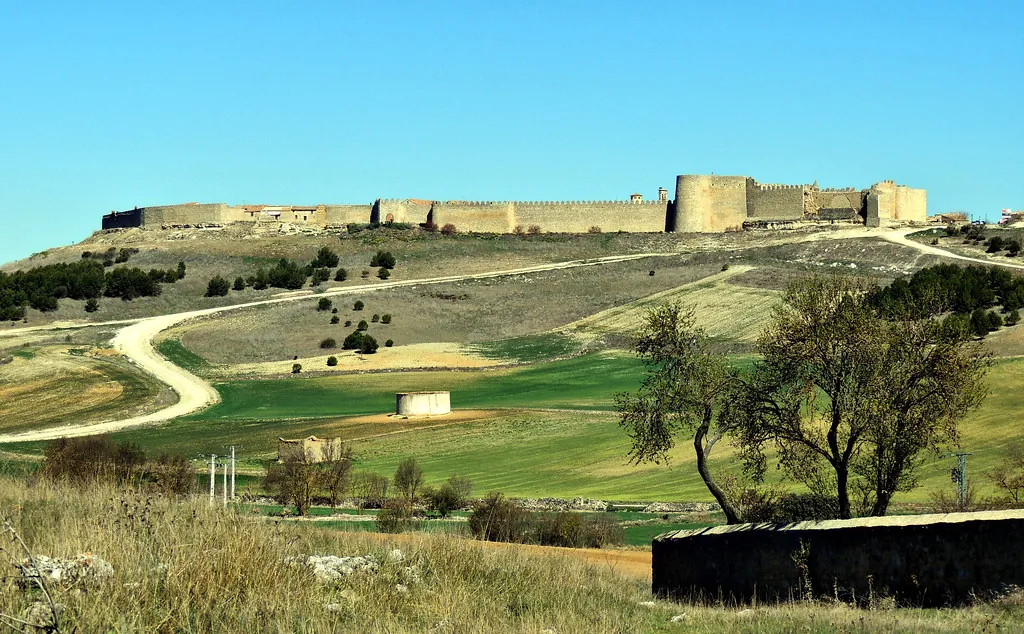
From the outskirts, the horizon stretches out flat with barely an obstacle in sight. In Tierra de Campos, the landscape allows long views: large plots, clay soil, and a patchwork that shifts colour with the seasons. Spring brings fresh green cereal crops. Summer turns everything dry and golden. Autumn introduces ochres and freshly turned earth.
Many houses still keep their adobe or rammed-earth walls, often resting on stone bases. On some old gateways, marks remain from carts that once passed through. At the centre stands the parish church dedicated to Santa María Magdalena. It is built in exposed brick with simple lines, typical of this part of Valladolid. The structure feels solid and unadorned, with a square bell tower visible from the paths that lead into the village.
Dovecotes and dirt tracks
Understanding Villardefrades means stepping beyond the main square. A short walk leads to farmyards, agricultural buildings, and the occasional dovecote scattered across the region. Many are partially collapsed, yet they remain one of the most recognisable shapes in the Campos landscape.
The tracks that leave the village are wide and made of compacted earth. Tractors use them, as do cars and anyone who wants a quiet walk without encountering many people. Early in the morning or towards evening, the light sits low over the wheat fields, and shadows stretch across the ground for several metres.
Moving across the plain
There are no marked routes or prepared viewpoints here. The usual approach is simple: pick a track and walk between plots of wheat, barley or oats. The sense of openness never fades, with a vast sky above and open land below.
Cycling works well on these tracks when the wind stays calm, although strong gusts are common in the area. Summer brings intense sun, and the middle of the day offers very little shade.
Birdlife adds movement to the otherwise still landscape. Kestrels and harriers often patrol the fields. With some patience, it is possible to spot great bustards walking through tall cereal crops. Vultures sometimes appear high overhead, carried by air currents.
Eating in the area
Villardefrades is small and does not have restaurants or places to sit down for a meal. People usually head to larger nearby villages or to busier towns such as Tordesillas or Medina del Campo.
The cooking in this part of Valladolid reflects what the land provides. Lechazo, roast lamb typical of the region, is a key dish. Bread made from wheat, pulses, and cured cheeses also form part of the local food culture. Many of these products are bought in shops across the region or at markets in nearby towns.
When the village fills again
For much of the year, the streets remain quiet. The atmosphere changes during the patron saint festivities, traditionally held in summer. At that time, many people who live elsewhere return. The village becomes more animated with open-air dances, long shared tables for meals, and processions that move through the main streets.
Holy Week also has a presence here, although in a simple and very local form.
Getting there and practical notes
From Valladolid, the journey heads south through the province, passing larger towns before reaching the smaller settlements of Tierra de Campos. It helps to plan the route in advance, as turn-offs between local roads can be easy to miss.
Anyone planning to walk in the surrounding area should bring water and protection from the sun. Shade is scarce on these plains, and the wind can make the temperature feel misleading. The most pleasant moments usually come early in the morning and late in the afternoon, when the low light turns the fields into a long band of gold that seems to stretch without end.