Full Article
about Villárdiga
Small Terracampo municipality with a striking parish church; set amid quiet cereal plains.
Ocultar artículo Leer artículo completo
The church bell strikes noon, but only three people cross the plaza. One carries a ladder, another a sack of feed, the third simply stands, scanning the horizon where wheat meets sky in an almost perfect line. This is Villardiga, a scatter of low adobe houses on the high plateau of Zamora province, population sixty on a good day, fewer when the harvest sends families to the fields.
Britons who reach this corner of Castilla y León have usually taken a detour from the Camino de Santiago or fled the Renaissance splendour of nearby Zamora city. What they find is not a film set of “old Spain” but a working fragment of it: tractors parked beside 300-year-old walls, straw caught in door hinges, silence so complete you can hear a pigeon flap a kilometre away.
The Architecture of Survival
Start at the parish church, the only structure taller than a single storey. Its tower is a patchwork: Romanesque stone at the base, brick additions from the 1700s, a modern concrete cap where storks nest each spring. The door is ordinarily locked; knock at the house opposite and Doña Milagros will wipe her hands on her apron before fetching the key. Inside, the nave is cool and plain, the walls washed the colour of wheat paste. A 16th-century polychrome Saint James wears boots that look suspiciously like walking shoes—local humour, perhaps, for a village that has never been on any pilgrimage route.
From the church, the streets—really tracks wide enough for a hay wagon—radiate outward. Adobe glows mustard-yellow in morning light, then turns the shade of digestive biscuits as the sun climbs. Many houses are empty; their timber doors hang askew, revealing courtyards where poppies grow through the paving. Others have been patched with cement and bright blue PVC windows, the architectural equivalent of a plaster on a cracked lip. The mix is honest: no heritage gloss, just whatever materials came to hand when a wall collapsed or a roof leaked.
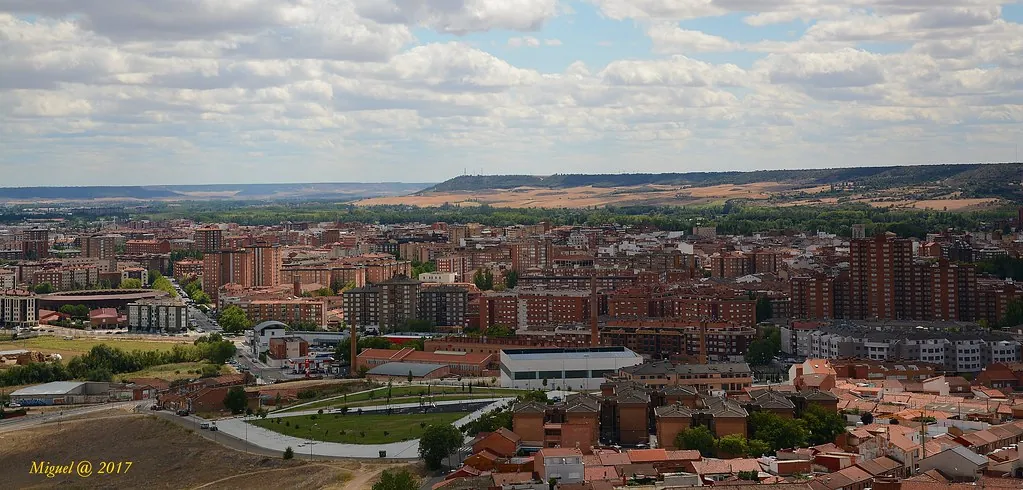
Walk to the eastern edge and you reach the grain co-operative, a corrugated-iron hangar that hums for two weeks each July when the wheat trucks queue back to the main road. The manager, Julián, will let you climb the external staircase for a view across the Tierra de Campos: forty kilometres of almost dead-flat cereal fields broken only by the distant chimney of a sugar-beet factory near Benavente. Bring binoculars in spring and you might spot a great bustard landing among the sprouting barley—Spain’s heaviest bird, heavier than a goose, yet able to vanish against the tawny soil.
Wind, Wheat and What to Do
There is no ticket office, no interpretive centre, no gift shop selling fridge magnets. Activity here is self-propelled. A network of unmarked farm tracks forms a loose grid; follow any for twenty minutes and you will loop back to the village, guided by the church tower that serves as a sundial. Summer walking demands an early start: by 11 a.m. the thermometer nudges 34 °C and the only shade is your own shadow. In winter the plateau turns brutal—icy gales sweep across from the Cantabrian Mountains, and the thermometer can dip to –8 °C at midday. April and late September give you colour, mild air and the best chance of sharing the path only with a hare.
Cyclists appreciate the几乎 traffic-free roads. The CL-615, five kilometres north, links Zamora with León; a morning spin eastward delivers you to Granja de Moreruela, home to a ruined Cistercian monastery where swallows nest between the altar stones. Return against the prevailing westerly and you will understand why Spanish professionals train here: the wind is a free gym.
Birdwatchers should head out at dawn with a flask of coffee. Apart from the bustards, you might see little bustard, stone-curlew and Montagu’s harrier quartering the fields. The trick is to sit beside a stone heap—legacy of centuries of hand-clearing—and wait. Patience beats kilometres; the birds here are shy of anything on two legs.
Eating and Sleeping (or Not)
Villardiga has no bar, no shop, no petrol station. The nearest bread is eight kilometres away in Muelas del Pan, where the bakery opens at 7 a.m. and sells out of custard tarts by 8.30. Plan accordingly: pack lunch, carry water, fill the tank before you leave the A-66 motorway. If you need a bed, the regional government lists three privately owned casas rurales in the village; two sleep four, one sleeps eight. Expect stone floors, wood-burning stoves, Wi-Fi that flickers when the wind is westerly and prices around €90 per night for the entire house. Bedding is provided, but bring slippers—farm dust is pervasive.
For supper you will drive. In Zamora city (35 min) the mesón “Arias” serves judiones del barco—giant butter beans stewed with pork trotter—followed by arroz con bogavante, a dish that tastes of the coast even though the sea is 150 kilometres away. Closer, in Santa Cristina de la Polvorosa, the roadside grill “El Emigrante” does excellent lechazo, roast milk-fed lamb, for €22 a quarter. Order a half-litre of the local Arribes del Duero red; it is dark enough to stain the glass and soft enough to drink without food if the lamb is slow.
When the Village Comes Back to Life
Visit in mid-August and the arithmetic reverses: former residents return, population swells to 300, and every house ejects a folding table laden with chorizo and lemonade. The fiestas last four days, centred on the Assumption mass followed by a communal paella cooked in a pan two metres wide. Visitors are welcome—someone will press a plate into your hand—but be aware that beds are booked a year in advance and the silence you came for has been stored away until September.
Spring fiestas are smaller but equally telling. On the Saturday after Labour Day the village holds the “Día de la Bicicleta”. Children who have never lived here polish ancestral bikes and ride the 12-kilometre circuit through neighbouring hamlets, escorted by a tractor carrying water bottles. It is part parade, part family reunion, part act of defiance against demographic decline.
Getting There, Getting Out
The practical route from the UK is to fly into Valladolid (Ryanair from Stansted, 2 hrs), collect a hire car and head west on the A-62 for 45 minutes before turning south on the ZA-605. Total driving time from the airport is just over an hour, but allow for the fact that Google Maps still thinks one section is a dirt track; it was asphalted in 2018. Trains reach Zamora from Madrid in 1 hr 20 min on the Alvia service, but the onward bus to Villardiga was cancelled in 2020. Without wheels you are stranded, which is half the point—until it is time to leave.
Leave you will, probably after a single night. The village does not solicit extended stays; it barely advertises its existence. Yet the memory lingers: the scrape of a metal gate, the smell of straw heated by sun, a horizon so wide it feels nautical. Somewhere between those wheat rows and that wind you will have tasted a Spain that package tours, and even many Spaniards, have forgotten. It is not comfortable, rarely convenient, but it is honest—and honesty, like the plateau wind, is hard to forget.