Full Article
about Villarramiel
Known for its cecina and leather crafts; noted for its Neoclassical church and Mudéjar tower.
Hide article Read full article
A village of the plain
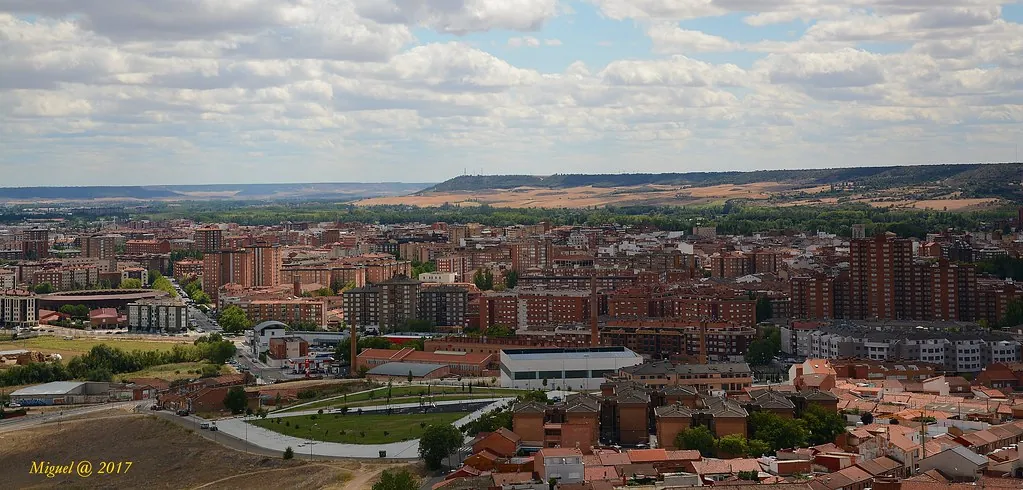
To understand Villarramiel, you must first understand Tierra de Campos. This is a geography of vastness, a sea of cereal fields where the horizon is a straight line. The village, home to some seven hundred people, sits within that expanse. Its low, compact form is built from the very earth it surveys, a cluster of adobe and tile that seems to have risen from the ground.
For centuries, life here was organised around grain and livestock. That logic remains. There is no transition between town and country; the last house gives way immediately to the first field.
Building with earth
The medieval settlers of this plain faced a climate of extremes—searing summer heat and a penetrating winter cold. Their solution was underfoot: they built with adobe and tapial, rammed earth. These materials were more than economical; they provided remarkable insulation.
A walk through the older streets shows how this works. You see walls with visible repairs, where layers of mud plaster have been renewed over decades. The lower sections are often reinforced with stone or brick to handle damp. This isn't decay; it's the traditional method of maintenance. The architecture is functional, its tones blending with the soil of the surrounding fields, especially in late summer when the landscape turns a pale gold.
The church and the street plan
The church of San Juan Bautista, from the 16th century with later modifications, provides the main vertical accent. Its bell tower is visible from the approach roads across the fields, acting as a guide. Its significance is as much about placement as architecture; it anchors the simple street grid at the village's core.
The layout is straightforward. Streets run straight, lined with continuous façades. You notice large doorways, built for carts, and iron window grilles. Grand houses are few. This is an architecture of endurance: thick walls for temperature control, interior courtyards sheltered from the wind, and roofs of curved clay tile. Decoration is spare, if it exists at all.
Life framed by the fields
Step beyond the last street and you are in the open. The fields here are large, divided by straight dirt tracks. The crop cycle dictates the colour of the world: green in spring, a brittle yellow by harvest. This austere landscape is known for its steppe birds. With patience and binoculars, you might spot great bustards in the distance or see birds of prey circling overhead. The sheer openness makes such sightings possible, though never guaranteed.
The climate is a constant factor. In summer, the sun is intense and shade is scarce. In winter, the wind moves across the plain unimpeded. It shapes everything, from the orientation of the houses to the experience of walking here.
A practical pace
Villarramiel is seen best on foot, at a slow pace. Its interest lies in the details: the texture of a repaired wall, the heavy timber of an old door, the direct view from a street's end into the fields. You can walk its entirety in little time.
The festive calendar revolves around the patron saint, San Juan Bautista, with celebrations that are largely communal. Traces of the agricultural rhythm persist in local gatherings, though mechanisation has changed the old patterns.
This village does not trade in monuments or itineraries. It offers a clear, unadorned example of how a place is shaped by its land. The plain made Villarramiel, and Villarramiel, in its form and function, explains the plain.