Full Article
about Quintana del Marco
Known for the discovery of Roman mosaics and a bust of Marcus Aurelius; farming area
Hide article Read full article
Arriving by Chance in Tierra de La Bañeza
Some villages are planned destinations. Others appear almost by accident, like stopping at a petrol station on a secondary road and ending up in a half-hour conversation with someone who lives nearby. Tourism in Quintana del Marco feels a little like that.
You do not arrive here in search of a headline monument or a landmark photograph. If you come at all, it is probably because you are travelling through Tierra de La Bañeza, a rural district in the province of León, and decide to turn off the main road for a while.
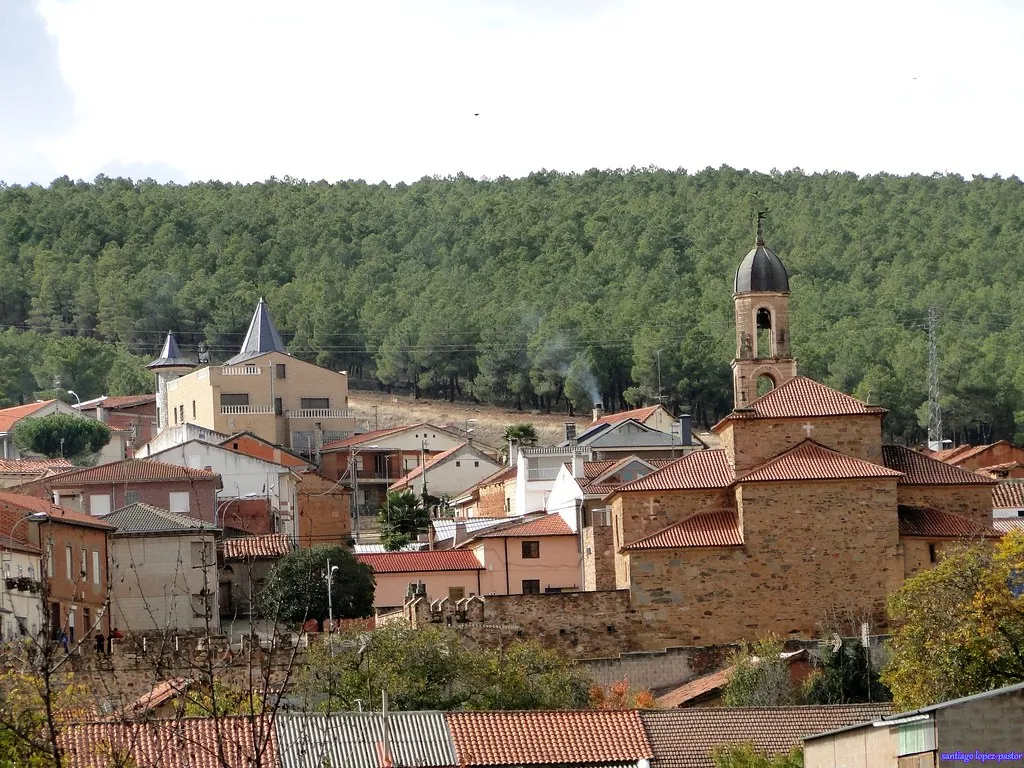
Quintana del Marco has around three hundred inhabitants and moves at the pace you might expect from a cereal-growing village on the León plateau. Stone houses line the streets, some façades still showing adobe. Large wooden gates, originally built for carts rather than cars, open onto courtyards. The layout of the streets makes it clear that life here revolved around agriculture, and in many ways still does.
This is not a place that overwhelms visitors with sights. Quite the opposite. Walking through the village feels a little like opening the toolbox of an old rural house: animal pens, small wine cellars attached to homes, agricultural sheds and yards where tools are still kept. Everything is straightforward and practical, yet instantly recognisable to anyone familiar with villages in León.
Beyond the houses, the landscape takes over. Long plots of cereal stretch outwards, with sunflowers in season, beneath a horizon that seems to run without interruption. For anyone used to city life, the sudden absence of noise can feel unusual at first, as if someone has switched off a constant background hum.
The Village and Its Surroundings
The clearest point of reference in Quintana del Marco is the parish church of San Pedro. Its tower can be seen from various points and acts as a guide when navigating the streets. The interior is not always open outside times of worship, which is common in small villages.
Apart from the church, the interest lies in the village as a whole rather than in individual monuments. A slow walk with no fixed route reveals traditional bodegas, corrals and enclosed patios that recall how agricultural life was organised decades ago. Many of these buildings remain private. Visitors should look with respect and avoid entering spaces that are not public.
The surrounding fields play a central role in the experience. The landscape changes noticeably with the seasons: intense green in spring, golden tones when the cereal ripens, and a barer, more stripped-back appearance in winter. Sunsets often spread across a wide expanse of sky, filling much of the horizon with colour.
There is little in the way of formal interpretation panels or curated routes. The appeal lies in observing everyday details and in understanding that this is a working environment, not an open-air museum.
Walking the Agricultural Tracks
For those who want to stretch their legs, the simplest option is to head out along one of the agricultural tracks that circle the village. These are straightforward dirt paths, the kind used by tractors, suitable for walking or cycling without much difficulty.
Two practical considerations define the experience here. In summer the sun can be intense, and shade is scarce. Carrying water and wearing a hat are sensible precautions in this open landscape.
The terrain is mostly flat, which makes distances appear shorter than they are. The sense of space is constant. Fields extend in long, geometric lines, broken only occasionally by farm buildings or clusters of trees near irrigation points. It is a landscape that rewards patience rather than speed.
For photography, the material is in the details: whitewashed walls, old wooden gates, farming tools leaning against a wall, or the contrast between compact houses and the vast open fields beyond. Early morning and late afternoon light tends to soften the scene and bring out textures in the stone and earth.
Food and Nearby Stops
Traditional food in this part of León revolves around what the land provides. Legumes feature heavily, along with substantial stews, lamb and local cured meats. In a village as small as Quintana del Marco, visitors should not expect a wide choice of places to sit down for a meal.
For that reason, many people combine a visit with a stop in La Bañeza or in other nearby towns where there is more activity. Quintana del Marco works better as a pause during a broader route through Tierra de La Bañeza than as a standalone gastronomic destination.
The connection between food and agriculture is easy to understand here. The fields seen from the edge of the village are the same fields that shape local cooking traditions. The rhythm of sowing and harvesting still influences daily life.
A Village That Keeps Its Own Pace
Like many villages in the area, Quintana del Marco celebrates its patron saint festivities in summer. These days typically include processions, gatherings of neighbours and activities organised by local residents. The atmosphere is community-focused rather than staged for visitors.
Outside festival periods, the village continues at its usual tempo. There is no attempt to reinvent itself for tourism, and that is part of its character. What you see is largely what has always been there: a small settlement tied closely to the land, adapting slowly but without dramatic change.
Quintana del Marco is not somewhere most people would travel to from far away with a single purpose in mind. Yet for those exploring Tierra de La Bañeza, taking a short detour offers a clear glimpse of everyday life in many parts of rural León. It is calm, rooted in agriculture and free from hurry.
Sometimes that is enough.