Full Article
about Alcazarén
A town with strong Mudéjar roots in the Tierra de Pinares, noted for its Romanesque-Mudéjar apses and wooded setting.
Hide article Read full article
Among the Pines of Valladolid
Alcazarén is the sort of place you reach because someone said, “head towards the pine forests and you’ll see.” It does not trade on a headline monument or a photo that circulates endlessly online. Yet after a short walk around the square, something shifts. There is the scent of resin in the air, the weekday quiet, and the unhurried rhythm typical of the Tierra de Pinares, the pine-covered area of the province of Valladolid where life seems to move at a different speed.
With just over six hundred inhabitants, Alcazarén does not attempt to impress. It works to its own logic. Neighbours stop to chat on the pavement, people settle on benches in the square as the sun dips, and mobile coverage appears and disappears depending on where you stand. It is not a destination for ticking off sights. It is somewhere to pause.
Early Footsteps on the Camino de Madrid
The day here can begin before sunrise. Alcazarén lies on the Camino de Madrid, one of the routes that lead pilgrims towards Santiago de Compostela. Early in the morning there is often movement in the municipal hostel, as walkers prepare to set off with poles in hand and boots laced tight.
Once they leave, the village slips back into its calm. Just outside the centre, a simple path follows the River Eresma through pine woods. It is an easy stroll that can be done in under an hour, bringing you back into the urban core without fuss. The route is neither long nor demanding. It is simply a way to breathe in the scent of the pines and listen to the river moving quietly beside you.
By the time the bars on the square open, locals begin to gather. Mornings here are social. Coffee is common, but something stronger is not unusual. A glass of wine and a small snack at the start of the day raises few eyebrows in this part of Castilla.
Two Churches and a Handful of Streets
Alcazarén can be crossed quickly. Within twenty minutes it is easy to find your bearings without looking at a map.
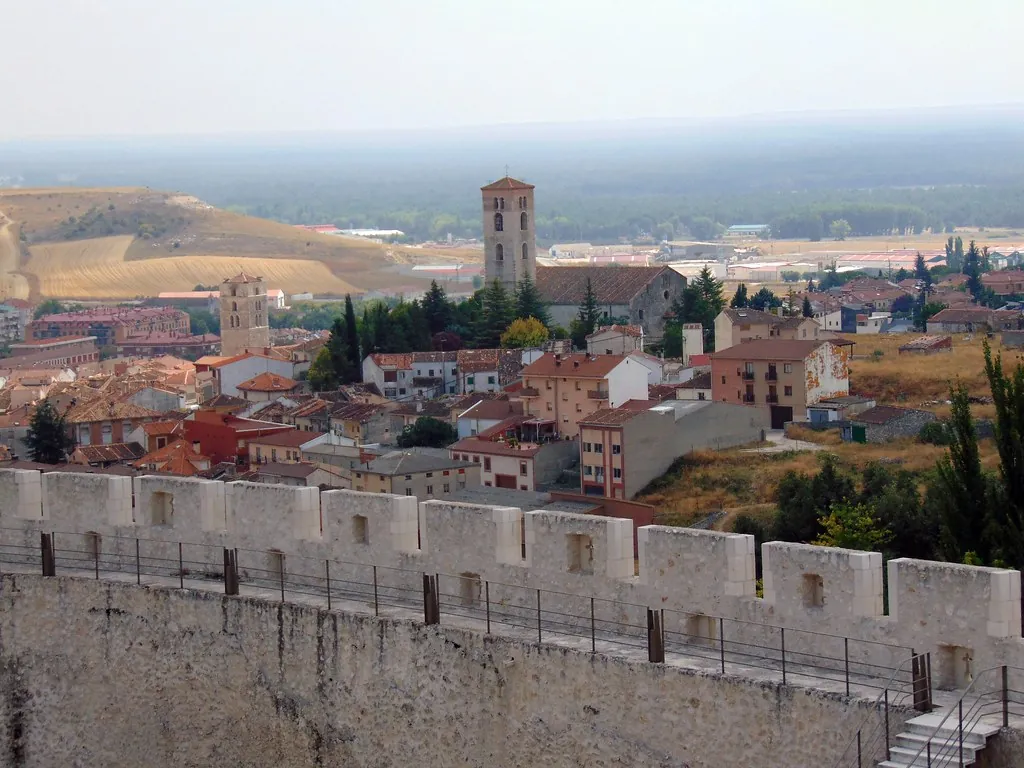
The Iglesia de Santiago is the building that draws the most attention. It has the Romanesque-Mudéjar character seen in several places around Valladolid: brick construction, rounded arches and a blend of styles that feels almost improvised yet coherent. Close by stands the Iglesia de San Pedro, whose tower shapes the skyline of the village.
The main square has changed over the years, as most do. It now has more stone and fewer irregularities underfoot, but it remains the centre of daily life. Conversations stretch out, errands are interrupted by chance meetings, and people drift back and forth across the open space. In a settlement this size, the square is more than decoration. It is where the day unfolds.
Stories Told in Passing
Some of Alcazarén’s history is not found on information boards. It surfaces in conversation.
One of the most frequently repeated stories concerns the bandit Luis Candelas. According to local tradition, he was arrested here in the nineteenth century while attempting to flee north. The episode is remembered in a house in the old centre where a plaque refers to the event. Whether visitors arrive already knowing his name or encounter it for the first time, the tale continues to circulate among residents.
Another figure associated with the village is the writer José Jiménez Lozano, recipient of the Cervantes Prize, one of Spain’s most important literary awards. He lived in Alcazarén for many years, largely removed from literary circles. Here he is remembered in a straightforward way, as a neighbour who happened to write extensively rather than as a distant cultural figure.
These connections do not dominate the streetscape. They emerge when you ask.
Autumn Light and the Taste of Castilla
Ask when Alcazarén feels liveliest and many will point to autumn. Around that time a fair dedicated to Luis Candelas is usually held, bringing together a market, activities and a noticeable buzz in the square. For a village of this size, it changes the atmosphere.
Even without the fair, autumn carries its own appeal. The pine forests shift in tone, chimneys release the smell of burning wood and the surrounding countryside grows quieter still. Fields and patches of dehesa, the open woodland typical of central Spain, stretch out around the settlement. The sense of space becomes more pronounced.
Conversations about food in this area often turn to lechazo, roast suckling lamb that is closely associated with Castilla. Being in this region makes its presence on local tables unsurprising. It is part of the broader culinary identity rather than a novelty.
A Circular Walk of Stone Crosses
On the outskirts of Alcazarén there is a small circular route that passes several old stone crosses. They are the remains of a former Vía Crucis, a devotional path that once linked the Ermita del Cristo del Humilladero with the parish church.
The walk is flat and straightforward. It leads through pine forest, patches of dehesa and open fields. There is nothing dramatic about it, and it does not aim to be spectacular. It suits a gentle outing after lunch, a chance to clear the head while following a route with quiet historical traces.
What stands out most is the silence. If no car passes nearby, the only sounds are wind moving through the pines and, with luck, a large bird gliding overhead. The setting does not demand attention. It rewards stillness.
What You Will Not Find, and Why That Matters
Alcazarén has no souvenir shops and no streets designed for fast tourism. Its population hovers just above six hundred, and daily life is organised around residents rather than visitors.
Does it justify a detour? That depends on expectations. This is not a place to fill a packed itinerary. It suits a few unhurried hours, a walk along the River Eresma, a slow circuit of the streets and time spent sitting in the square without watching the clock.
In this corner of Valladolid, the appeal lies in understanding how life unfolds in the Tierra de Pinares. Pine forests frame the horizon, the Camino de Madrid threads quietly through, and stories of bandits and writers surface in conversation rather than on billboards.
Alcazarén works best without haste. Sometimes that is exactly what is needed.