Full Article
about Aldeamayor de San Martín
A steadily growing municipality near Valladolid; it blends modern residential areas with a traditional old quarter and vast pine forests.
Hide article Read full article
Arrival Through the Pines
Tourism in Aldeamayor de San Martín often begins in the same way. You drive along the VA‑201, pines lining both sides of the road, with very few signs suggesting that anything in particular is about to appear. Parking is rarely an issue. Around the Plaza Mayor and the nearby streets there is usually space, except on the occasional weekend when a local event draws a crowd.
Then the village appears, suddenly, in the middle of the pine forest of Valladolid province. Pines are the first thing you notice. And then more pines. Aldeamayor de San Martín is home to just over six thousand residents, spread between the main historic centre and several residential developments around it. It feels compact, but not tiny.
The setting explains much of its character. This is flat Castile, where woodland and open land alternate, and where villages sit low against the horizon.
The Village Created by Royal Signature
Local history points to a precise date: 19 May 1776. On that day, King Carlos III signed the document that united several scattered hamlets into a single town. Aldeamayor was born from that decision. The anniversary is still marked today with a fair, usually held in May on the nearest weekend to the date. Expect market stalls, traditional music and the kind of atmosphere that turns the main square into a meeting point for neighbours.
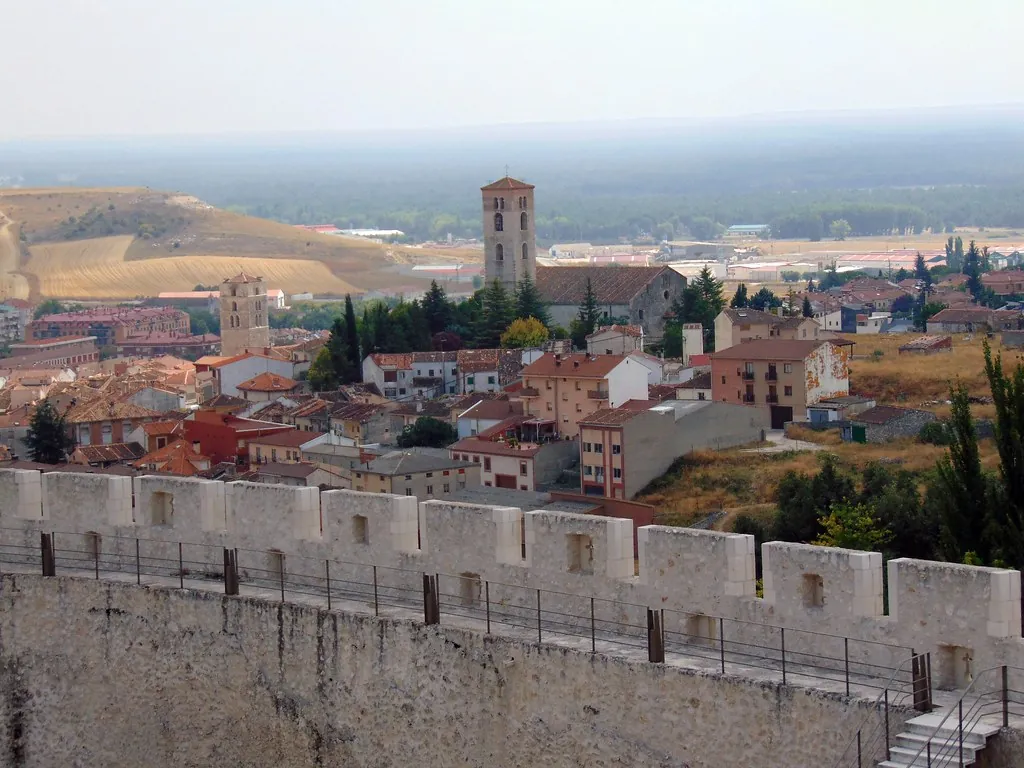
In the old quarter, the Iglesia de San Martín Obispo stands out clearly. It combines Gothic elements with later additions, which is typical in this part of Spain. Churches were often begun in one century and finished in another, leaving behind a mixture of styles rather than a single, uniform design.
A short walk away is the 15th‑century Capilla de Santa Catalina. Inside, it preserves a Renaissance altarpiece and an image of the Virgin that plays a central role each spring. On 13 May, the statue traditionally travels in romería, a popular religious procession, to the Ermita de Compasco. The route is about five kilometres through the pine forest. If a visit coincides with that date, it is common to see groups of people walking the same path, turning the woodland into a moving line of pilgrims.
These traditions give context to what might otherwise seem like a quiet, residential town. Dates and rituals still shape the calendar.
Where the Pines Set the Rules
The Salgüeros de Aldeamayor forms part of the Red Natura 2000 network, the European Union’s system of protected natural areas. In simple terms, this means safeguarded pine forest with marked footpaths. There are no dramatic viewpoints or sweeping panoramas. The appeal lies elsewhere.
One of the best‑known routes is called “Donde los pinos sueñan”, which translates roughly as “Where the pines dream”. It usually begins at the Ermita de Compasco and follows an easy path, almost always in shade. The experience is understated: quiet, the scent of resin in the air, and a soft carpet of pine needles underfoot.
Many visitors who come by car leave it near the hermitage. Close by stands the pino Carranza, also known as the pino de la Tía Hilaria, an old specimen that has become a local reference point. There is a stone table nearby, useful if you have brought something to eat. Beyond that, facilities are limited. In the pine forest there are no services and no bars.
The absence of extras is part of the setting. This is a place for walking rather than sightseeing in the conventional sense. The forest sets the pace and tone.
Golf on the Dehesa
On the outskirts of Aldeamayor de San Martín lies a golf course within the dehesa, the traditional Spanish landscape of open woodland and pasture. It was built some years ago with the intention of attracting players from outside the town, particularly from Valladolid and Madrid.
At weekends there is usually more activity. During the week the atmosphere tends to be calmer. For those who do not play golf, there is little reason to go simply out of curiosity. Access is controlled and entry is not always allowed to people who are not there to play.
The course sits somewhat apart from the older core of the town, reflecting a more recent phase in its development. It coexists with the forest and residential areas, rather than defining them.
Eating, Timetables and Everyday Rhythm
Food in Aldeamayor follows the traditions of this part of Valladolid province. Lechazo asado, roast suckling lamb, is the classic dish. The cooking is hearty and there is little interest in experimentation. It is sensible to ask about the price of lechazo before ordering, as it can vary depending on the season.
Bars and restaurants keep fairly fixed hours. In mid‑afternoon many close for a while, and the town becomes noticeably quiet. This pause is part of the daily rhythm. Outside peak times, the streets can feel almost still.
The tourist office opens in summer and during certain specific periods. For the rest of the year, the most practical approach is to ask at the town hall or speak to a local resident. In places like this, information often circulates more effectively by conversation than by leaflet.
A Simple Way to Understand Aldeamayor
If there is a season to choose, autumn has its advantages. After the first rains, the scent of the pine forest changes, and there tend to be fewer people on the paths.
A straightforward plan works best. Park in the centre, take a short walk around the Plaza Mayor, step into the Iglesia de San Martín Obispo if it is open, and then head towards the pine forest. Aldeamayor de San Martín makes more sense after half an hour among the trees than after studying a map of its streets.
There are no grand monuments or dramatic landscapes competing for attention. What defines the place is continuity: a town created by royal decree in the 18th century, religious traditions that still bring people together in May, and a protected forest that begins almost at the edge of the houses.
In Aldeamayor, the pines are not a backdrop. They are the main presence. Walking beneath them, with resin in the air and needles underfoot, is the clearest way to understand where you are. For many visitors, that is enough.