Full Article
about Almenara de Adaja
Town with a notable Roman legacy on display in its villa-museum; set in the quiet Pinares region.
Hide article Read full article
A quiet start in Tierra de Pinares
Early in the morning, the streets of Almenara de Adaja are almost empty. Light slips in low between façades of adobe and stone, clinging to rough walls as if reluctant to wake them. The air carries the smell of damp earth and old firewood. Now and then a tractor can be heard somewhere out in the fields, then silence settles again.
Tourism here does not follow the pattern of a planned getaway. Almenara de Adaja is small, just a handful of houses gathered around a church, and daily life follows the rhythm of the land. It sits in the region known as Tierra de Pinares, about 45 minutes by car from Valladolid, in a flat landscape where pinewoods appear as dark patches across pale, sandy ground.
At around 770 metres above sea level, the altitude shapes the atmosphere. In summer, the midday sun is intense, but later in the day a light breeze often drifts in from the Adaja valley. Winter feels different. Cold lingers close to the ground, and the streets seem to absorb what little daylight there is.
Adobe walls and the church of San Bartolomé
The layout of the village is simple. Straight streets, low houses and enclosed courtyards hidden behind wooden gates define the space. Many homes still have walls made from adobe mixed with stone, in earthy tones that shift depending on the hour. Some doorways retain old iron fittings, and windows are protected by thick metal grilles.
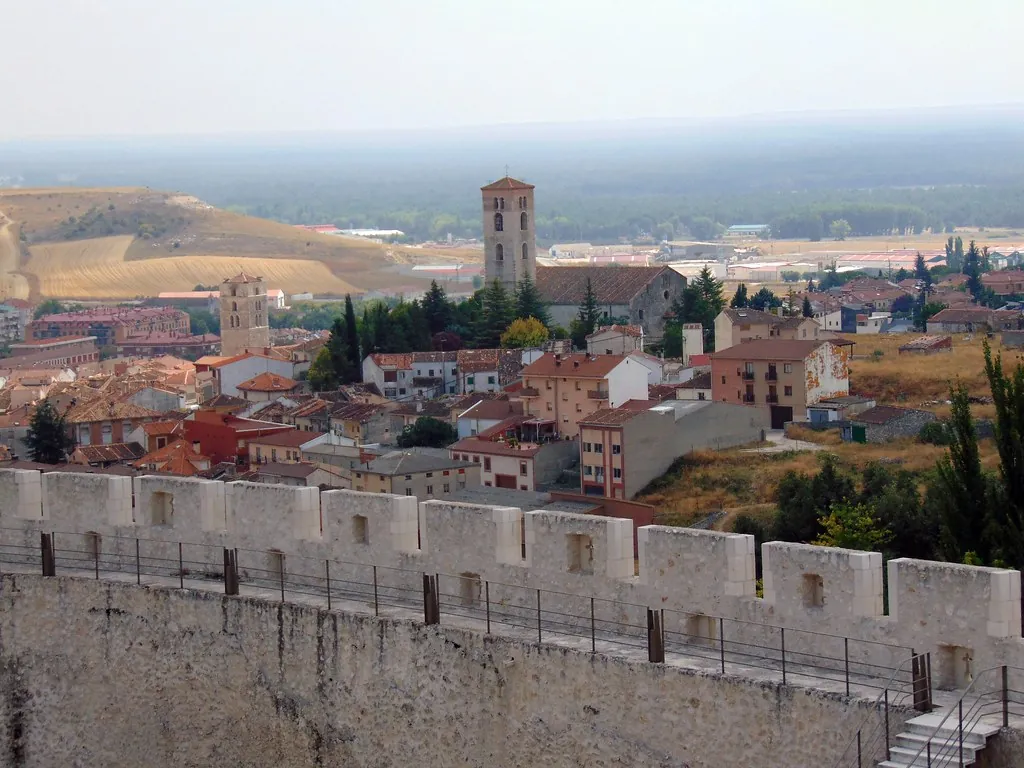
At the centre stands the church of San Bartolomé. It is modest in size, with a rectangular nave, thick walls and a small bell tower that barely rises above the rooftops. The stone on the façade is a pale grey that, on winter afternoons, takes on a faint bluish hue.
When the square is empty, which is often the case, the only sounds are the wind moving through overhead cables and the sharp closing of a door somewhere nearby.
The Adaja river and nearby pinewoods
The Adaja river runs close to the village. It is not always visible from within the settlement itself, but its presence can be felt in the humidity of the air and the change in vegetation as you approach it. The riverbanks are lined with poplars and reeds, and in quieter stretches it is common to spot herons or a kingfisher darting low over the water.
To the west begin the pinewoods that give the region its name. These are forests of resin pine, growing in sandy soil, with wide tracks that lead between straight trunks. Walking here brings a distinct sound underfoot, the crunch of dry pine cones, and a resinous scent that becomes stronger in the heat.
Rural paths connect Almenara de Adaja with nearby villages such as Puras and Villaverde de Medina. Some sections follow old livestock routes that once guided seasonal movements of herds. They are not marked as formal walking trails, but they can be followed without difficulty if you carry water and avoid the hottest hours in summer.
A Roman past: Almenara‑Puras
A few kilometres away lies the archaeological site known as the Roman villa of Almenara‑Puras. Here, mosaics and remains of an ancient rural residence have been preserved. They offer a glimpse into how this plain has been inhabited for centuries, even if today it appears quiet and sparsely populated.
The site works well as a complement to a visit to the village, adding a historical layer to the surrounding landscape.
Living with few services
It is worth arriving prepared. In Almenara de Adaja, services are limited and not always available throughout the year. Daily life often depends on larger nearby towns, where it is more practical to stop for food or basic supplies before arriving.
Even so, small direct sales of local produce do appear from time to time. Sheep’s cheese, pulses or wine from the area can sometimes be found. These are not always signposted; occasionally they are discovered simply by asking around.
When the village fills with life
For much of the year, the village remains very quiet. That changes in August, when the festivities of San Bartolomé take place and residents who live elsewhere return. There is a procession, music and a noticeable increase in activity in the streets.
There is also a romería, a traditional pilgrimage, to a nearby hermitage set among the pinewoods. On these days, the village regains voices, parked cars and a sense of movement that contrasts with its usual stillness.
When to go and how to move around
Spring and early autumn tend to be the most comfortable times for walking along the surrounding paths. In summer, the midday heat can be demanding, especially in areas without shade.
If arriving by car, it is easiest to leave it at the entrance and continue on foot. The village can be crossed in just a few minutes, and its pace invites exactly that: slow walking, and paying attention to what happens when very little seems to happen at all.