Full Article
about Carbonero el Mayor
Major industrial and service hub; noted for its monumental church and pork-processing industry.
Hide article Read full article
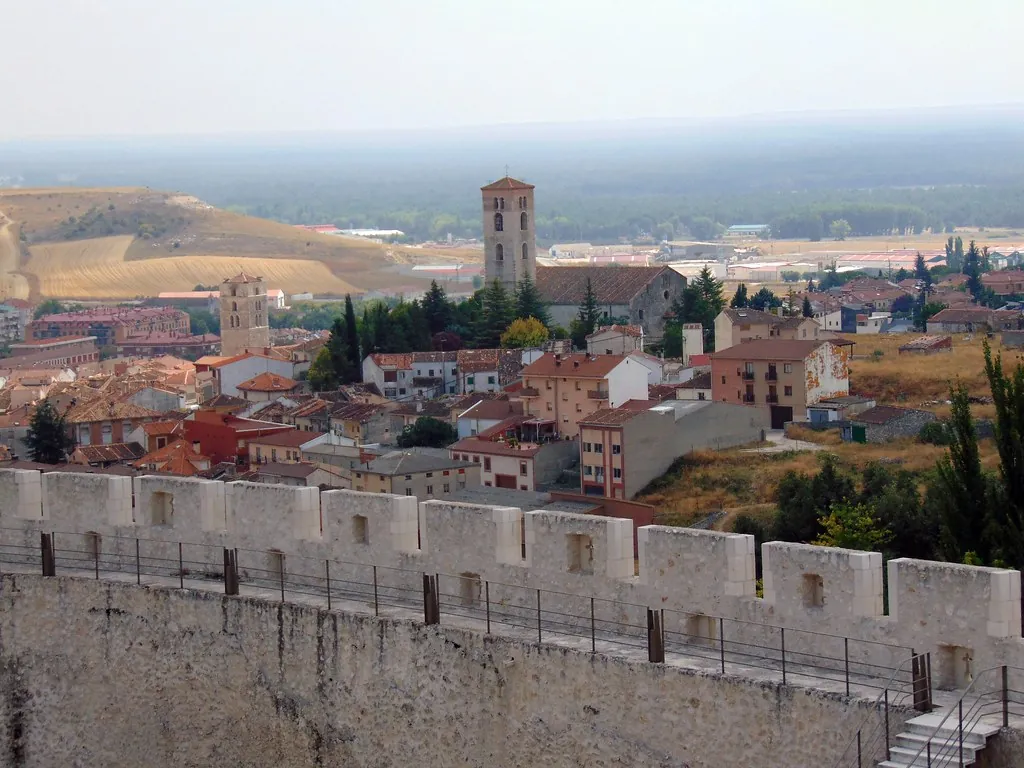
The smell of warm resin reaches you before the village comes into view. It drifts down from the pine forest, which spills over the slope like a dark green tide and stops just where the red-tiled roofs begin. On an October Saturday at four in the afternoon, Plaza de España is almost completely still. Only an orange cat stretches out on the sun-warmed stone of the fountain.
Tourism in Carbonero el Mayor begins like this, with the pine forest pressed up against the edge of the village and the quiet of the middle hours of the day. It appears after a bend in the SG‑232, when the road stops being perfectly straight and climbs slightly. The village lies around thirty kilometres from Segovia and has just over two thousand inhabitants.
Here, the passing of time is most noticeable in the air. In summer it carries resin and pale dust. In winter it descends cold from the pinewoods and lingers between the streets. Locals say you can see the change of season on the rooftops and in the thin thread of smoke that sometimes rises from the ham-drying sheds.
The Altarpiece of San Juan Bautista
The church of San Juan Bautista often has its door left slightly ajar. Stepping inside means pausing for a few seconds while your eyes adjust to the dim light. Then the main altarpiece comes into focus.
It is large and gilded, crowded with figures that blend the final traces of Gothic style with a language already turning towards the Renaissance. The wood catches the light that filters through the high windows and reflects it back in warm tones. Angels have rounded, almost childlike faces. The columns seem to twist gently on themselves.
There is a scent of wax and cold stone. The floor slabs are worn in the same spots where generations have walked. In a side chapel, a Virgin in a dark blue mantle gazes towards the centre of the church with the calm expression common to many old religious images.
If visiting, it is best to do so early in the morning or late in the afternoon. At midday the church is usually closed.
When the Pine Forest Meant Work
The village’s name is not metaphorical. For centuries, much of the local activity revolved around charcoal made from pine wood. In clearings in the forest, charcoal burners built carboneras: piles of logs covered with earth that smouldered slowly for days.
The whole area, known as Tierra de Pinares, has lived from this woodland. Even today the landscape sets the rhythm. Pines encircle the municipal boundaries and the air carries that dry, slightly sweet scent that appears when the heat intensifies.
In the centre, Calle Real still preserves old houses built of stone and tapial, a traditional technique using compacted earth. Many façades show a slight outward curve at the base, shaped by years and by moisture rising from the ground. By mid-afternoon it is common to see residents bringing a chair out to the doorway as the shade begins to stretch across the street. The sun remains strong, yet the air brings a light freshness from the pines.
The Pilgrimage to El Bustar
On the Saturday before Pentecost Sunday, Carbonero el Mayor turns its attention in the same direction: towards the hermitage of El Bustar. It stands on the outskirts, on a small rise surrounded by open countryside.
The ascent follows a reddish dirt track that, if it has not rained, lifts dust with every step. Many families walk, others drive as far as they can. They carry Spanish omelette, bread, cured meats and wineskins passed from hand to hand.
From the top, the entire village is visible: the church tower, the red roofs and beyond them the dark mass of the pinewoods. When the sky is clear, the distant outline of the sierra can be seen to the south.
People remain there for much of the day. The descent happens slowly, when the sun begins to drop and the path no longer dazzles with light.
Springs and Paths Among the Pines
About two kilometres from the town centre, along a track that begins where the tarmac ends, lies the abandoned settlement of Fuentes. Few remains are left, yet the church of the Asunción still has much of its walls standing.
Its interior has long been open to the sky. Moss grows across the stone and, after damp days, the place carries that scent of cold earth found only in abandoned buildings. From the entrance arch, looking east, the tower of Carbonero can be glimpsed between the trees.
In the area of Peña Carrasquilla there are also rock shelters with prehistoric paintings. They are not always easy to distinguish at first glance. Initially they seem like simple stains on the stone. When sunlight falls at an angle, shapes begin to emerge, such as the outline of an animal with curved horns.
Paths are not always marked with modern signposts, so it is sensible to carry a map or ask in the village beforehand. Morning light is softer and more comfortable for walking. In summer, from midday onwards, the heat among the pines becomes dry and persistent.
When to Go
September is often a good time. The heat begins to ease and the pine forest smells stronger after the first cool nights. Around 8 September, the village marks its local celebrations, and the atmosphere shifts from the usual calm to something more animated, while the presence of the forest and the steady outline of the church tower remain unchanged.
Carbonero el Mayor does not present itself all at once. It unfolds through its resin-scented air, the glow of its altarpiece and the slow paths that lead out towards pines and open fields.