Full Article
about Carrascal del Río
Gateway to the Hoces del Duratón; known for the Ermita de San Frutos within its bounds.
Hide article Read full article
By mid-morning, once the sun has started to warm the sandy tracks, the air around Carrascal del Río carries the scent of pine and dry earth. Sound travels easily here. Wind brushes the tops of tall trees, a door closes somewhere along a street, a dog barks without much urgency. Carrascal del Río, in the north of Segovia, has moved at this unhurried pace for decades.
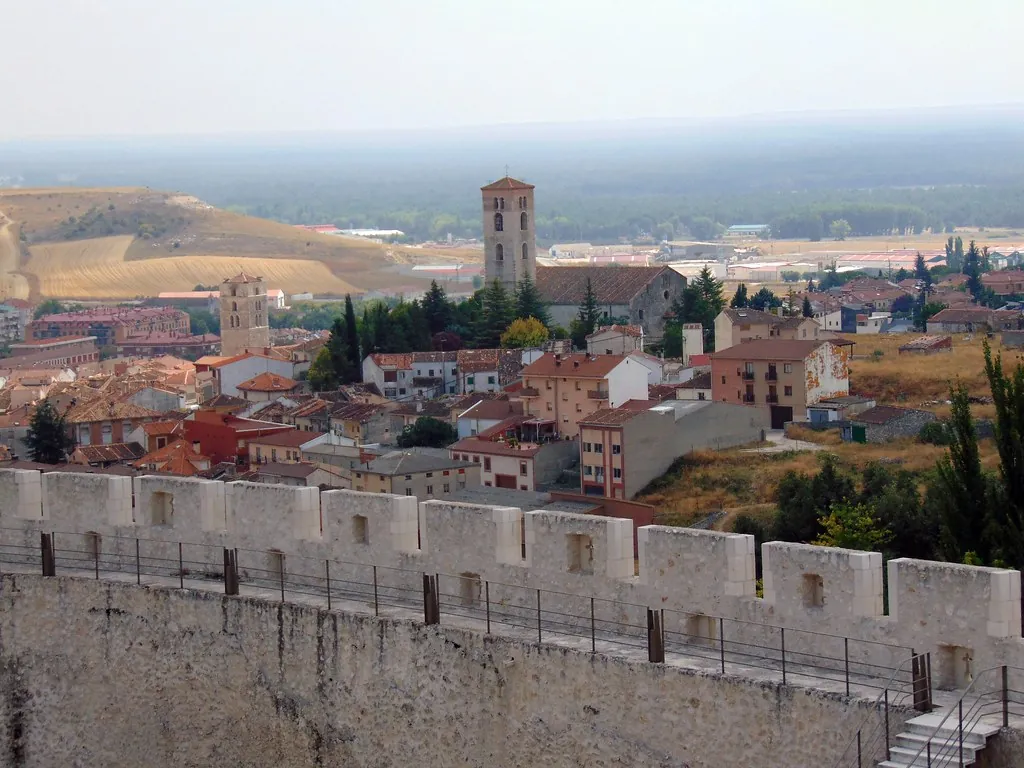
The village has just over a hundred residents. Houses cluster along short streets, with stone walls and wooden gates marked by many winters. There are no large squares or attention-seeking buildings. Everything happens on a small scale. The parish church stands at the centre, plain in appearance, its bell tower still marking the hours on quiet days.
A walk through the village does not take long, though it is worth slowing down. Yards appear between houses, stacks of firewood are kept in neat order, and small vegetable plots sit close to the street. In autumn, those plots are often covered with a thin white layer of frost at dawn. Winter arrives early in these wind-exposed streets, so visits at that time of year are easier once the sun is already high.
Between pine forest and limestone cliffs
The municipal area opens out towards the pine forests known as the Tierra de Pinares and, not far away, towards the cut limestone walls of the river Duratón. On clear days, the contrast becomes obvious. One side shows the dark, even green of the pinewoods. The other reveals pale rock faces shaped over centuries by the river.
These pine forests are extensive and notably quiet. In summer they offer dense shade and a resinous smell that clings to clothes after even a short walk. Resin tapping used to be a common job in this area. Some residents still remember the cuts made into the bark and the containers placed to collect sap.
Forest tracks begin almost without warning at the edges of the village. Not all of them are signposted, so it helps to have a route saved on a phone or a simple map to hand. Most are easy paths with little change in elevation, stretching for kilometres through the trees.
Close to the Duratón canyon
A short distance from Carrascal del Río, the landscape starts to shift. The ground becomes uneven, the colour of the soil changes, and the river appears suddenly at the bottom of steep cliffs. This is the area of the Duratón gorges, known locally as the hoces del Duratón.
Griffon vultures are a constant presence here. They ride the air currents and glide high above the cliffs, often without moving their wings. The scale of the landscape becomes clearer when watching them circle over the canyon.
Care is needed near the edges. It is best to follow the paths already marked by use and to approach slowly. In some stretches the limestone breaks away easily, and the drops are steeper than they seem from a distance.
Wildlife, quiet and a bit of patience
There is plenty of activity between the pine forest and the river, though it is not always obvious at first glance. Birds are often heard before they are seen. Species such as coal tits, crossbills and jays move through the trees, their calls carrying through the still air.
At dawn and again towards evening, roe deer sometimes cross the open spaces between the pines. These moments are brief and usually at a distance. This is not a place set up for easy wildlife watching. Animals appear when they choose, often far from the path.
A slower pace works best. Walking without hurry and stopping now and then increases the chances of noticing what is around, even if it is just a flicker of movement or a sudden call from deeper in the woods.
Practical notes before you go
Carrascal del Río is a small village with very limited services. It makes sense to arrive with essentials already sorted in larger towns nearby.
Parking is simplest at the entrances to the village, then continuing on foot. Streets are narrow and traffic is minimal.
Summer brings strong midday heat, especially on paths outside the pine forest where there is little shade. Walks are more comfortable earlier in the day or later in the afternoon, when the light softens and the air begins to cool.
At night, under a clear sky, darkness is almost complete. From the tracks leading out of the village, the band of the Milky Way can be seen clearly when there is no moon. Artificial light remains scarce here, and the sky reflects that.