Full Article
about Castro de Fuentidueña
Small hilltop village with sweeping views; still as quiet as ever.
Hide article Read full article
Morning Light in a Village of Forty
At nine in the morning, sunlight slips sideways through the small windows of the church of San Andrés. The stone warms quickly. Inside, golden light mixes with cool shadow. Tourism in Castro de Fuentidueña often begins like this: in silence, with the scent of resin in the air and the sense that the day has not fully started.
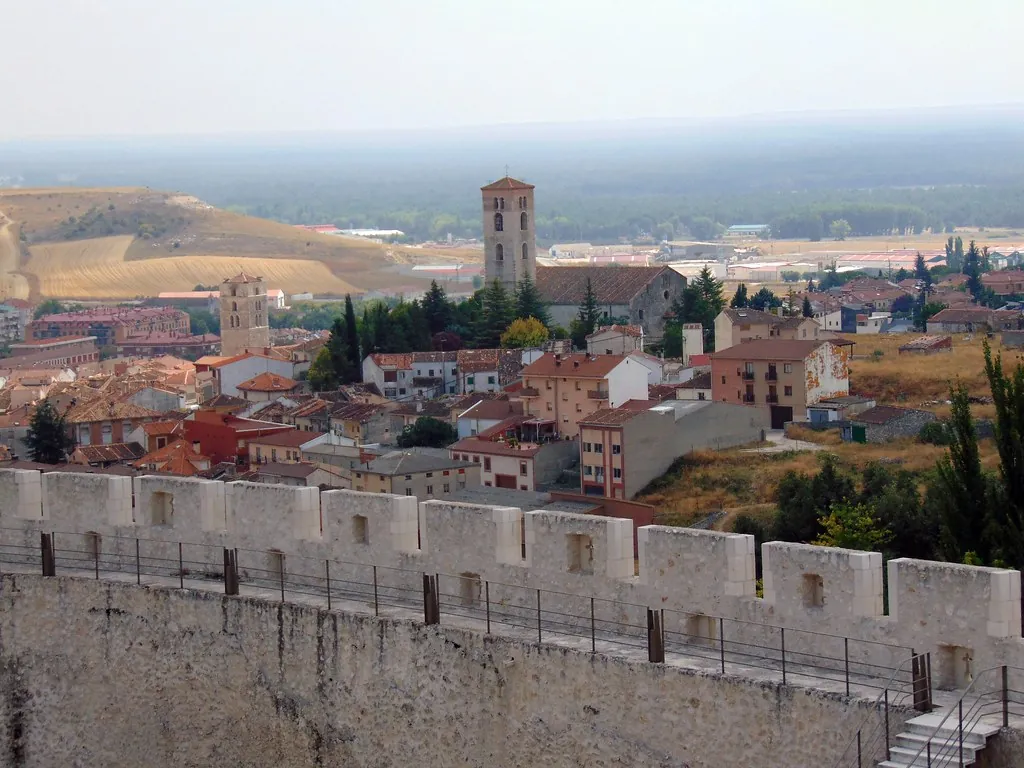
Castro de Fuentidueña is a tiny village in the Tierra de Pinares, a landscape in the province of Segovia known for its extensive pine forests. Around forty people live here. The houses are built of rough masonry. Some lean slightly to one side, others have been carefully restored. Doors sit low in their frames. Fine cracks run across many façades, opening like veins in the stone. In this place, time shows more clearly on walls than on clocks.
Life moves at a steady rhythm. There is no rush to fill the streets, no steady flow of traffic. What stands out instead is stillness, broken by the occasional sound of a door closing or footsteps on stone.
San Andrés and the Heart of the Village
A narrow street climbs from the small square up to the church. The walk takes barely a couple of minutes. San Andrés is simple, almost austere in appearance. A short tower holds two bells. Thick walls keep the interior cool during the summer months.
Several houses around the square are lived in all year. Others open only in summer, when families return to what were once their grandparents’ homes. In August, the atmosphere shifts. Cars arrive. Doors that have been shut for months open again. Voices carry across the square in the evening light.
For most of the year, however, the village remains quiet. The scale of Castro de Fuentidueña means that any change is noticeable. A handful of extra people can alter the mood. Yet even at its busiest, it never feels crowded.
The Pine Forest at 1,100 Metres
Castro de Fuentidueña stands at about 1,100 metres above sea level. The pine forest begins as soon as you leave the last houses behind. Two species dominate: pino resinero and pino piñonero. Their trunks grow straight and fairly well spaced. When the sun grows strong, the air carries the dry scent of resin.
In autumn, the ground lies covered with needles and open pine cones. Footsteps sound soft, almost cushioned. Winter brings colder, clearer air. Even in summer, when the sun falls hard at midday, the shade beneath the pines keeps temperatures reasonably manageable.
The forest shapes daily life. Light filters through the canopy in shifting patterns. Colours change with the seasons. In the late afternoon, the trunks can take on a reddish tone as the sun drops lower, and the smell of pine seems stronger.
Dirt Tracks Between Villages
There are no marked footpaths or information panels around Castro de Fuentidueña. Instead, wide forestry tracks and agricultural paths connect the village with nearby places such as Villaverde de Montejo and Torre Val de San Pedro.
The tracks are broad and made of compacted earth. Some stretches are scattered with loose stones. They can be followed on foot or by bicycle without too much difficulty, provided you are used to this kind of terrain. The central hours of July and August are best avoided. Shade is not continuous, and heat gathers on the more open sections.
These routes are practical rather than curated. They serve the land and the forest first, visitors second. That simplicity is part of the experience. There are no signposts explaining what you see. The landscape speaks for itself, if you are willing to pause.
Mushrooms, Birds and the Sound of the Wind
In damp autumns, the forest attracts mushroom hunters. Níscalos, known in English as saffron milk caps, tend to appear beneath young pines, half hidden among dry needles. On those days, cars line the entrances to the tracks.
The area also supports a good number of woodland birds. Thrushes move through the trees. Blue tits flit between branches. Occasionally a woodpecker can be heard working at a trunk. A bird of prey may pass overhead, riding the air currents that form above the pine canopy. There are no observation hides or dedicated facilities. Stopping and watching for a while is enough.
Silence plays a central role here. It is not absolute, but layered: wind in the treetops, a distant bell, the muted crunch of footsteps. The absence of infrastructure reinforces that feeling. Nothing interrupts the line of sight through the trees.
Festivities in Honour of San Andrés
The main local celebrations take place in August in honour of San Andrés. They are modest affairs. Short processions move through the village. Neighbours gather. People who have returned for a few days meet in the square and catch up.
Outside those days, the calendar is quieter. At Christmas, some houses set up simple nativity scenes. During Holy Week, the church bells still ring at certain moments of the day. These small gestures mark the passing of the year more than any large public event.
Seasonal change is visible in other ways too. August brings more movement and more open second homes. The rest of the year belongs largely to the permanent residents and to the forest.
Reaching Castro de Fuentidueña
Castro de Fuentidueña lies about fifty kilometres from the city of Segovia, reached by secondary roads. The drive passes through several small villages before arriving at Castro. The final kilometres run between fairly dense pine woods.
It is best reached by car. Public transport in this area is limited and does not always extend to such small villages.
Spring and autumn are usually the most pleasant times to walk through the pine forest. Summer brings a little more life to the village, along with more cars and reopened houses. Anyone looking for deep quiet will find it more easily outside August, on a cool morning when the only sound is the wind moving through the tops of the pines.