Full Article
about Cobos de Fuentidueña
Near the Duratón River; riverside farmland with quiet charm.
Hide article Read full article
A small village on the Segovian plain
Cobos de Fuentidueña sits in the Tierra de Pinares area of Segovia, a region defined by the meeting of wide cereal plains and extensive pine forests. At around 830 metres above sea level and with only a few dozen registered residents, it belongs to a network of very small settlements that still shape the rural landscape of northern Segovia.
The surrounding pinewoods have long influenced local life. For generations, resin extraction from these trees played a central role in the economy, alongside dry farming and a small amount of livestock. That way of life has gradually shifted. Many houses now open mainly in summer or at weekends, when people with family ties return.
Cobos lies close to Fuentidueña and the Duero valley, placing it within a wider area with a long history. Even so, the village itself has always remained modest in scale.
Rural architecture and everyday spaces
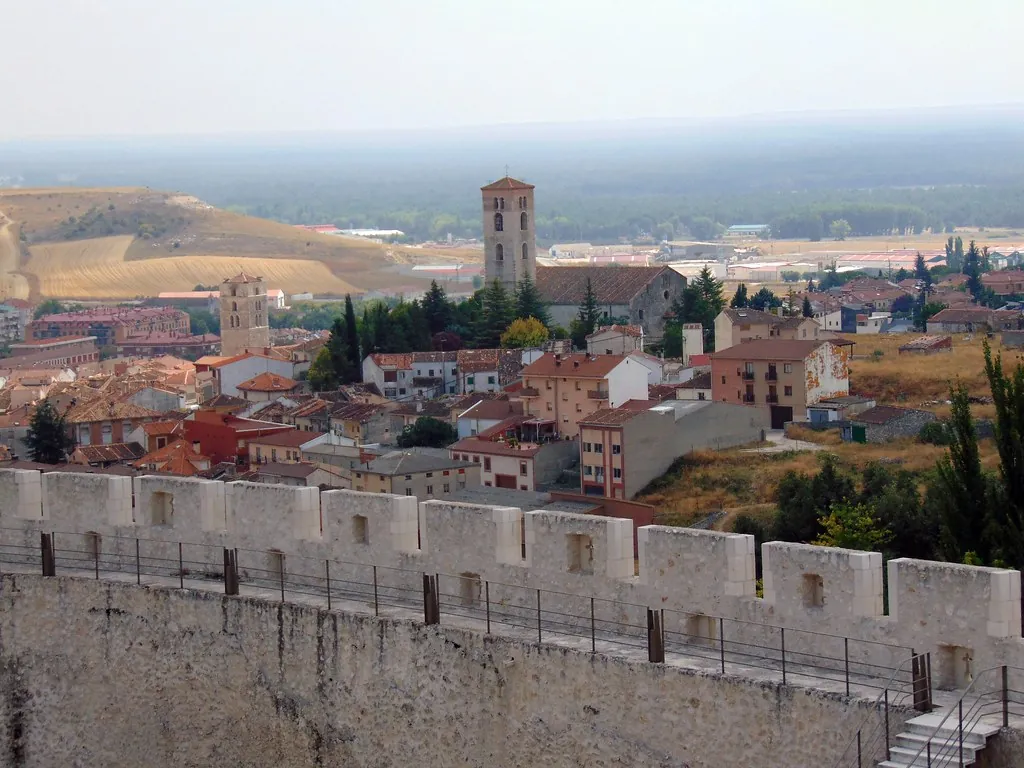
The layout of the village follows a familiar pattern for this part of Segovia. Houses tend to be one or two storeys high, built using local stone and adobe. They are arranged around courtyards and small working areas linked to domestic life.
At the highest and most visible point stands the parish church, dedicated to San Juan Bautista. The current building is usually dated to the 16th century, although later alterations have shaped its present appearance. It is a solid, compact structure with thick walls and a simple tower that functions as a bell tower. Rather than dominating the surroundings, it acts as a reference point for the small cluster of homes around it.
Walking through the streets, traces of traditional building techniques are still easy to spot. Large gateways once used for carts remain in place, along with barns attached to houses and some wooden galleries facing south, designed to capture sunlight during the colder months.
Pine forests shaped by work
The landscape around Cobos de Fuentidueña is largely defined by pine forest. This is not untouched woodland in the strict sense, but terrain that has been managed for centuries for resin and timber.
A network of agricultural and forestry tracks leads out from the village into these wooded areas. Many of these paths are still used for work related to the land, so it is important to move carefully and avoid blocking access.
In autumn, it is common to see people searching for mushrooms. Níscalos, a well-known edible variety in Spain, appear in the pinewoods in wetter years. Their collection is regulated in much of the province, so checking the current rules is advisable.
Between the pines, clearings open up views towards the cereal fields that characterise this part of Segovia. The contrast between forest and farmland is one of the defining features of the area.
A very small place to pause
Cobos de Fuentidueña is quiet even by rural Spanish standards. With around twenty-five inhabitants, daily life unfolds at a slow pace and with limited services.
A visit to the village itself is usually brief. Its size means it can be explored in a short time, and it tends to work better as a stop along a wider route than as a destination on its own. Just a few minutes away by car lies Fuentidueña, whose medieval walled enclosure and position above the Duero valley add a different historical layer to the area.
It is also common to combine a visit with other villages in Tierra de Pinares. Across the region, the same pattern repeats: wide stretches of pine forest and small, scattered settlements.
Local traditions and seasonal gatherings
The festival linked to San Juan Bautista remains a key point in the local calendar. In villages of this size, celebrations often concentrate in the summer months, when former residents and relatives return, and Cobos follows a similar rhythm.
During these days, the village becomes more active. There are gatherings among neighbours, religious events, and shared meals in communal spaces. The emphasis is less on a packed programme and more on reconnecting with people who maintain ties to the place.
Practical notes for visiting
Cobos de Fuentidueña is reached via local roads that connect with Fuentidueña and other nearby villages in the area. It is sensible to arrive prepared, with fuel and any necessary supplies arranged in larger towns.
A walk through the village does not take long. To gain a better sense of the surrounding landscape, it is worth spending more time exploring the forest tracks and then heading towards the Duero valley, which lies close by.