Full Article
about Cogeces de Íscar
Small town on the river Cega, known for its Gothic church and riverside setting among pine woods.
Hide article Read full article
A village shaped by the pines
In the central part of the Tierra de Pinares in the province of Valladolid, Cogeces de Íscar sits within one of the most continuous stretches of pine forest in the area. Here, the landscape is inseparable from the pino resinero, a species of pine that for generations defined the local economy and still shapes the terrain today. With just over 140 inhabitants and lying at around 730 metres above sea level, the village retains the scale of agricultural settlements typical of the Castilian plateau, where most things happen on foot and the rhythm of life follows the seasons.
Cogeces de Íscar belongs to a wider network of small villages that structure the Tierra de Pinares. These settlements grew around forestry and cereal farming, using materials found locally such as adobe, brick and timber. The layout is compact and practical, designed more as protection against the climate than as an expansion outwards.
Daily life continues to revolve around this connection to the land. Expressions like “ir a la finca” (going out to a plot of land) or “estar en la era” (being at the threshing ground) still make sense here, as many families maintain small holdings or fields. Although depopulation has reduced activity, the agricultural landscape continues to function much as it always has, with rotating cereal crops, rural tracks created through land consolidation, and pinewoods spreading in broad green patches around the village.
Buildings and surroundings
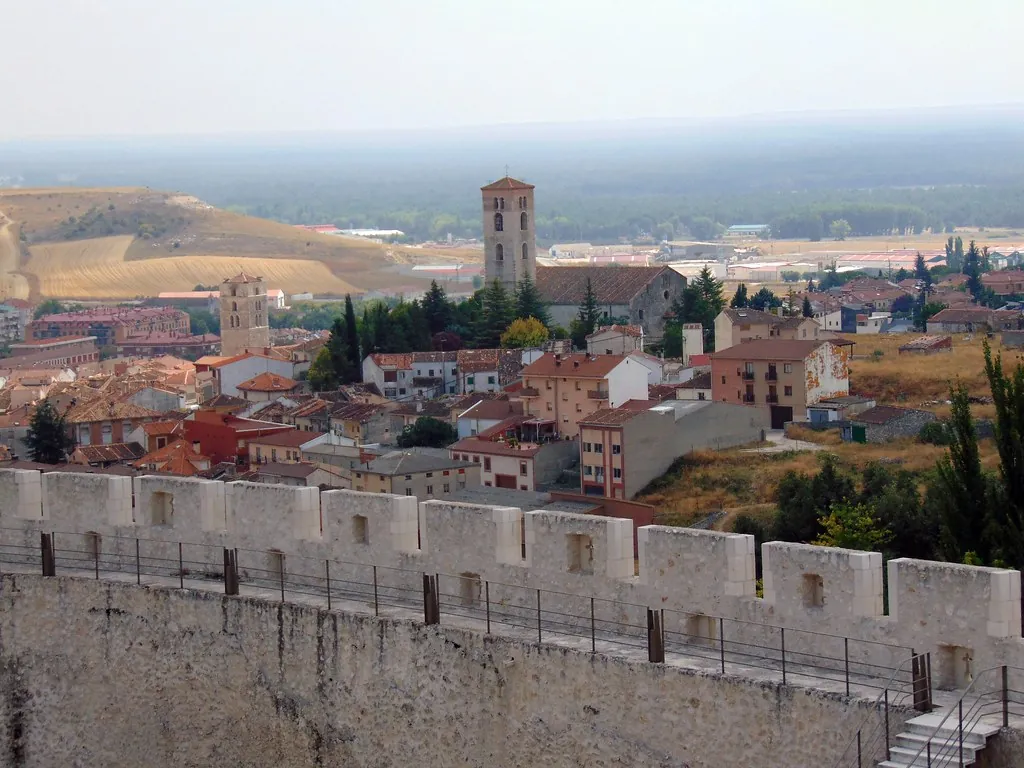
The built environment follows the traditional architecture of the Castilian plateau. Houses combine rammed earth, adobe and brick, with earthy-toned façades and roofs of curved tiles. There are no grand buildings or a defined monumental centre. Instead, the interest lies in the coherence of the whole and in how the village fits naturally into its surroundings.
At the centre stands the parish church dedicated to San Martín. The building appears to be the result of different construction phases, something common in villages of this size where churches were adapted according to the means of each period. Its importance is less about architectural detail and more about its role as a meeting place. For centuries, it served as the setting where announcements were made, celebrations organised and decisions shared among residents.
Beyond the village, the pine forests that give the region its name extend in all directions. These are flat woodlands, easy to explore along forest tracks that run for kilometres between the trees. Many trunks still bear the marks left by resin extraction, a trade that supported the economy of numerous villages in the area throughout much of the twentieth century.
Between these pinewoods lie the cereal fields. The landscape changes noticeably with the seasons, shifting from intense green in spring to golden tones in early summer, then fading into more muted colours when the land is left fallow.
Walking through the pinewoods
To understand Cogeces de Íscar, it helps to leave the village streets and follow the paths that lead into the surrounding forest. There are wide forestry tracks used by farmers and locals, alongside narrower trails formed by repeated passage over time.
Walking here is not about steep climbs or dramatic views. Distance and weather tend to define the experience, particularly the wind, which can be a constant presence on the plateau. On calmer days, the movement of pine canopies becomes audible, along with the calls and flight of woodland birds. It is a restrained landscape, but one that clearly reflects this part of Valladolid.
Autumn brings a different kind of activity, as the forests attract those interested in wild mushrooms. Varieties such as níscalos and boletus appear when rainfall conditions are right. Collecting them requires knowledge of the terrain and respect for local regulations, which in many parts of the region govern mushroom picking to protect the environment.
The secondary roads linking Cogeces de Íscar with neighbouring villages are also suitable for exploring the area by bicycle. Routes are generally long and flat, with difficulty more likely to come from wind or summer heat than from any incline.
Everyday life and traditional food
The food associated with this area follows the traditions of Castilian cooking, shaped by agriculture and livestock farming. Dishes tend to be hearty and closely tied to the rural way of life. Roast lechazo (young lamb), cured meats and legume stews are common at family gatherings and celebrations. Bread baked in wood-fired ovens was, for a long time, a regular part of domestic life.
It is worth bearing in mind that, as a very small municipality, Cogeces de Íscar does not always offer regular options for eating out. Anyone planning to stop for a meal is best advised to check in advance in nearby villages or to plan their visit with some flexibility.
Festivities and local rhythm
The village’s main celebrations revolve around San Martín. In a place of this size, the festive calendar retains a strongly local character. Events typically include a procession, activities organised by residents and family gatherings that bring back those who now live elsewhere.
Rather than a large-scale event, these dates offer a chance to see the village with more movement than usual and to understand how community life is maintained in a place where the population is small.