Full Article
about Fuente el Olmo de Fuentidueña
A village surrounded by nature, known for its festivals and devotion to its patron saint.
Hide article Read full article
Arriving and getting your bearings
In Fuente el Olmo de Fuentidueña, the practical side is straightforward. Drive in, leave the car along one of the wider streets at the entrance, and continue on foot. The village is small enough that everything is within easy reach.
Only a few hundred people live here, around 400 in total. There is very little in the way of services for visitors and, during the week, hardly any activity. A summer Saturday can feel different, with more movement as people return to spend time in the village, but for most of the year the pace is slow and steady.
This is not a place designed around tourism. It works on its own rhythm, and that is part of the point.
A quick look around the village
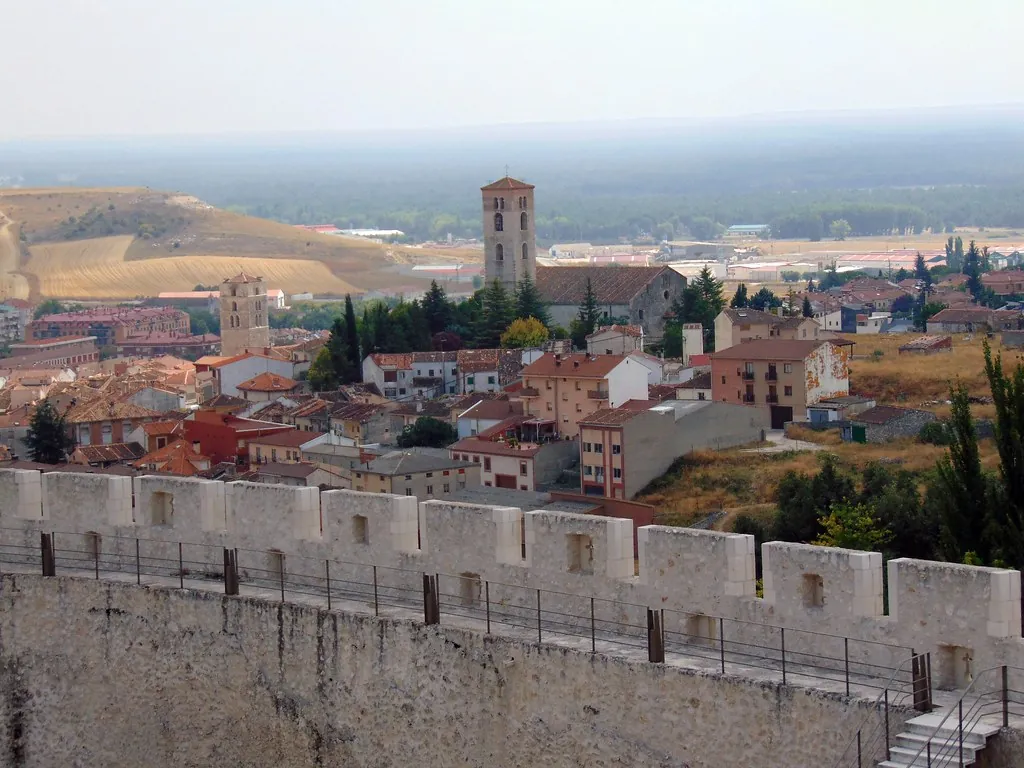
There are no major landmarks to draw you from one spot to another. The centre of attention is the church of San Pedro, a simple building that defines the main square and little else around it.
The streets are short and fairly straight. Houses combine stone and brick, often with large wooden gates and enclosed yards behind them. It all feels consistent with what you find in many villages across this part of Segovia, without trying to stand out.
You can walk the entire village in about half an hour. That is not an exaggeration. It really is that compact. The appeal lies less in ticking off sights and more in observing the everyday layout of a small rural settlement.
Nothing here is designed to impress, and that is precisely why it feels honest.
The pine landscape that surrounds it
The setting matters more than the built-up area. Fuente el Olmo de Fuentidueña sits within the Tierra de Pinares, a wide region known for its expanses of resin pine. These trees dominate the surroundings and shape how the place feels.
Tracks lead out from the village in several directions. They tend to be wide and mostly flat, making them easy for walking or cycling without much effort. Underfoot, you will often find a soft layer of pine needles mixed with loose sand, so the ground is not especially firm.
This is not rugged terrain or a place for demanding routes. It is quiet, open and repetitive in a way that can feel calming if that is what you are after.
In autumn, when the conditions are right, some locals head out to collect mushrooms. It is worth noting that this is regulated in many areas, and not everything can be gathered freely. Anyone interested would need to check the local rules beforehand rather than assuming open access.
Pairing it with Fuentidueña
A few kilometres away lies Fuentidueña, which offers a very different visit. There you will find remains of a defensive wall, several Romanesque churches, and older streets running alongside the river Duratón.
Many people choose to combine both places in a single outing. The usual approach is to stop first in the smaller village, spend a short time walking around, and then continue on to Fuentidueña, which requires a bit more attention and time.
This combination makes sense. Fuente el Olmo de Fuentidueña on its own is brief, while Fuentidueña adds historical depth and more to explore.
Getting there and what to expect
Access is via local roads that cut through pine forests and farmland. Whether coming from Segovia or from the A-1, the final stretch is always calm, with little traffic and no sense of urgency.
It is best to approach this as a short stop rather than a destination in its own right. The village does not offer a full day of activity, and it does not try to. It fits more naturally into a wider route through the Tierra de Pinares.
If you are already travelling through this region, it is easy to make a small detour, take a walk, and then carry on. If you are not, there is no real need to go out of your way just for this stop.
That balance defines the experience. Fuente el Olmo de Fuentidueña is simple, quiet and limited in scope, but it sits comfortably within its surroundings and within a broader journey through the area.