Full Article
about Fuente-Olmedo
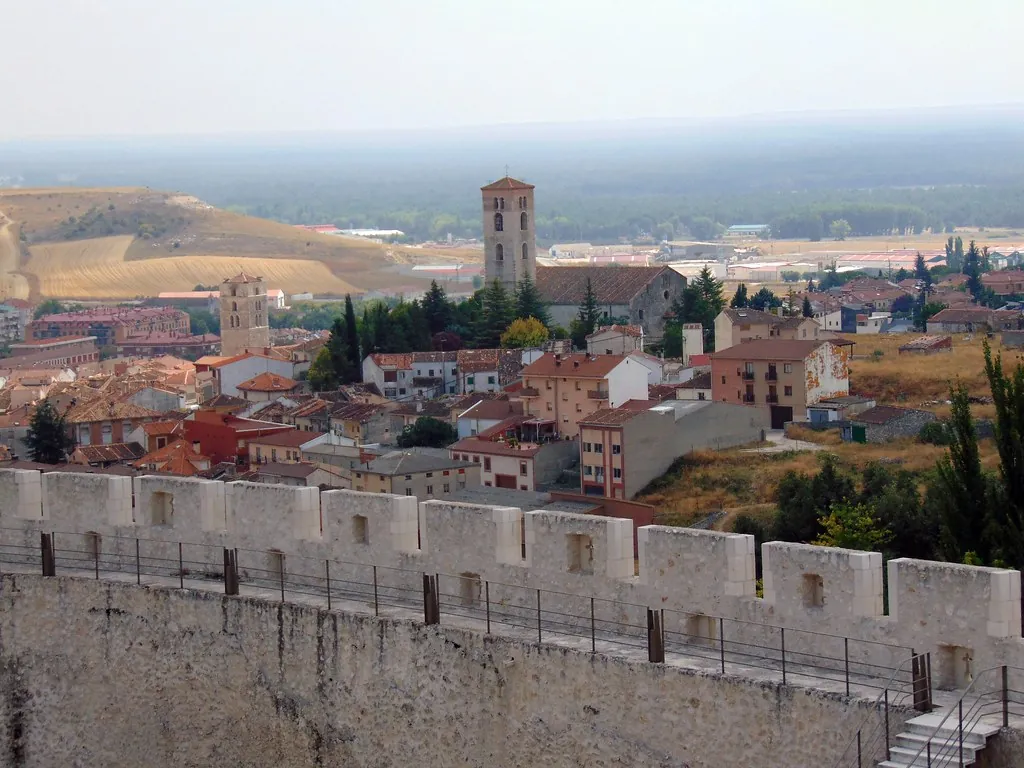
Small village surrounded by fields; known for its quiet and the parish church dedicated to San Juan.
Hide article Read full article
A village that wakes slowly
Early on a cold morning, Fuente-Olmedo barely makes a sound. The light arrives flat and grey, settling against façades of brick and adobe. A wooden door might open here and there, the dry creak typical of older houses breaking the stillness. This is a very small settlement in the Tierra de Pinares, home to just over forty people, where daily life follows the rhythm of the land rather than the clock.
The village lies on the southern plain of the province of Valladolid, in terrain with almost no relief. The horizon stays low and uninterrupted, stretching out cleanly in every direction. Many houses still keep their traditional form: whitewashed walls, exposed brick, and wide gateways originally designed for carts rather than cars.
A straightforward layout
The road into Fuente-Olmedo runs straight through the centre. There are no detours or loops. You enter, pass along a single line of buildings, and leave again towards open fields. On either side stand one or two-storey homes, some restored, others still showing wooden beams beneath the eaves.
The parish church of San Juan Evangelista stands out from a distance thanks to its square tower topped with reddish tiles. It acts as a useful point of reference when walking through the village streets. Religious services tend to take place on specific days or occasions, so it is quite common to find the church closed if arriving without prior planning.
There are no large squares or monumental spaces. Instead, small openings appear between houses, informal places where people gather to talk in the evening. As the sun drops, the air cools, even in summer, and conversation stretches into the fading light.
Pine forest on the edge of the village
Step beyond the last houses and the landscape quickly shifts to pine forest. Fuente-Olmedo forms part of the extensive woodland of the Tierra de Pinares, an area long associated with resin extraction. Some trees still bear the marks of this activity, old incisions visible as dark scars on the bark.
Forest tracks cut through these stands of resin pine in fairly regular patterns. When the wind picks up, the sound becomes continuous, a long, soft friction passing from treetop to treetop. On warmer days, the scent of resin becomes more noticeable in the air.
Autumn brings a different kind of activity. It is common to see people searching for níscalos, a type of wild mushroom, in the clearings between the trees. In many forests across the region, collecting is regulated, so it is worth checking the rules before heading out with a basket.
Walking and cycling across sandy tracks
The forest tracks around Fuente-Olmedo are long, straight and mostly flat. They are well suited for walking or cycling without steep climbs, although stretches of loose sand can slow progress.
Signposting is limited, and many junctions look similar. For longer routes, it helps to carry a track or a downloaded map on a mobile device.
With some patience, wildlife begins to appear. Roe deer sometimes cross between the pines, especially at dawn or towards evening. Birds of prey can often be heard overhead, though they are not always easy to spot clearly through the canopy.
A small place with a concentrated rhythm
Fuente-Olmedo has very few services, so it makes sense to arrive prepared if planning to spend several hours in the area. Nearby towns in the surrounding comarca offer more options for food or accommodation.
The main celebrations are held in honour of San Juan. During these days, the village fills with both residents and people who still maintain family homes here despite living elsewhere. The atmosphere shifts noticeably: more cars parked along the streets, longer conversations outdoors, and shared meals that extend well into the afternoon.
For the rest of the year, life returns to a much quieter pace. After dark, when the few village lights go out, the sky becomes deeply black. On clear nights, far more stars are visible than many would expect to see on the Castilian plateau.
There are no major attractions or monuments here to fill an itinerary. What defines Fuente-Olmedo is something simpler: open countryside, stretches of pine forest, and a handful of houses where life remains closely tied to the land. Sometimes it is enough to walk along the sandy tracks and listen to dry pine needles crunch underfoot.