Full Article
about Fuentepiñel
A farming and beekeeping village that keeps traditions like the enramada.
Hide article Read full article
A few kilometres off the road that cuts through the pine forests of the Tierra de Pinares in Segovia, a dirt track turns into the woods. In summer, cars kick up a light cloud of dust, and the scent of resin appears almost immediately, growing stronger the deeper the route goes between the trees. At the end of that track sits Fuentepiñel, a village of around 63 residents. Houses gather along a handful of short streets, with no traffic and little sense of urgency.
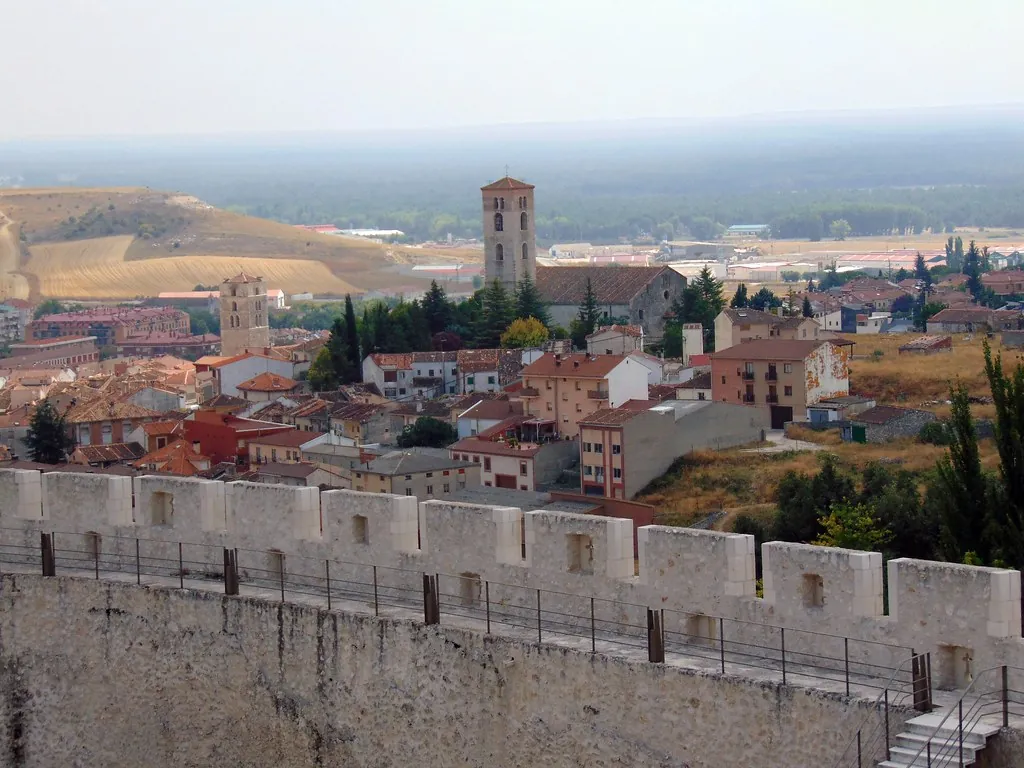
The name of the village, which suggests a spring among pines, is quite literal. Near the main square there is a small natural spring surrounded by tall pine trees that provide welcome shade in the hotter months. Buildings here are restrained in style: stone walls, pale façades, and reddish roof tiles that fade under years of sun. The parish church of San Juan Bautista rises into view from the surrounding fields. It is a simple structure, one that has evolved gradually through modest repairs rather than major redesigns.
Walking through the streets reveals wooden gates worn by time, animal pens still in use, and courtyards where traces of old ovens remain. For generations, life in Fuentepiñel revolved around the forest and livestock, along with small kitchen gardens and nearby farmland. At the edges of the village, there are still underground wine cellars dug into the earth and enclosures that once sheltered animals during winter.
The pine forests around Fuentepiñel
Fuentepiñel lies within a vast stretch of pine woodland that covers much of this part of Segovia. These forests are extensive, with straight trunks rising from a ground carpeted in dry needles that crunch underfoot. Some trees still bear the marks of past resin extraction, visible as angled cuts in the bark. These scars recall a trade that was once common across the area.
The landscape is easy to explore thanks to the network of wide forest tracks. Many of these routes were originally used by carts and livestock. They remain open today, although signposting is limited. It is wise to carry a map or use a GPS-enabled phone if venturing too far from the village.
Autumn brings a shift in pace. Mushroom foragers appear in the clearings between the pines, searching mainly for níscalos, a type of saffron milk cap common in Spanish forests, and sometimes boletus in damper patches. Mushroom picking is regulated across much of the province, and identifying species correctly is essential. Not everything that grows from the forest floor is safe to eat.
The woods also show signs of wildlife. Tracks in the soil and narrow paths through the undergrowth hint at regular movement. Roe deer often cross these areas at dawn or dusk, when the forest is at its quietest.
Short streets and everyday rhythms
Fuentepiñel does not rely on grand monuments or striking architecture. Its layout is compact and practical. Houses face directly onto the street, with simple façades and, in some cases, wooden shutters on the windows. In summer, conversations drift out into the open air during the evening, with people gathering at their doorways. Winter shifts activity indoors, and the streets grow quieter.
Agriculture has gradually lost its central role over time, although some plots around the village are still cultivated. A small amount of livestock farming continues as well. This combination explains the mix of structures found here: animal pens, storage buildings, and small agricultural sheds sit alongside older homes.
The village retains a sense of continuity with its past. Daily life moves at a steady pace, shaped by routines that reflect both older traditions and present-day needs.
Traditions that continue
August tends to bring more activity, as families with ties to the village return for a period of time. The main square becomes a shared space for gatherings, games, and simple music organised by residents themselves. These are informal events rather than large-scale celebrations, but they give the village a livelier atmosphere.
In May, San Isidro Labrador is remembered. He is a figure closely associated with farming in Spain, and his day forms part of the traditional agricultural calendar. Celebrations are not always large, yet some families continue to mark the occasion by gathering together or heading out into the countryside.
Winter brings another longstanding custom: the matanza del cerdo, or pig slaughter. In some households, this practice continues as a domestic activity carried out among relatives. It is a way of preparing food such as chorizos, morcillas, and cured pork loin, which are then left to cure for several weeks. These are long working days, shared among family members, and they remain part of the rural calendar.
When to visit and how to experience it
Spring and autumn are usually the most pleasant seasons for walking along the forest paths. Summer brings dry heat at midday, although early hours remain cool beneath the trees. Each season changes the feel of the pinewoods, from the scent of warm resin in summer to the quieter, busier forest floor in autumn.
Fuentepiñel is a small village with limited services compared to larger towns. It is best approached with a relaxed plan: arrive, take a walk through the streets, and spend time following the tracks that lead into the forest. The essence of the place becomes clearer there, among tall pines, dirt paths, and that persistent resin scent that accompanies almost every step.