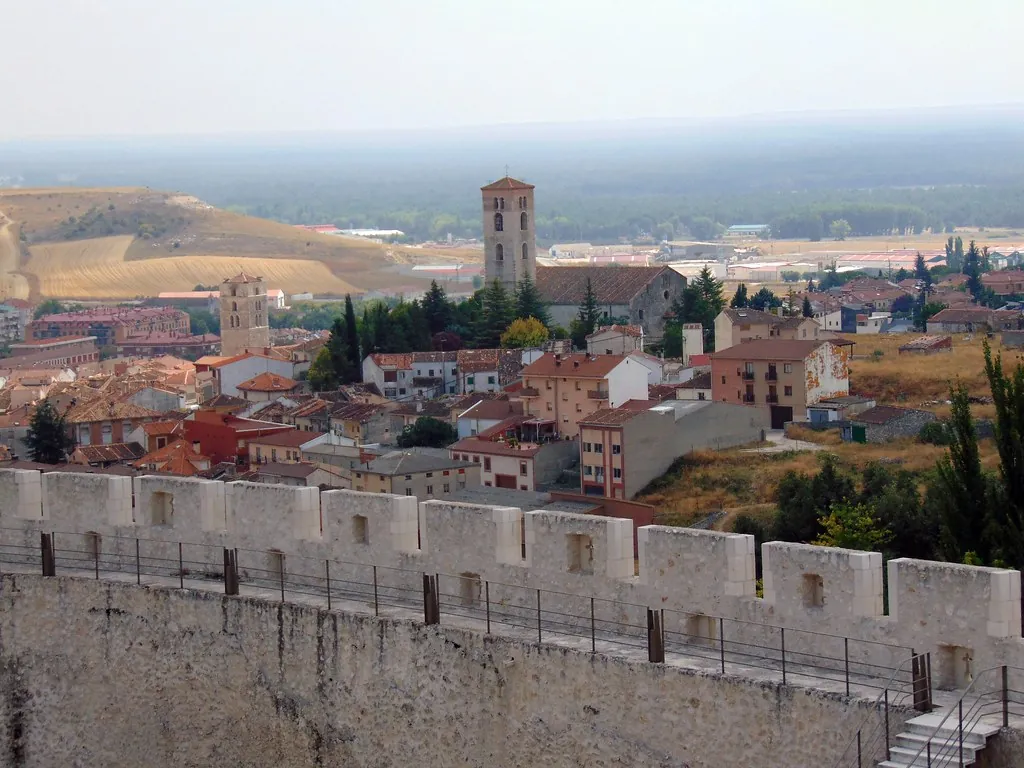
Vista aérea de Fuentesaúco de Fuentidueña
Instituto Geográfico Nacional · CC-BY 4.0 scne.es
Castilla y León · Cradle of Kingdoms

Fuentesaúco de Fuentidueña

The church bell strikes eleven and the only other sound is a tractor starting up somewhere beyond the stone houses. At 892 metres above sea level, ...

216 inhabitants · INE 2025
892m Altitude

Why Visit

Mountain Church of Santo Domingo de Silos Visit the church

Best Time to Visit

summer

Santo Domingo Festival (August) agosto

Things to See & Do
in Fuentesaúco de Fuentidueña

Heritage

  • Church of Santo Domingo de Silos
  • Rural setting

Activities

  • Visit the church
  • Hiking

Festivals
& & Traditions

Fecha agosto

Fiestas de Santo Domingo (agosto)

Las fiestas locales son el momento perfecto para vivir la autenticidad de Fuentesaúco de Fuentidueña.

Full Article
about Fuentesaúco de Fuentidueña

Known for its Romanesque church and former chicory production.

Ocultar artículo Leer artículo completo

The church bell strikes eleven and the only other sound is a tractor starting up somewhere beyond the stone houses. At 892 metres above sea level, Fuentesauco de Fuentidueña sits high enough that the air carries differently—slower, clearer, as though the village’s full name wasn’t already a mouthful. Two hundred-odd residents live here, scattered among lanes barely two cars wide, where adobe walls the colour of weathered parchment absorb the morning sun and release it again by nightfall.

High-plains arithmetic

Castilla y León’s Tierra de Pinares is measured less in kilometres than in silences. From the village edge, wheat stubble rolls east until it meets the first dark smudge of resin pine; westwards, the land drops 150 metres to the river Cega, then climbs again towards the granite bulk of the Sierra de Guadarrama, forty kilometres distant. That extra altitude matters. April mornings can begin at 4 °C even when Madrid, an hour and a quarter by car, is already tee-shirt weather. In July the same height gifts cooler nights—locals still shut windows at dusk to keep warmth in—yet midday sun is fierce, and shade is currency. Winter tightens early: the first frosts arrive mid-October, snow can cut the road for a day or two, and the single bus to Zamora simply doesn’t run when the pass whitens.

Walking boots, therefore, live by the door year-round. Paths strike out from the last house on the Calle Real, become farm tracks within ten minutes, and then dissolve into the cañadas—ancient drove roads wide enough for a hundred sheep. The Cañada Real Soriana Oriental, one of Spain’s major transhumance routes, skirts the municipal boundary; follow it south-east for two hours and you reach a stone drinking trough fed by a natural spring, water so cold it makes teeth ache even in August. No signposts point the way: you need the IGM 1:50,000 sheet or a phone app that works offline, because phone reception itself flickers in and out like a bored lighthouse.

What passes for sights

There is no ticket office, no audioguide, no gift shop. The Iglesia de San Miguel occupies the highest point of the village, a modest, thick-walled rectangle finished in the local limestone that looks beige at noon and honey-coloured by six. The portal carries a date of 1647 but incorporates earlier stones—visigothic fragments reused as rubble. Inside, the retablo is plain, painted in muted reds and oxidised greens; the priest unlocks only for Sunday mass at ten, so if interior geometry matters, time the visit or ask in the bar. The church’s bell, cast in 1762, cracked in 1938 and was welded rather than recast; the resulting tone is dull, more thud than chime, which somehow suits the place.

Below the square, the recently restored lavadero still channels spring water through four stone basins. Until the 1970s women brought family laundry here on Monday mornings; now the only person you’ll meet is José, retired, who fills plastic bottles because “the tap stuff tastes of chlorine.” Elderflower bushes—saúcos—grow where waste water spills out, a living footnote to the village’s name. The scene is not spectacular; it is simply still used, and therefore alive.

Adobe houses line up shoulder-to-shoulder, their wooden doors painted the traditional indigo that reputedly repelled insects. Some façades are immaculate, others slump gently, roofs patched with corrugated tin that rattles in the wind. Photographers hunting perfect rustic decay will be happy; those expecting a manicured heritage site will not.

Eating and sleeping (or not)

Fuentesauco keeps one restaurant, El Saúco, open Thursday to Sunday lunch only. The set menu runs to cordero lechal—milk-fed lamb roasted in a wood oven until the skin shatters like thin toffee—followed by piñón-flavoured custard. A three-course comida, bread and half a bottle of house Ribera del Duero costs €16; dinner service does not exist, so plan accordingly. There is no hotel, no casa rural registered for tourists, and the nearest beds are in Zamora, thirty kilometres west. The pragmatic solution is to treat the village as a day-trip base for walking, then retreat to the city for a shower. If you must stay, ask at the bar: locals occasionally rent out a spare room for cash, but expect Spanish-only negotiations and shared bathrooms.

Breakfast is easier. The panadera van arrives Tuesday and Friday at nine, horn blaring. Queue with the villagers and buy a barra of crusty bread still warm from the oven in Vallisoletano, 80 km away—an absurd distance, yet cheaper than keeping a village bakery alive.

Seasons of quiet

Spring is the kindest season. Green wheat ripples like a North-Sea swell, storks drift overhead on thermals, and the temperature gradient means you can walk all morning without draining a water bottle. Wild asparagus sprouts along field edges; pick a handful, add eggs from the woman who keeps hens on the Calle San Roque, and you have lunch for under two euros. Autumn repeats the trick in reverse: ochre and rust replace green, mushrooms pop after the first storms, and locals emerge with wicker baskets and Opinel knives. The regional government publishes a free map of permitted pine zones; ignore it and you risk a €300 fine, policed by forest guards who appear on quiet motorbikes.

Summer is doable if you start early. By two o’clock the thermometre can read 34 °C, yet shade under a resin pine is fifteen degrees cooler—bring a paperback and wait. Mid-July fiestas last three nights: a portable bar, a brass band playing pasodobles slightly out of tune, and a communal paella cooked in a pan the size of a satellite dish. Visitors are welcome but not announced; buy a beer ticket and you are instantly local.

Winter strips the landscape to its bones. Sky widens, wind sharpens, and the population halves as grandparents decamp to city flats belonging to offspring. Snow photographs beautifully against adobe, but the access road, the CL-605, is untreated for the final eight kilometres. Carry chains October to March, or you may spend an unplanned night learning Spanish vocabulary for “tow truck.”

Getting here, getting away

No train comes within thirty kilometres. From the UK, fly to Valladolid (VLL) with Ryanair out of London Stansted, collect a hire car, and drive ninety minutes north-west via the A-62 and the CL-605. Salamanca airport also works, but adds twenty minutes. Public transport is academic: one daily bus from Zamora at 14:00, returning at 06:00 next day, timed for agricultural labourers, not tourists. Car hire is therefore non-negotiable, and petrol stations close at 20:00—fill up in Toro before the final approach.

Leave expectations of souvenir epiphanies behind. Fuentesauco de Fuentidueña offers space, stone, and the small revelation that rural Spain still functions when no one is watching. Walk, listen, say buenos días first, and the village will answer in the same measured key.

Key Facts

Region
Castilla y León
District
Tierra de Pinares
INE Code
40089
Coast
No
Mountain
Yes
Season
summer

Livability & Services

Key data for living or remote work

2024
Connectivity5G available
HealthcareHealth center
EducationElementary school
Housing~5€/m² rent · Affordable
CoastBeach nearby
Sources: INE, CNMC, Ministry of Health, AEMET

Planning Your Visit?

Discover more villages in the Tierra de Pinares.

View full region →

More villages in Tierra de Pinares

Traveler Reviews