Full Article
about Herradón de Pinares
Includes the village of La Cañada; a key railway junction surrounded by pine forests and mountains.
Hide article Read full article
Getting There and Getting Around
Anyone considering tourism in Herradón de Pinares should start with the basics: how to get there and how to move around once you arrive. The village lies in this part of Tierra de Pinares, a landscape known for its extensive pine forests, and is reached easily by car via the road that crosses the area and connects with the AV‑500 towards Ávila. Driving is straightforward and parking is usually simple enough. There are spaces along the main streets, although arriving early is a sensible idea.
Herradón de Pinares is small. Once parked, the car can stay where it is. Everything is done on foot. The centre can be covered quickly, and in under an hour you will have seen the essentials. The streets are not complicated to navigate, though some have short inclines and narrow pavements.
There is no large, clearly defined historic quarter. Instead, the village has grown gradually around the main road and the central square. It feels like a rural nucleus that has expanded over time rather than a preserved medieval core.
A Working Village in Ávila
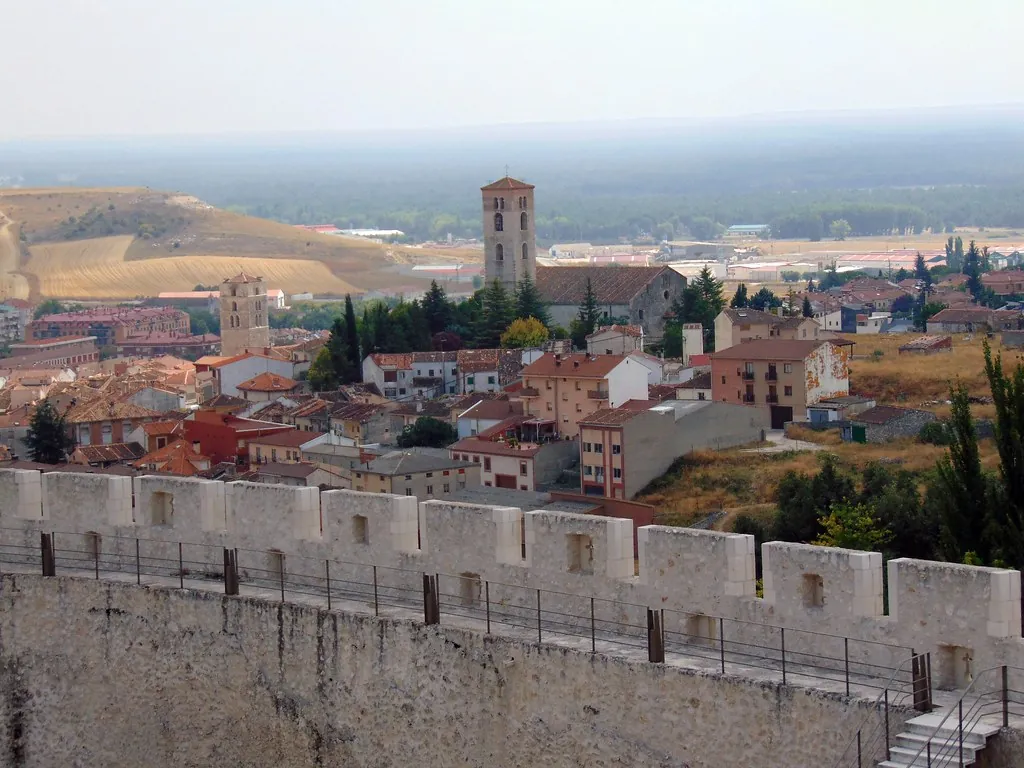
The most visible landmark in Herradón de Pinares is the church of San Nicolás de Bari. It is generally dated to the 15th century, although it has undergone later alterations. Built in stone, it has a simple, solid volume and a bell tower that rises above the surrounding houses. Decoration is minimal. The overall impression is restrained and practical.
Beyond the church, the village matches what is typical in this part of the province of Ávila. Stone and masonry houses line the streets. Large wooden gates hint at agricultural use. Some ground-floor windows retain old iron grilles. Streets such as Calle Mayor and Calle Real preserve the atmosphere of a working settlement rather than a polished showpiece.
There are not many shops and no constant flow of activity. During the week, the pace is calm. This is a place where daily life continues at an unhurried rhythm, without staging itself for visitors.
Surrounded by Pinares
What truly defines Herradón de Pinares is what lies just beyond its last houses. The pine forests begin almost immediately at the edge of the village. These pinares are the dominant landscape feature and shape the experience of being here.
Expect wide tracks rather than dramatic footpaths. They are used by local residents, cyclists and agricultural machinery. The terrain is fairly uniform: pine trees, dry ground and, when the heat rises, the scent of resin in the air. It is suitable for an easy walk or taking the dog out. Beyond that, expectations should be modest.
Those searching for dramatic viewpoints or sweeping vistas will not find them here. The appeal is quieter. The repetition of trees, the filtered light and the soft carpet of needles underfoot create a consistent, almost meditative environment.
Signposting of paths is irregular. If you plan to wander further from the village, having a map on your phone is helpful. It is easy enough to follow the main tracks, but once you turn off them, orientation can become less clear.
Autumn and the Season of Mushrooms
The atmosphere shifts slightly in autumn. The ground fills with pine cones and dry needles, and dampness lingers in the shadier patches of forest. At this time of year, many people head into the nearby pinares to look for mushrooms.
Caution is essential. Not all species are edible and some are protected. Without the knowledge to distinguish between them, it is wiser to observe rather than collect. The forests may appear open and accessible, yet they demand respect, especially during mushroom season when interest in foraging increases.
Even without gathering anything, an autumn walk brings a different texture to the landscape. The scent of damp earth replaces the dry resin of summer. The colours remain subdued, but the ground feels softer and the air cooler.
A Quiet Base in Tierra de Pinares
Herradón de Pinares works better as a calm base than as a destination packed with sights. From here, it is easy to drive to other villages in the area or head towards Ávila. The connection via the AV‑500 makes short excursions straightforward.
Within the village itself, the plan is simple. Arrive early, take a short walk through the streets, pause by the church of San Nicolás de Bari, and then continue out towards the pine forest. It does not require a complex itinerary.
The key is adjusting expectations. If the aim is silence and an uncomplicated walk, Herradón de Pinares delivers. The compact layout, the absence of crowds and the immediate access to woodland make it suitable for a brief stop or a slow morning outdoors. If, on the other hand, you are looking for major monuments, extensive heritage sites or varied landscapes, the village may feel limited.
In that sense, Herradón de Pinares reflects its surroundings. It is practical, understated and closely tied to the land around it. The pine forests define both the scenery and the rhythm of life. Visitors who appreciate that simplicity are likely to find what they came for. Those expecting more will probably move on quickly to explore further afield in Castilla Leon.