Full Article
about Hontalbilla
A town with history, noted for its church and the old resin-making tradition.
Hide article Read full article
A Small Stop in the Tierra de Pinares
If you are planning a bit of tourism in Hontalbilla, keep the practical side simple. Arrive by car, drive slowly through the centre and park near the Iglesia de San Pedro or along one of the wider streets. The village is small and can be covered on foot in little time. From Segovia, the journey takes around an hour along secondary roads that wind through extensive pine forests.
Hontalbilla has fewer than 300 inhabitants. Life here revolves around farmland and the surrounding pinar, the vast pinewoods that define this part of the province. That rural character is visible everywhere: trailers parked by houses, stacks of firewood, working corrals still in use.
This is not a place that competes for attention. It is a working village, quiet for much of the year, and best understood at its own pace.
The Village Layout and Everyday Architecture
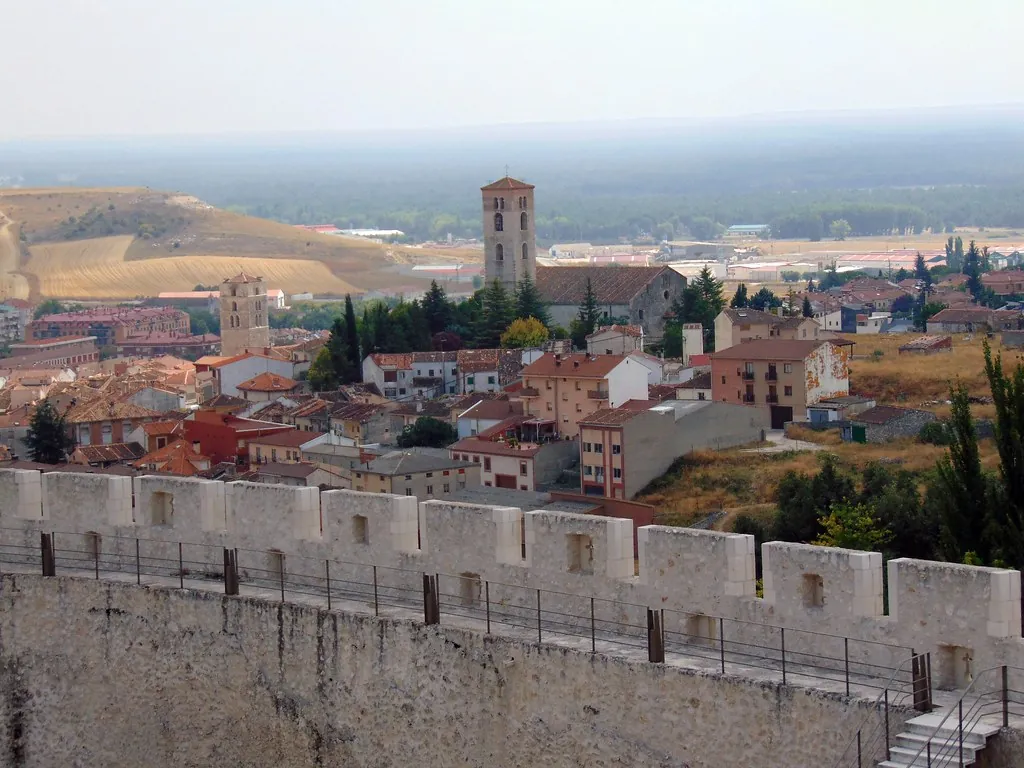
The centre is straightforward. There is a main square, the Iglesia de San Pedro and a handful of streets branching out around them. The church has been remodelled several times and is well maintained, yet it is not a monumental building. It serves as the village’s reference point and little more.
The houses follow a style common across this part of Segovia: stone façades, large wooden gates and interior courtyards hidden behind solid walls. In summer, more doors stand open. Families who emigrated years ago often return during the warmer months, and the streets feel briefly fuller.
There are no grand façades or decorative details to seek out. The interest lies in the ordinary: how homes are built for climate and work, how outdoor spaces connect to agricultural life, how daily routines shape the look of the streets.
Walking around does not require a plan. In half an hour most of the centre will have revealed itself.
Wineries Underground and Traditional Structures
In several streets you will notice bodegas dug into the ground. These underground cellars were traditionally used to store wine at a stable temperature. Some are still in use, while others retain only their door and small ventilation shaft.
Other traditional elements survive as well. There are corredores, old communal ovens and corrals. They are not signposted, nor arranged into any formal route. There are no interpretation panels or marked trails within the village itself. The appeal here lies in looking carefully while walking, noticing details that remain part of everyday life.
If you are searching for monuments or museums, you will not find them in Hontalbilla. The built heritage is modest and functional. What endures is a sense of continuity in how space is used.
The Pinewoods Beyond the Streets
The real landscape begins outside the urban area. Hontalbilla forms part of the Tierra de Pinares, a region characterised by kilometres of pino resinero, the maritime pine traditionally exploited for resin. The forests stretch out around the village in every direction.
Several forest tracks leave directly from the edge of Hontalbilla. They are wide dirt roads used by local residents and forestry workers, suitable for walking or cycling without much difficulty. There are no dramatic viewpoints or spectacular routes. What you find instead is calm woodland, flat terrain and the scent of resin in warm weather.
In autumn there is usually more activity in the woods. Mushroom foraging attracts visitors from nearby towns and cities. Níscalos, known in English as saffron milk caps, appear in some years if rainfall has been sufficient. Boletus can also be found in certain areas. Before setting out, it is worth checking local regulations, as there are rules in place and not all woodland is freely accessible.
The pine forest defines the area more clearly than any building in the village. Spending time among the trees gives a better sense of Hontalbilla than remaining in the square.
Local Rhythms and Seasonal Life
Hontalbilla becomes livelier mainly in summer. Many residents who live elsewhere return during the holidays, and August is typically when local fiestas take place, as happens in much of this region. These gatherings are part of the annual calendar rather than events designed for visitors.
For the rest of the year, daily life follows the pattern of a small rural municipality: agricultural work, forestry tasks and limited movement in the streets. Shops and services are few, and the pace is slow.
In winter, some families still carry out the matanza del cerdo at home. This traditional pig slaughter, common in rural Castile, provides meat and cured products for the year ahead. It remains a domestic custom rather than a spectacle.
Visitors should approach these rhythms with respect. Hontalbilla is not set up as a tourist destination in the conventional sense. It is a lived-in place where traditions continue because they are useful or meaningful to residents.
Food and Practicalities
Services in Hontalbilla are limited. If you plan to spend the day, it is sensible to bring food with you or look for options in larger nearby villages. There is nothing particularly associated with the village itself in culinary terms.
The cooking in this part of Castilla y León follows long-established Castilian traditions: roast lamb, pulses and cured meats. It is hearty, rural fare shaped by climate and agricultural cycles.
Do not expect a broad range of facilities. Hontalbilla works better as a brief stop than as a base with extensive amenities.
A Straightforward Visit
Hontalbilla makes sense as part of a wider exploration of the Tierra de Pinares or as a starting point for a walk in the surrounding woodland. The village itself can be seen quickly. If you enjoy walking among pine forests, you may choose to linger longer. If not, half an hour is enough to understand its scale.
There are no major sights to tick off, no curated visitor trail, no headline attraction. The appeal lies in its simplicity: a small community in Segovia province where the church anchors the square, underground bodegas hint at older practices and pinewoods stretch out beyond the last houses.
Approach it without expectations of spectacle. Take a short walk, notice the materials and the working spaces, and then head into the forest. In Hontalbilla, the landscape tells the fuller story.