Full Article
about Íscar
A key industrial and timber town dominated by its castle, noted for its heritage and Dance Museum.
Ocultar artículo Leer artículo completo
The castle tower appears first, a pale stone finger poking above the pine canopy long before the village itself comes into view. From the A-601 it looks almost close enough to touch, yet the road keeps winding, dipping, climbing again, until suddenly the whole meseta drops away and Íscar is there—perched at 757 m, its rooftops tilting like loose change towards the cliff edge. One moment you’re in cereal country, the next you’re braking for storks on the church bell-tower and wondering how anything this compact managed to boss the landscape for eight centuries.
Up on the Rock
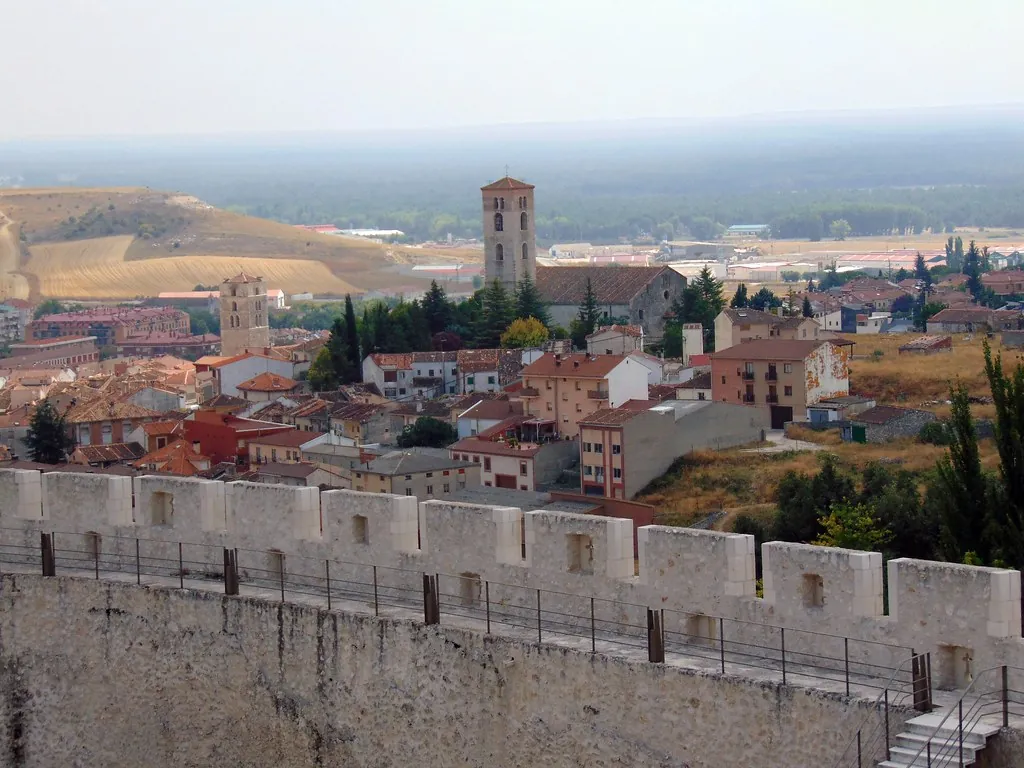
The fortress is private, so don’t expect gift-shop tat or a café selling overpriced cans of Coke. What you get instead is a free, thigh-burning ascent on uneven slabs, then a 360-degree pay-off that stretches from the resin-scented Pinares to the distant glasshouses of Medina del Campo. Locals swear you can spot the snow on the Gredos on a winter morning; on a hazy July afternoon the heat shimmer makes the grain silos float like ships. Bring water—there’s no tap—and go early: by 11 a.m. the stone radiates heat back at you, and the only shade is inside the 30-metre keep, where swallows dive through empty arrow slits.
The ruins are exactly that: walls, partial arches, a staircase that stops in mid-air. British visitors expecting Warwick-style battlements sometimes mutter about “health-and-safety nightmares”, yet the informality is the point. You can edge right up to the lip where the rock falls away, feel the wind rasp your cheeks and understand why medieval scouts thought they could police half of Valladolid from this single chair. If vertigo attacks, sit on the west side and watch the village streets spiral out like a child’s drawing—terra-cotta roofs, tiny plazas, the odd rooftop pool glinting turquoise.
Down in the Lanes
The descent brings you to the Plaza de San Miguel, a rectangle of granite slabs barely big enough for a Sunday football kick-about. The church door is usually open; inside, the air smells of candle wax and old pine benches. A Romanesque font squats by the altar like a short, fat knight—proof that people have been baptised here since before Magna Carta was drafted. Look up and you’ll see a 16th-century choir loft whose carving is so delicate it could pass for a Flemish cabinet; look down and you’ll notice the floor slopes gently south, the result of centuries of feet and processions wearing away the stone.
From the square it’s a three-minute shuffle to the Palacio de los Zúñiga, now the town hall. No one tries to sell you a ticket; you simply walk into a courtyard ringed by colonnades and heraldic shields. The stonework is the colour of weak tea, soft enough that you can read the family motto with a fingernail. On market days—Tuesday and Friday—stalls laden with white beans and purple garlic butt right up to the Renaissance portal, giving the palace the air of a grandee who’s been press-ganged into running the village shop.
Branch off the obvious streets and the town shrinks to single-file lanes where adobe walls bulge like well-fed ponies. House numbers jump from 3 to 7; the missing 5 collapsed in the 1970s and no one bothered to rebuild. Somewhere a radio plays Luz Casal, and the smell of roast lamb drifts from an unseen kitchen extractor. This is not postcard Spain—paint flakes, dogs snooze in doorways, a Ford Focus from 1997 reverses at nerve-shredding speed—but it is alive, and it is ordinary in the best possible way.
Fuel & Furniture
Íscar’s other industry is wood. Three factories on the southern edge turn pine into tables and chairs that end up in John Lewis “rustic” ranges, though you’d never guess it among the geraniums of the old centre. The timber smell lingers on damp mornings, a sweet reminder that the village earns its living from something other than tourism. That translates into decent prices at the bars: a caña still hovers around €1.40, and the menú del día—soup, roast lechazo, wine, dessert—rarely breaks €14. Hostal San Antonio does a reliable version; if you’re vegetarian the alternative is tortilla the size of a cartwheel, served lukewarm as tradition demands.
Wine comes from Rueda, twenty minutes west. Ask for “verdejo” and you’ll get something closer to Sauvignon than to heavy Rioja—crisp, lemon-peel notes that cut through lamb fat nicely. Brits who’ve done the tour report it travels better than the local reds, so stuff a couple of bottles between the dirty laundry for the flight home; customs rarely argue with a Castillian postcode.
Into the Trees
The pinares start where the tarmac ends. Tracks are wide enough for a tractor and signed only at the junctions that matter: “Cuéllar 12 km”, “Peñafiel 35 km”. Walking is flat, occasionally sandy, and scented with resin that sticks to boot leather. In April the forest floor is a carpet of white daisies; by late June everything has the brittle gold of shredded wheat. Cicloturists like the network because cars appear once an hour, usually driven courteously by someone who’ll wave with the entire forearm. Take the GR-14 south and you’ll reach the abandoned resineros’ huts—low stone shelters where workers once slept during the pine-tapping season. Their blackened hearths still work if you fancy a rogue barbecue, though the forestry commission takes a dim view.
Come October the woods echo with shotgun pops: red-legged partridge season. Locals will tell you the birds taste of “campo y romero”, but you’ll need an invitation to find out—restaurants don’t put them on the menu, and supermarket freezers stock the French-farmed version. If blood sport offends, stick to mushroom spotting. Boletus edulis hides under the pines after rain, but so does amanita phalloides, so unless you passed your mycology badge in the Scouts, photograph, don’t pick.
When the Noise Starts
Fiestas begin on 29 September, the eve of San Miguel. By 6 p.m. the plaza is cordoned off for “juego de la calle”, a form of human skittles where teams hurl a wooden cylinder at ankle height. The rules are opaque, the beer flows fast, and within an hour half the village is limping yet grinning. Midnight brings a fireworks castle wheeled through the narrowest street; sparks ricochet off second-floor balconies, so stand up-wind unless you fancy holes in your T-shirt. The next morning a drum troupe marches the saint’s effigy around town, followed by girls in velvet dresses balancing baskets of marigolds. It is loud, devout, and entirely without PA systems—just drums, brass and the occasional cracked bell. Accommodation trebles in price and the single ATM runs dry; book early or day-trip from Valladolid.
Winter is the inverse. At 757 m the meseta gets proper frost; the castle viewpoint becomes a wind tunnel that would shame the Pennines in February. Snow is sporadic but pretty when it sticks, turning the ochre walls wedding-cake white. The upside is silence: you can hear your own pulse on the ramparts, and the bar owners are so pleased to see a new face they’ll throw in a chupito of orujo with your coffee. Summer, by contrast, is furnace-hot. By 3 p.m. the streets empty; even the swallows nap under the eaves. Sensible visitors follow the siesta rule, re-emerging at 7 p.m. when the stone releases its stored heat and the square fills with prams and grandmothers comparing lottery numbers.
Getting There, Getting Out
Madrid-Barajas to Íscar is 140 km, most of it on the toll AP-6. A hire car lets you stitch together a castle circuit—Cuéllar’s Disney turrets in the morning, Coca’s brick mega-fort after lunch, Íscar for sunset. Public transport exists but demands patience: ALSA runs roughly hourly from Madrid’s Estación Sur to Valladolid, then Monbus squeezes south to Íscar two or three times daily, not at all on Sunday. Miss the 19:30 and you’re spending the night among the naughty cherubs of Valladolid’s Plaza Mayor.
Staying over means either Hostal San Antonio (clean, €55 double, no lift) or the smarter Apartamentos-Suites Íscar where the rooms come with kitchenettes for self-catering escapes. British couples who’ve done both say the hostal is “fine for one night, but bring earplugs—Spanish walls discuss everything.” If you fancy country-house chic, drive ten minutes to Cuéllar and check into Casa Rural La Aurora del Henar; the garden has hammocks and the host speaks fluent BBC English from a year in Bristol.
Worth It?
Íscar will not change your life. It has no Michelin stars, no flamenco tablaos, no gift-shop fridge magnets. What it does have is an unvarnished slice of Castilian life served at altitude: a castle you can clamber over at your own risk, bars where the coffee still costs less than the newspaper, and forests that smell like someone left the pine-fresh lid off the entire countryside. Come for the view that, yes, etches itself into memory; stay for the realisation that somewhere between the cereal plains and the resin-scented hills, Spain still keeps time with its own heartbeat. And if the tower’s top step gives you vertigo, remember: the descent leads straight to a glass of cold Rueda, and nobody times your stay at the bar except the barman—and he’s in no hurry.