Full Article
about Pedraja de Portillo
Town known for its bull run and church; located in the Pinares region.
Hide article Read full article
A landscape that sets the tone
Tourism in La Pedraja de Portillo makes more sense when you begin with its surroundings. The village sits in the Tierra de Pinares, a broad area in the south of the province of Valladolid where stretches of resin pine forest alternate with cereal fields. With just over a thousand inhabitants and an elevation of around 717 metres, the place remains closely tied to this landscape. For generations, the pinewoods provided work, just as the surrounding farmland continues to do.
The name “Pedraja” is often linked to the stony nature of parts of the terrain. The addition “de Portillo” points to its historical proximity to Portillo, a nearby settlement that held administrative and defensive importance for centuries. La Pedraja de Portillo developed as part of a network of small agricultural villages that shape this region.
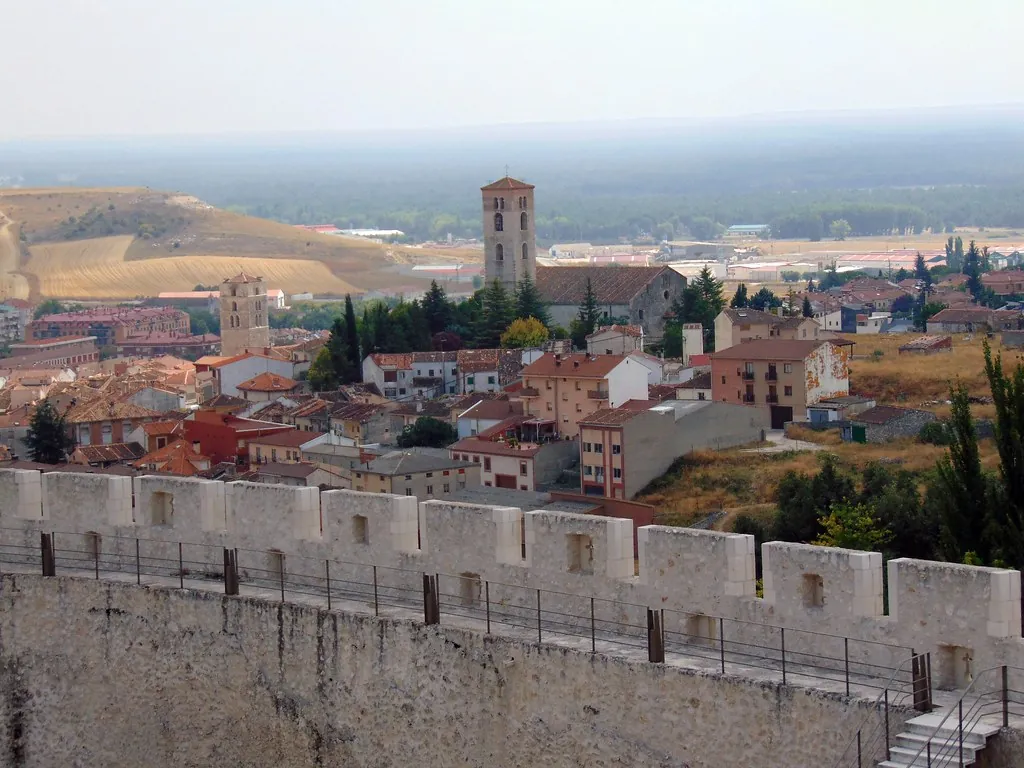
That background is still visible in the layout of the town. Streets lead naturally towards the main square, which continues to function as the centre of daily life. The architecture reflects what is common across much of inland Valladolid: brick walls, older adobe structures, and more recent alterations sitting side by side without much uniformity. It is not a monumental historic centre, but it offers a clear sense of how these agricultural communities have been organised over time.
The church and the shape of the town
The parish church stands out within the urban area. Built mainly in brick, it reflects a material widely used in the traditional architecture of the province. Its appearance is restrained, in line with many rural churches across the Meseta, where construction tended to prioritise function over decoration.
Beyond the building itself, the church helps define how the town is understood. As in many Castilian villages, it acts as a key reference point in the layout. For centuries, it has also been a focal space for community life, from religious celebrations to gatherings and moments tied to the local calendar.
This relationship between architecture and daily life is easy to read when walking through the streets. The scale is modest, the spaces practical, and the organisation closely linked to routines shaped by agriculture and seasonal work.
Pine forests and working landscapes
The pinewoods that give the Tierra de Pinares its name extend around the village. These forests are relatively uniform, crossed by straight paths that were often opened for resin extraction or to access forestry plots.
For much of the 20th century, resin was an important activity in these woods. Traces of that past remain visible, with marks from old extraction methods still present on some tree trunks. Although this industry no longer has the same weight, it forms part of the area’s identity.
Today, the pine forests are used mainly for walking, cycling, or simply spending time outdoors. The terrain is notably flat, which makes movement easy and accessible. This lack of steep gradients is a defining feature of this part of the province and shapes how the landscape is experienced.
In autumn, mushroom picking becomes common in the nearby woods. In many areas of Castilla y León this activity is regulated, so it is worth checking local guidelines before heading out. Even without taking part, the seasonal rhythm is noticeable, as the forests attract more activity during this time.
A cereal-growing village
La Pedraja de Portillo fits closely with the model of a cereal-producing village on the Meseta. The settlement forms a compact core surrounded by farmland and, in this case, by extensive pinewoods. This structure reflects a way of life shaped by cultivation and the management of nearby natural resources.
Some houses still retain underground cellars, dug beneath the ground as a traditional solution for keeping wine and other foods at a stable temperature. Although viticulture no longer plays the role it once did, these spaces remain part of the domestic landscape and offer a glimpse into earlier practices.
The combination of fields and forest is one of the defining features of the area. It is not a dramatic landscape, but it is consistent and functional, shaped over time by work rather than by ornament. That continuity is what gives the village its character.
Walking through it at your own pace
The town itself can be explored easily on foot in a relaxed walk. Its scale and layout make it straightforward to navigate without any particular plan. The more distinctive part of the surroundings lies along the paths that lead out towards the pinewoods, where the flat terrain allows for unhurried routes.
Spring and autumn are generally the most comfortable times to walk in the area, when temperatures are milder and the pinewoods are more frequently used by local residents. During these seasons, the connection between the village and its environment becomes especially clear.
Beyond that, the most sensible approach is to take La Pedraja de Portillo as it is: a small settlement in the Tierra de Pinares, closely linked to its landscape and to the traditional activities of the region. Its appeal lies less in individual landmarks and more in how its streets, fields and forests fit together into a coherent whole.