Full Article
about Laguna de Contreras
In the Duratón valley; known for its riverside landscapes and historic remains
Hide article Read full article
A village shaped by pine and resin
In the Tierra de Pinares area of Segovia province, Laguna de Contreras sits in a landscape long defined by the pino resinero, the maritime pine tapped for its resin. For centuries this tree shaped both the scenery and the local economy. Today the village has just over a hundred residents and a compact, sober layout that reflects its rural character.
Buildings are constructed from what the surroundings provided: stone, brick and pine wood. These materials were quite literally at hand for generations of residents. The result is a village that feels consistent in tone, with practical architecture built to endure local conditions rather than to impress.
Laguna de Contreras stands at around 800 metres above sea level, part of the patchwork of small settlements scattered across this part of the province of Segovia. The setting is largely flat, with extensive pinewoods broken up by shallow depressions where seasonal lagoons form. In wet years they fill with water, drawing amphibians and some water birds. In dry seasons they can pass almost unnoticed, blending into the sandy terrain.
The pine forest dominates everything: the horizon, the ground underfoot and even the air. The soil is sandy, the shade almost constant beneath the canopy, and on warm days the scent of resin becomes especially noticeable.
Echoes of the resin trade
For much of the 20th century, resin was one of the area’s main resources. Walking through the nearby woods, it is still possible to see the scars on the trunks. These incisions were cut to collect miera, the raw resin extracted from the trees. Some stands of pine clearly continued to be worked for longer, while others were abandoned when the activity ceased to be profitable.
These marks, sometimes subtle and sometimes striking, provide a direct link to a way of life that only faded a few decades ago. In certain parts of the forest there are also remains of small structures associated with resin work. They are not always signposted, but they help explain how this landscape functioned as a workplace as well as a natural environment.
Laguna de Contreras does not revolve around major monuments or headline attractions. Its story is written in the forest itself, in the rhythm of agricultural and forestry labour that sustained the community through much of the last century.
Village architecture and everyday heritage
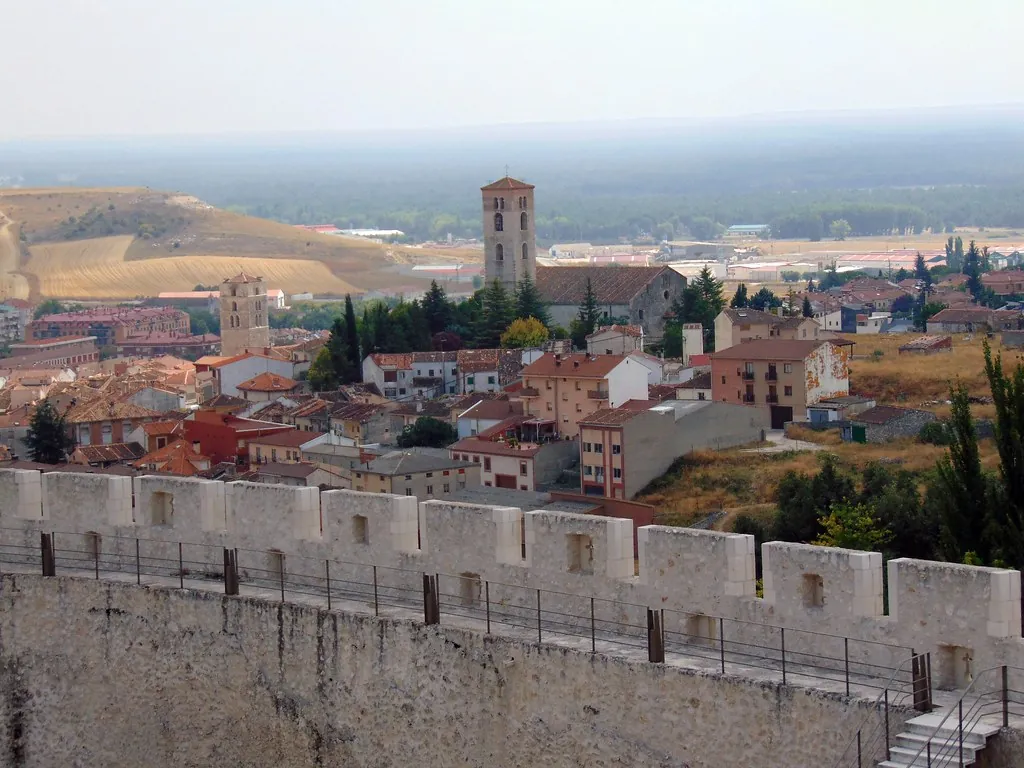
The village centre is organised around a main street where the parish church of the Asunción stands. Built in masonry and marked by simple lines, the church has undergone alterations over time, something common in rural Castilian churches. Rather than housing specific artistic treasures, it is best understood as a practical parish building adapted to the possibilities of a small community.
Walking through the residential streets reveals one and two storey houses with stone and brick walls. Many display visible pine beams and wooden doors darkened by age. In courtyards and barns, structures linked to agricultural and livestock life are still recognisable.
Small details repay attention. Brick chimneys rise above tiled roofs. Wall tops and wrought iron grilles show careful workmanship. Everything speaks of architecture designed to last, built with materials sourced from the immediate surroundings. There is little ornamentation, yet the consistency of form and material gives the village a quiet coherence.
Forest tracks and seasonal changes
Beyond the built-up area, wide forest tracks branch off into the pinewoods. These routes were used for decades for forestry work. They can be explored on foot or by bicycle, though many stretches lack clear signposting. Anyone planning to venture far from the village would be wise to carry a map or GPS.
The character of the forest shifts with the seasons. In spring and autumn there is more moisture in the air, the greens and ochres deepen, and temperatures are milder than in summer. During the colder months, frosts are not uncommon. Early in the day some paths can be slippery, especially after freezing nights.
Mushroom picking forms part of local culture. In autumn, níscalos, known in English as saffron milk caps, appear along with other species associated with pine forests. As in much of Castilla y León, mushroom gathering is usually regulated, with quotas and designated areas. It is advisable to check the rules before heading out into the woods.
The seasonal lagoons also respond to changes in weather. After rainy periods they become visible features in the landscape, briefly transforming shallow hollows into reflective sheets of water. In drier spells they retreat, leaving behind little more than a change in vegetation or soil texture.
Getting there and what to expect
Laguna de Contreras is reached by secondary roads that connect with larger towns in the area, such as Cuéllar and Sepúlveda. The village itself can be covered on foot in a short time. The real interest lies in the forest tracks that extend in different directions from the settlement.
Those intending to spend the day in the area will find that nearby towns tend to concentrate most of the bars and restaurants. In this part of Segovia province, traditional dishes are common. Lechal, roast suckling lamb, and cochinillo, roast suckling pig, are regional staples, alongside local pulses and cured meats. In season, mushrooms also feature in many kitchens.
Laguna de Contreras is best understood slowly. It is not a place of rapid sightseeing or landmark ticking. Its appeal lies in walking through the pinewoods, observing the old resin cuts on the trunks, and noticing the modest architectural details within the village. Here, the landscape explains almost everything: how people built, how they worked and how they adapted to a forested environment that continues to define the character of this small community in Castilla y León.