Full Article
about Llano de Olmedo
Small town near Olmedo; known for its church and the surrounding farmland and pine woods.
Hide article Read full article
A landscape-led place
Tourism in Llano de Olmedo has little to do with ticking off monuments. It is more about understanding the landscape. This very small settlement in the Tierra de Pinares area, in the province of Valladolid, has barely fifty residents and sits on a broad plain of cereal fields and pinewoods. On arrival, the impression is of a place still closely tied to the land around it, with few recent changes.
The name says a lot. “Llano” reflects the flat terrain, while the reference to Olmedo points to its historical link with the nearby town. For centuries, Olmedo organised the economic and administrative life of this part of the region, and that relationship still lingers in the name.
Pines and open ground in Tierra de Pinares
The wider comarca takes its identity from the extensive pine forests that spread between cultivated land. These are mainly resin pines, and for much of the 20th century resin extraction was an important activity here. Traces of that work can still be spotted today. On some trunks, there are visible cuts where resin was collected. They are not always obvious from a distance, but a short walk along the sandy tracks through the pinewoods usually reveals them.
Between these wooded areas lie patches of cereal crops, low embankments and agricultural paths that link one village to another. The overall feel is open and expansive. Horizons stretch a long way, with few interruptions. On clear days, the sky dominates almost everything.
This is not a landscape that overwhelms with dramatic features. Instead, it unfolds gradually. The contrast between pine and field, between shade and open ground, gives it a quiet rhythm that becomes clearer the longer one spends walking through it.
Everyday architecture and San Miguel
In Llano de Olmedo, the main point of interest is domestic architecture rather than grand buildings. Several houses still retain walls made from adobe and rammed earth, materials commonly used across the central Spanish plateau where stone is scarce. These are practical constructions, designed to cope with cold winters and dry summers.
The streets follow a simple layout. There are no large squares or imposing civic buildings. The scale remains modest throughout, consistent with the size of the population.
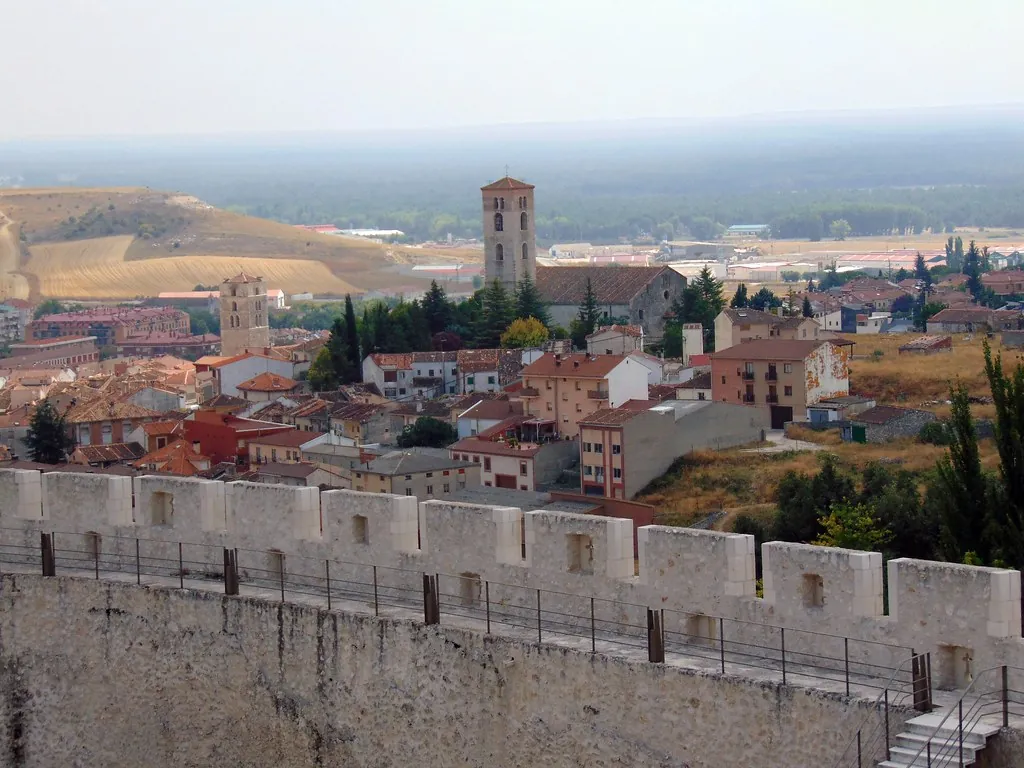
At the centre of the village stands the parish church of San Miguel. It is a small building, with a single nave and an understated presence within the settlement. Architecturally, it does not seek to stand out. Its importance lies elsewhere.
Like in many villages across the Tierra de Pinares, the church functions as a traditional meeting point. It has long been a place where community life gathers, marking moments that go beyond the purely religious. That role helps explain its significance within such a small setting.
Walking the surrounding tracks
The area around Llano de Olmedo is best explored on foot, following agricultural tracks and paths used by local residents. There are no marked walking routes as such, but that lack of formal signage is part of the experience. Moving through these paths gives a direct sense of the surrounding environment.
The same elements repeat, though never in quite the same way: cereal fields, pinewoods and small strips of vegetation marking boundaries between plots. The terrain remains mostly flat, making for easy walking, but the openness means that distances can feel longer than expected.
With a bit of patience, there is also wildlife to notice. Birds typical of open countryside are relatively common here. Species such as cogujadas and aguiluchos move across these spaces, often low over the fields or perched briefly before disappearing again into the distance. Observing them requires slowing down and paying attention, something that fits naturally with the pace of the place.
A short and quiet visit
Llano de Olmedo does not take long to see. A gentle walk through its streets, followed by a short stroll towards the nearby pinewoods, is enough to get a sense of what it offers. The appeal lies in that simplicity rather than in a long list of sights.
It is worth bearing in mind that services within the village itself are very limited, which is typical for settlements of this size. For anything more substantial, such as eating or shopping, the usual approach is to head to larger nearby towns. Olmedo, which has long been connected to this village, is the closest reference point.
During the summer, the patron saint festivities take place. At that time, many former residents return, having spent the rest of the year elsewhere. The population temporarily increases, and the village regains some of the activity it once had decades ago.
Outside those dates, life here remains quiet. That calm is not presented as an attraction in itself, but it shapes the experience. Llano de Olmedo is a place where the landscape sets the tone, and where time seems to move at the same steady pace as the fields and the pines that surround it.