Full Article
about Megeces
A town on the Cega river, known for its dam and natural summer setting.
Hide article Read full article
Between sand and pines
Understanding Megeces starts with its setting. The village lies in the Tierra de Pinares area of Valladolid, a stretch of sandy land where the maritime pine has shaped both the landscape and local livelihoods for centuries. At around 740 metres above sea level and with just over four hundred residents, Megeces belongs to a network of small settlements that grew among pinewoods, cereal fields and trades linked to the forest.
For a long time, resin extraction was a routine activity across this region. Even today, a walk through the nearby pinewoods reveals tree trunks marked by the cuts once used to collect resin. This long relationship with the forest explains much of the village’s character. The sandy soil, the long straight forest tracks and the horizon filled with pines all reflect that connection.
A compact village and San Andrés
The built-up area of Megeces is small and orderly, with straight streets and houses of one or two storeys. Many homes still show traditional materials from the region, including adobe, rammed earth and brick, sometimes coated with lime.
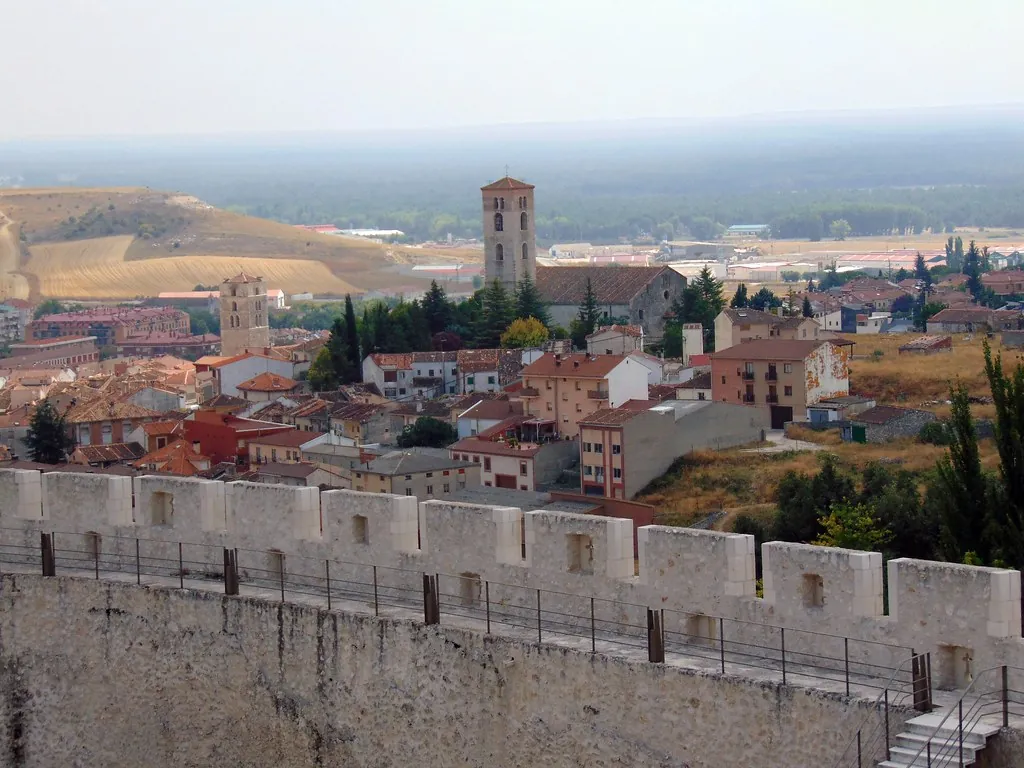
At the centre stands the parish church of San Andrés. The building dates from the 16th century, although it has undergone later alterations. Its brick tower is the first element visible from nearby streets. The overall design follows a typical Castilian parish style, functional and suited to an agricultural community rather than intended to impress.
Inside, there is a simple Baroque altarpiece, likely from the later modern period. It is not a grand artistic ensemble, but it helps illustrate how the parish has remained central to village life over the centuries.
The pinewoods of Tierra de Pinares
Leaving the village, the pinewoods appear almost immediately. These expanses of maritime pine extend across much of the province and continue southwards towards the neighbouring province of Segovia.
Historically, these forests were used for resin, timber and grazing. Today they remain an important shared space for residents. People head out to walk, to look for mushrooms when the season arrives, or simply to follow the forest tracks that run through the area.
Autumn brings a noticeable change. The first rains combine with the scent of resin and damp sand, altering the atmosphere of the woodland. It is also the time when more people appear along the paths, often carrying baskets for mushroom gathering.
Easy routes on foot or by bike
The land around Megeces is flat. Tracks through the pinewoods are generally wide and easy to follow, many of them originally created for forestry work.
This makes the area suitable for exploring on foot or by bicycle, without steep climbs or demanding terrain. Along the edges of the woodland it is common to spot wildlife such as rabbits or partridges, while birds of prey can sometimes be seen circling above open clearings, especially early in the morning or towards evening.
Local life and traditions
The main celebration in Megeces is linked to San Andrés, the patron saint of the parish, marked at the end of November. As in many small villages in Castile, these festivities combine religious observances with community gatherings and activities organised by residents themselves.
Memories of resin work are still very present in local identity. Although it no longer carries the same economic importance, it remains part of how the area understands its past and its relationship with the surrounding pinewoods.
Practical notes for a visit
Megeces is located in the southern part of the province of Valladolid, within the Tierra de Pinares. It is reached by local roads connecting it with nearby villages such as Íscar, Pedrajas de San Esteban and Mojados.
The village itself can be explored in a short time. For most visitors, the main interest lies beyond the streets, in walking through the surrounding pinewoods and observing how this landscape has shaped everyday life here over generations.