Full Article
about Montemayor de Pililla
Hilltop town ringed by mountains; known for its wooden bullring and natural setting.
Hide article Read full article
A place you end up staying longer than planned
Some villages appear almost by accident, the kind you reach on the way to somewhere else, then decide to stop for a stretch of the legs. Montemayor de Pililla fits that pattern. It rarely comes up with bold claims or big headlines, yet a short walk after parking is enough to understand what it offers: pine forest all around, quiet streets, and a pace where no one seems in a rush.
It sits within the Tierra de Pinares area of Valladolid province and has fewer than a thousand residents. The atmosphere matches what many expect from this part of Castilla: low houses, interior courtyards barely visible from the street, and a noticeable stillness in the middle of the afternoon. It does not try to draw attention. If anything, it does the opposite, and that restraint is part of its appeal.
The village and the church
The name Montemayor suggests a medieval origin linked to watchtowers and territorial control. Today, what remains is less about visible structures and more about a general sense of an old settlement that has settled into itself over time.
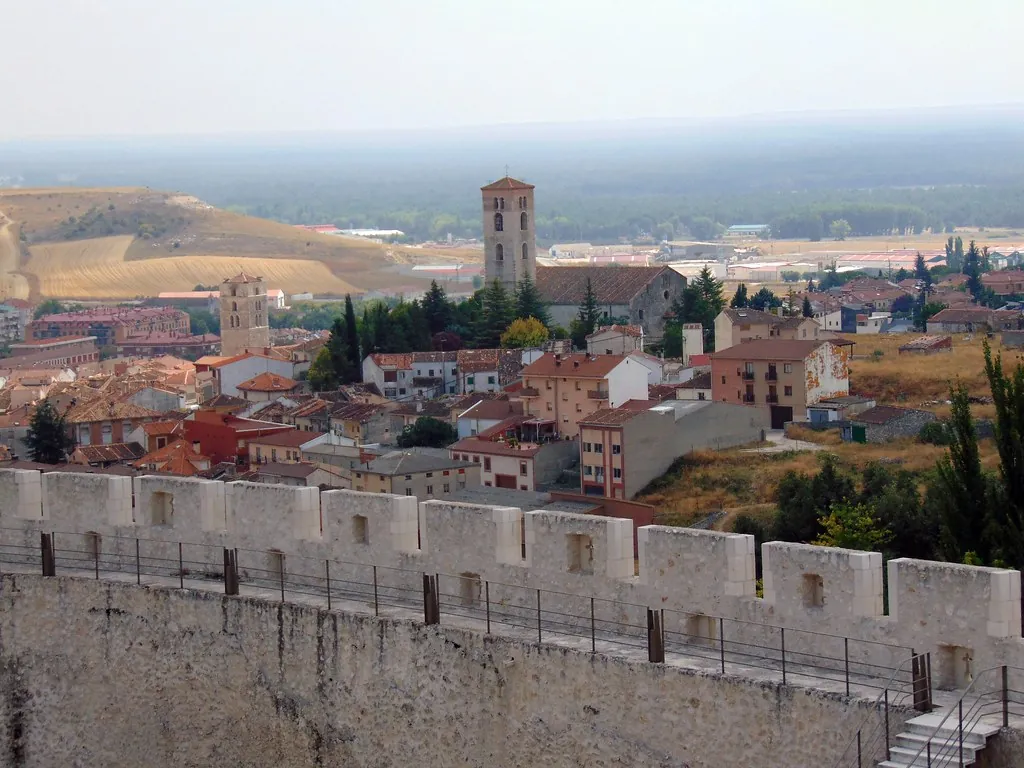
The parish church of San Juan Bautista is the clearest visual reference when arriving by road. It is not a monumental building, yet its tower can be seen from various points and quickly becomes a useful point of orientation while walking through the village.
The streets carry a strong sense of continuity. Many houses still show adobe walls or a mix of older brick with more recent updates. Large wooden gates appear here and there, hinting at inner courtyards or former working spaces behind them. The overall impression is of a place where daily life has not shifted dramatically in recent decades. The layout, the materials, even the rhythm of movement all suggest a way of living that remains close to what it was not so long ago.
Pine forests that define the landscape
The surrounding pine forests explain much of Montemayor de Pililla’s character. The village is encircled by a wide stretch of woodland that continues across the Tierra de Pinares and reaches into neighbouring areas, including parts of Segovia province.
These are not landscaped parks or curated walking areas. They are working pine forests. Many trees show the marks of resin extraction, with cuts in the bark and the containers traditionally used to collect resin. It is a very uniform landscape: tall, straight trunks, a ground layer of needles and cones, and a distinct pine scent that becomes stronger when the sun warms the forest floor.
Light changes the experience here quite noticeably. Towards evening, it filters in at a lower angle between the trunks and turns the tones warmer. It is not a place filled with obvious landmarks or viewpoints, yet it encourages unhurried walks, the kind where the setting itself is enough reason to linger.
Easy routes on foot or by bike
Several forest tracks and agricultural paths begin directly from the village. They are not marked as official routes, nor do they come with signposts or interpretation panels, but they are generally straightforward to follow if you have a map on your phone or a clear sense of direction.
The paths are wide and manageable, suitable for walking or cycling without much difficulty. The terrain is largely flat, so there are no major climbs to contend with. Instead, the experience is defined by steady movement through pine forest and open fields, covering distance without much effort.
In summer, timing matters. The heat in this part of Castilla can be intense, and while the pine forest provides some shade, it does not completely shield you. Heading out early or later in the day tends to make more sense than being outside at midday.
Autumn and the mushroom season
With October comes a different kind of activity in the forests. Cars appear parked along the edges of tracks, and people move slowly through the trees, eyes fixed on the ground.
Mushroom picking is part of local life. Níscalos, a type of saffron milk cap associated with pine forests, are among the species that can be found when conditions are right, particularly if rainfall has been favourable. There is a shared understanding about respecting the environment and not overharvesting.
For visitors unfamiliar with mushroom varieties, caution is important. It is better to go with someone experienced or simply observe. In these forests, there is usually someone nearby who knows far more about the subject.
Food rooted in tradition
The food in Montemayor de Pililla follows the traditions of this part of Castilla. Dishes are hearty and straightforward, the kind that call for bread on the side. Lechazo asado, roast lamb typical of the region, appears alongside local cured meats and migas, a dish often prepared in colder months.
There is no elaborate storytelling around the cuisine. These are recipes passed down through generations, prepared in the same way over time. When done well, they do not need much explanation.
A quiet stop in the Tierra de Pinares
Montemayor de Pililla works best as a calm pause within the wider Tierra de Pinares area. There is no long list of major monuments, nor a large historic centre that demands hours of sightseeing.
The experience is simpler. A walk through the village, followed by time in the surrounding pine forest, often turns into a longer stay than expected. Parking the car, heading out for a walk among the trees, and returning at an unhurried pace tends to suit the place perfectly.