Full Article
about Navas de Oro
A leading resin town, known for its resin museum and industrial chimneys.
Hide article Read full article
Morning Light in the Tierra de Pinares
Early in the day, when the air still carries the scent of damp resin, tourism in Navas de Oro begins almost without announcement. Light slips low between the pines that ring the village and falls across pale façades. A car engine turns over somewhere, a metal shutter rattles upwards, and birdsong spills in from the nearby woodland. It is a brief pause. As the morning moves on, the streets fill again with everyday movement.
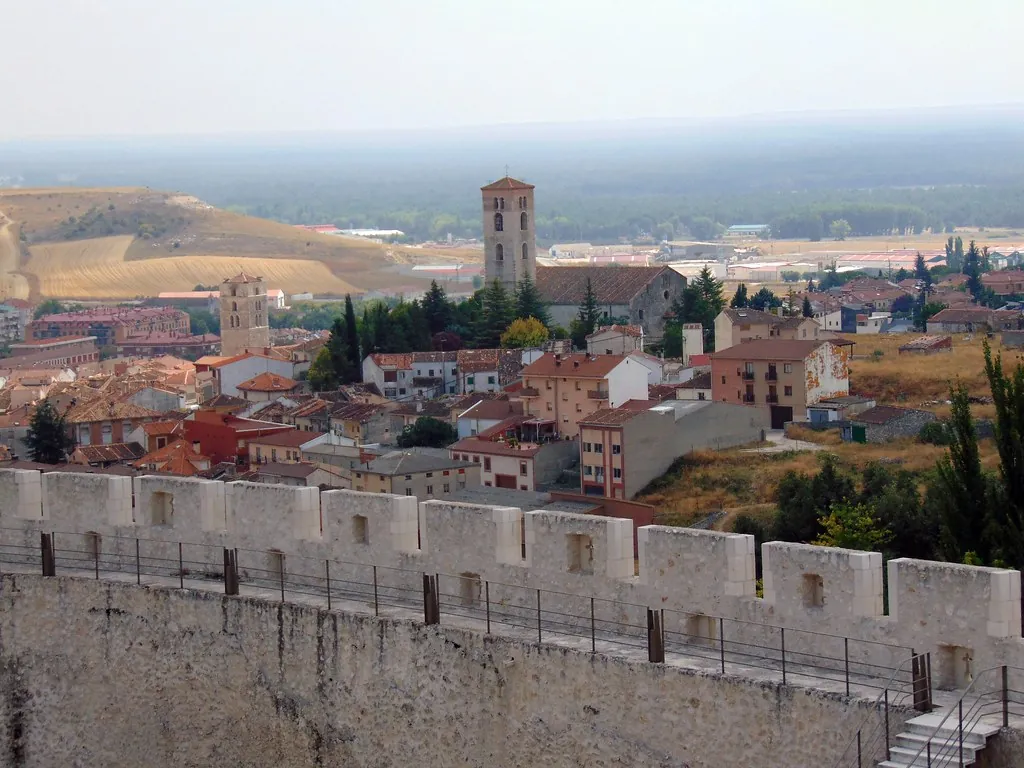
Navas de Oro lies in the Tierra de Pinares of the province of Segovia, around 800 metres above sea level, and has a population of just over a thousand. Here, the forest is not simply a backdrop. For generations it has shaped working life and daily routines. A short walk through the centre reveals wide gateways once designed for carts, yards where tools are still stored, and brick and limewashed walls that have aged under the sun.
This is not a place of grand monuments or dramatic squares. What remains is more domestic in scale: quiet streets, low houses and the constant scent of pine drifting in from the edge of the municipality.
Around the Church and the Quieter Streets
The Iglesia de Nuestra Señora de la Natividad stands at one of the most recognisable points in the centre. Like many churches in villages across this part of Castilla Leon, it has been enlarged over time. From the outside it appears restrained: pale walls, a simple arched doorway and a tower rising above the rooftops.
Several of the busier streets gather around it. Step a little further away and the pace softens. Large wooden gates open into working yards, corrals still in use and small vegetable plots pressed up against boundary walls. In summer, by mid-afternoon, many of these streets fall almost silent as daily life shifts towards patches of shade.
If arriving by car, it is often easier to park on the outer streets and walk into the centre. The village is small enough to explore on foot, and this avoids navigating the narrower lanes repeatedly.
There is no sense of spectacle here. Instead, the rhythm comes from routine: neighbours crossing paths, doors left ajar, the faint smell of timber lingering in the air. It feels lived in rather than arranged for visitors.
Where the Pine Forest Begins
One of the defining features of Navas de Oro is how close the forest stands to the last row of houses. From the edge of the village, pale sandy tracks lead into the pinar within minutes. The ground is soft, layered with dry pine needles that muffle footsteps and quieten the world around you.
Many of these routes are forestry tracks used for work in the woods. During periods of timber cutting or maintenance, it is wise to stay alert for vehicles or machinery. Even so, they suit an unhurried walk: long straight stretches, deep shade beneath tall trunks and clearings where the light shifts suddenly.
The character of the pinar changes as the day fades. In the evening, sunlight filters between the straight trunks and turns the sandy ground a muted orange. As temperatures drop, a warm resin scent intensifies, hanging low in the air. It becomes easier to understand how closely the village and the forest are bound together.
The Tierra de Pinares takes its name from these expanses of pine woodland, which stretch across parts of Segovia and neighbouring provinces. In Navas de Oro, that landscape begins almost at the doorstep. There is no long approach, no gradual transition. Houses give way to sand and trunks in a matter of steps.
Autumn Mushrooms and Long Walks
Autumn brings a noticeable shift. Across the comarca, the pine forests draw people out in search of wild mushrooms. Níscalos, known in English as saffron milk caps, are among the most familiar finds, though other species appear depending on rainfall and the year’s conditions. Not every woodland area allows free picking, so it is important to check local rules or permit requirements beforehand.
Even without a basket, a walk at this time of year is worthwhile. The forest floor crunches underfoot and, now and then, a thrush darts up from low scrub. The air feels cooler and carries a different weight, less resinous, more earthy.
In summer, the approach needs adjusting. The sun bears down hard at midday on sandy tracks beyond the trees, and shade can be scarce outside the pinar. Early morning or late afternoon are the more sensible moments for walking. At those times, the light is softer and the forest offers shelter from the heat.
Season by season, the surroundings alter the tempo of life. Work in the woods, the search for mushrooms, the retreat to shade during hot spells. These patterns have repeated for decades and still shape the village today.
Cooking in the Segovian Manner
Food in this part of Segovia remains closely tied to the wood-fired oven and to long-established recipes. Roast lamb and cochinillo, the region’s celebrated suckling pig, are typical centrepieces. Pulses are cooked slowly, and cured meats are still prepared in many households during the traditional matanza, the annual pig slaughter that historically supplied families with charcuterie for the year.
This is not quick or light cooking. Dishes take time and are usually served at long tables, especially at weekends or during family gatherings. Meals stretch out, anchored by recipes that have changed little.
The cuisine reflects the landscape as much as the architecture does. Wood for ovens, livestock raised in the surrounding countryside, methods passed down through generations. As with the forest, there is continuity rather than display.
A Village Defined by Its Pines
Navas de Oro does not demand a long list of sights to make sense. A walk to the edge of the village is often enough. Facing the pinar, with its straight trunks and pale sandy paths, the connection becomes clear. The scent of resin, present even within the streets, explains much about how this place works and breathes.
At around 800 metres above sea level, in the heart of the Segovian Tierra de Pinares, daily life unfolds on a modest scale. There are no grand gestures, only the steady presence of the forest and the routines shaped around it.
For those travelling through Castilla Leon, Navas de Oro offers something simple: a village where the boundary between settlement and woodland is thin, and where the character of the land remains visible in brick, sand and pine.