Full Article
about Olmedo
Olmedo, the Town of the Seven Sevens; known for the Knight of Olmedo and its Mudéjar theme park.
Ocultar artículo Leer artículo completo
The first thing you notice is the storks. Not one or two, but whole colonies of them, clattering their beaks like castanets from the terracotta roof of a 12th-century convent that's been turned into a spa hotel. It's a scene that sums up Olmedo rather well: deeply traditional, slightly unexpected, and quietly confident about its place in the world.
At 770 metres above sea level, this small town in Valladolid province sits where the flat ochre plains of Castilla begin their gentle roll towards the pine forests of Tierra de Pinares. The altitude matters more than you might think. Summer evenings cool down nicely, winter mornings can drop to minus eight, and the air carries that particular clarity that makes the brickwork of medieval towers glow against an cobalt sky.
The Brick Symphony
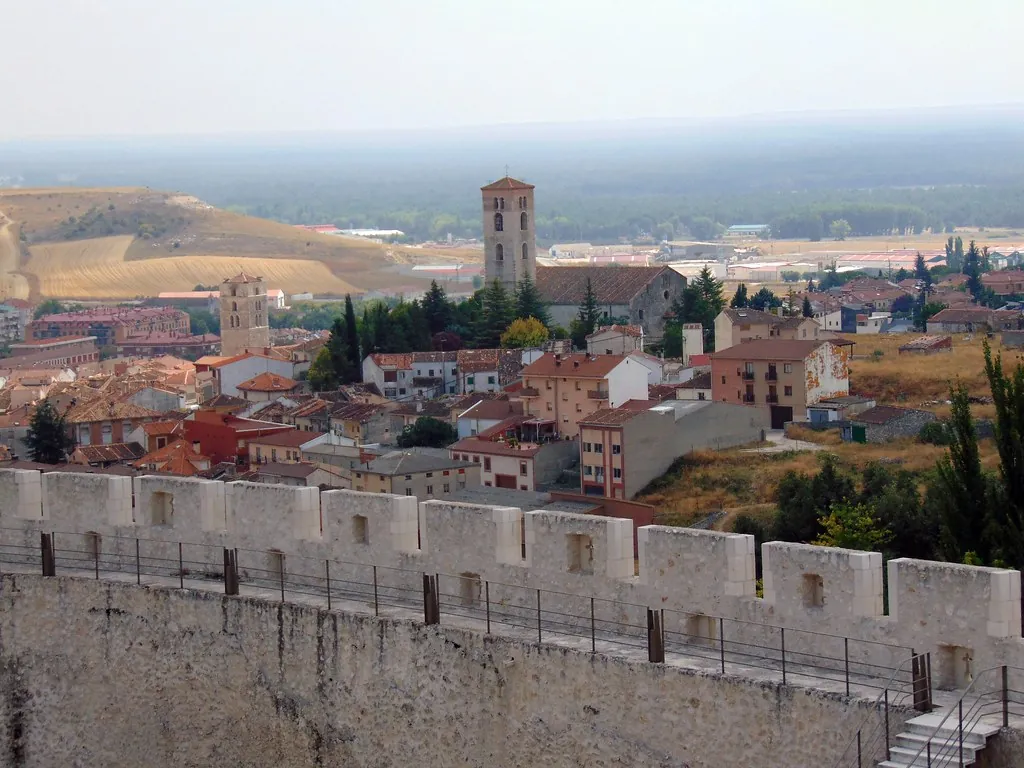
Olmedo's skyline is a lesson in mudéjar architecture, that distinctive Spanish style where Islamic brickwork techniques met Christian building projects. The Church of San Miguel's tower rises in geometric patterns, each section slightly different from the last, like someone playing variations on a theme. It's visible from kilometres away, a medieval beacon that guided travellers long before GPS.
The town walls still partially encircle the historic centre, though they've lost their defensive purpose. Seven original gates remain, with the Arco de San Miguel and Arco de la Villa forming natural entry points for wandering visitors. What makes Olmedo unusual is that these aren't museum pieces – they're part of daily life. Children kick footballs against 15th-century walls, pensioners gather for cards in the shadow of fortified towers, and the weekly market spreads beneath brick battlements that once kept out hostile armies.
Inside the walls, the streets follow their medieval pattern, narrow and irregular, opening suddenly into small squares where the Church of Santa María del Castillo anchors the community. Its interior houses a retablo that's either beautifully preserved or over-restored, depending on your taste for 16th-century polychrome. The Church of San Andrés offers a quieter experience, its compact mudéjar tower perfect for those who've developed church-fatigue elsewhere in Castilla.
The Theme Park That Isn't Rubbish
Just outside the walls sits the Parque Temático del Mudéjar, and before you recoil at the words 'theme park', understand this: it's essentially an outdoor classroom with scaled replicas of Castilla y León's finest mudéjar monuments. British visitors who've spent hours driving between remote churches often wish they'd started here. The models help decode what you're looking at when you see the real thing – why those particular patterns, how the brickwork techniques evolved, which elements are restoration and which original.
Early morning works best. The park opens at 10 am, and for the first hour you'll likely share it only with local dog walkers and the occasional German cyclist. Interpretation boards offer English translations that actually make sense, rare in this part of Spain.
Thermal Waters and Practical Considerations
The Castilla Termal hotel dominates the northern approach to town, a sophisticated conversion of the former Convento de Sancti Spiritus. Its thermal waters bubble up from 800 metres below ground at a steady 38 degrees, rich in minerals but mercifully low on sulphur smell. British tour operators package it as the relaxing finale to cultural tours, and they're not wrong – after days of cathedral-hopping, floating in the outdoor pool while storks wheel overhead feels distinctly therapeutic.
But here's what the brochures don't mention: the hotel sits two kilometres from the town centre, along a road that lacks pavements for most of its length. The walk takes 25 minutes and feels longer after dark. Taxis from the town rank cost €8, though you'll need to phone for one since there's no taxi office. Most British guests end up eating in the hotel's Hontanar restaurant, which serves competent modern Castilian food – the roast suckling lamb is notably less salty than village bars serve, and they'll swap morcilla for a mild tomato sauce if you ask.
If you do venture into town for dinner, options are limited. Restaurante Olmedo on Plaza de España does traditional roasts in wood-fired ovens, while Bar La Muralla near the Arco de San Miguel serves simpler tapas. Both close unusually early by Spanish standards – last orders typically before 10 pm.
Forests and Fortresses
Olmedo makes a practical base for exploring Tierra de Pinares, though the landscape surprises those expecting dramatic mountain scenery. This is gentle country, rolling hills cloaked in pine plantations that produce resin and pine nuts. Waymarked walks radiate from the town, following forest tracks where the scent of warm pine mingles with wild thyme. Distances are modest – five to ten kilometres – and gradients minimal. The GR-14 long-distance path passes through, connecting to medieval villages like Mota del Marqués, where a 15th-century castle rises above wheat fields.
Spring brings wildflowers and comfortable walking temperatures. Autumn offers golden forests and the grape harvest in nearby Rueda, whose crisp white wines appear on every local menu. Summer can be fiercely hot – temperatures regularly top 35 degrees – while winter brings clear skies but sub-zero nights. Snow isn't uncommon, though it rarely lingers.
The Reality Check
Olmedo isn't picture-postcard perfect. The industrial estate on the southern approach isn't pretty, and like many Spanish towns, empty houses show where younger generations have moved to Madrid or Valladolid. Some medieval towers are propped up with worryingly modern scaffolding, restoration work that seems to proceed at Spanish speed – slow, deliberate, with long coffee breaks.
Yet these minor imperfections make it real. This is a working town where tourism supports the economy rather than defining it. The weekly Friday market still sells vegetables grown in local allotments, elderly gentlemen still gather for dominoes in Bar Central, and the evening paseo remains a social necessity rather than cultural performance.
Come for the architecture, stay for the spa, use it as a base for gentle exploration. Olmedo won't change your life, but it might restore your faith in small-town Spain – storks, brick towers, thermal waters and all.